As I write this, it’s Friday, Jan. 31. About three-and-a-half weeks ago was Jan. 7. Check your own personal calendars, news headlines and the like. It’s not that long ago. That matters to me, and this blog, because this is where the Beatles come in.
Flip (or click) back several calendar pages – 45 in fact – and we’re at January 1969, dominated by the Get Back sessions. Jan. 31 marked its final day, a short day dedicated to nailing for film and for tape usable takes of Paul’s non-rooftop-suitable “Two of Us,” “Let It Be” and “The Long and Winding Road.” (The clips appeared in the movie prior to the rooftop show, but were in fact filmed the next day).
What of Jan. 7? That’s where we left off last in the session timeline, at a genuine pivot point. George suggested the group “have a divorce,” Paul said he’d thought about that, too. The Doldrums. It hung over the band.
So what happened between Jan. 7 and Jan. 31, 1969, to recast the sessions? Well, I’m not going to give it all away at once. What else would I blog about, the recording of Sentimental Journey? (That actually seems like an interesting, star-studded, intercontinental story, but I digress.) Three and a half weeks is such a short period of time, in relative terms, and we know that the group was on the brink Jan. 7. By Jan. 31 so much memorable musical output was in the bank and in the works. Factor in that there’s 10 ½ days without George after his walkout and more than a week without any rehearsals at all, and I’m left grasping at superlatives.
To wit: From Jan. 7-13 and Jan. 21-31, 1969 (18 days, and that includes weekends not spent in the studio):
Paul wrote the majority of “The Long and Winding Road,” “Let It Be” and “Get Back” and debuted future solo tracks “Another Day,” “Teddy Boy” and “Back Seat of My Car”
George wrote: “I Me Mine,” “Old Brown Shoe” and “Something,” as well as “Wah-Wah” at home during his break from the band.
Everything you hear on “Let It Be,” plus “Don’t Let Me Down” was recorded.
We saw the birth – and if not the birth, than at least the studio debut – of Abbey Road’s “I Want You,” “Oh! Darling” and “Octopus’s Garden.”
We have the rooftop show, too.
The Beatles even found time to meet with Allen Klein for the first time.
And I feel like I’m understating what happened.
So, there’s just a little bit of food for thought before I return to the timeline (soon!). Context is everything, and with January here and now gone, it provided the perfect chance to put into focus how much these guys got done throughout the madness they, for the most part, created themselves.
Blogoversary week continues with a look back at my posts about today in Nagra tapes history: Jan. 7, 1969, a dramatic, dynamic day rich in music that has proven eternal and one that brought the Beatles to the brink as they questioned why they were even together.
Still they lead him back: Jan. 7 begins with a proper debut for “The Long and Winding Road,” poignant and revealing given the mood at the sessions and the prior day’s tension.
Sing a lullaby: “Golden Slumbers” debuts, and the day-old “Carry That Weight” isn’t all a hurting Paul fits it with that morning.
Signature song: It’s the origin story for “Get Back,” the song perhaps most identified with these sessions, featuring Paul, George and an absent Jackie Lomax.
Power Hour: Putting Paul’s Jan. 7, 1969, morning session in context, 44 years later.
On their own at the holiday camp: As Mr. Epstein’s ghost lingers, what motivates The Beatles in January 1969? The group openly questions that very thing.
Taking the easy way out, now: The Beatles, comfortable as a studio-only band and admittedly shy to perform live but also fed up playing together, get a pep talk as they try to find the desire to stage a concert.
Ain’t got no ‘pow’: Still searching for the elusive hook to their live show, the Beatles recall a misguided fan-club show, consider their lack of charity and foretell one of rock’s iconic moments.
Entertainment is almost enough: In which the Beatles are asked to embrace showbiz, because “you may never do another television show.” Perhaps a captive audience is the answer.
Have a divorce: The Beatles’ frustration with each other and the state of the group — an issue they admit dates back more than a year — reaches a tipping point as a conversation that began with the continued search for a live venue concludes with the band’s future in question.
Pulled their socks up: “Divorce” was all talk, no action for the Beatles, who casually moved to “I’ve Got a Feeling” and “Oh! Darling” (briefly) after agreeing they should split up — without actually doing so — moments earlier.
Joke whistlings: Amid the “Maxwell’s Silver Hammer” origin story, Paul wants a little more “razzmatazz” but please keep the whistle solos “straight,” OK?
Bangers and mashups: After making accidental musical history, The Beatles whistle while they work extensively on “Maxwell’s Silver Hammer.”
Tumble blindly: The anachronistic, symbolic “Across the Universe” returns to The Beatles orbit, while the group also has a brief re-exploration of another John tune, “Gimme Some Truth,” as a Beatles number.
Et cetera: Picking up the pieces from remaining storylines of the day, including a few covers and a link between “Don’t Let Me Down” and “Devil in Her Heart.”
A wanderingdiscussionostensiblyabout the staging of a Beatles live concert prior to the full-band session on Jan. 7, 1969, was light-hearted no longer as the conversation eclipsed the half-hour mark.
The pressure of the clock and calendar is very real if this thing was going to pull together the way it’s being planned — insomuch as it’s being planned at all — and Paul makes clear to everyone else just how dire the situation is.
Start caring. Now.
Paul: If we’re going to do the show here, we’re going to have to decide today. …If we’re going to do these songs, we’re going to have to learn the chords. … We’ve got to learn the words, certain basic things we’ve just got to do if we’re going to do it.
There’s only two ways. And that’s what I was shouting at the last meeting we had. We’re going to do it, or we’re not going to do it. And I want a decision, because I’m not interested enough to spend my fucking days farting around here while everyone makes up their minds whether they want to do it or not.
I’ll do it. If everyone wants to, then all right. It’s just a bit soft. It’s like a school, you’ve got to be here. And I haven’t. We’ve all left school, and we don’t have to come. But it to a scene where you do have to come.
Michael Lindsay-Hogg: The first thing to get together is yourselves totally. And then we all follow with our kit bags and our cameras.
It’s not the first time this conversation Paul compared the experience to school. And as made clear in the Beatles’ biography, we know how much these four men cared for their responsibility to the classroom.
Things are right back where the discussion started out the “Get Back” introduction earlier that hour. Paul loves this band and doesn’t think anyone else has nearly the level of commitment anymore. And he’s right.
Keeping the Beatles as a performing unit, much less determining how their live show would come off, is not a small issue here, but a minor mystery — the band’s initial, planned timetable for a live show – does become clear in this exchange as Paul continues.
“Five days before [the show] is a week from now,” Paul says, “and that means by the time a week from now comes, all these songs we’ve got we’ve got to know perfectly. And then five days, we really, really get us to know them.”
Beautiful! The early timeline is clarified and confirmed: Five days from this is Jan. 12, a week before Jan. 19. Falling within the estimate drawn from their discussion the prior day — Jan. 18-22 — this pinpoints the original plan for concert day.
Flash forward to the rooftop, when they ended up playing just five complete songs. Do the math, and the Beatles end up on the same timeline originally proposed here.
(Turns out they already know those five songs by Jan. 7 — the just-written “Get Back,” “Don’t Let Me Down,” “I’ve Got a Feeling,” “One After 909” and “Dig a Pony.”)
A conversation between Georges Harrison and Martin about a Jackie Lomax session is held as Paul and Lindsay-Hogg’s continuing discussion on the urgency of the schedule.
As far as the director is concerned, the session’s first day – the abbreviated gathering on Jan. 2 – was the best musical day yet. So at least to him, the entirety of the sessions so far as been a study in deterioration.
“If people aren’t interested, I lose interest,” Paul says.” We can’t blame our tours … and so on and so on.”
“The past couple of months, its been this. The [White] album was like this. The album was worse.”
“What, agony?” Lindsay-Hogg asks.
“Just the whole idea of, “Do you want to do it?’” Paul says.
“And that’s the whole joke of it. After it all came about we all phoned [Neil Aspinall] individually, saying things like, ‘Could you get them together.'” — Paul McCartney, Jan. 7, 1969
Paul relates a story of every Beatle phoning Neil Aspinall individually, with each asking the Apple Records manager and band confidant to reassemble the group.
“Instead of asking each other, we went to Neil asking what are the lads doing. You know, we should just have it out.”
It’s a damning indictment of where the band’s interpersonal communication — a reflection of their desire — stood post-White Album in late 1968, before the sessions at Twickenham would even begin.
George steps back into the conversation with a key admission and seemingly parameters for an endgame for the Beatles.
George: Like you said, ‘Well I’d like to do this, this and that. And I’d like to do this … and I’d like to do that, and I’d like to do that. And we end up doing something, again, that nobody really wants to do.
Paul: If this turns into that, it should definitely be the last for all of us. Because there just isn’t any point.
MLH: That would be sad, as an audience.
Paul: It’s stupid. But it’s even more stupid the other way. To go through it.
George: ‘Cause this time you could using for what you want to be doing: creating, instead of doldrums, which it always is.
The word struck a nerve with Lindsay-Hogg, who was keeping a diary of his recent experiences. “‘Doldrums’ is the word I used. The doldrums have been coming like to a ship on a calm sea.”
“The Beatles have been in doldrums for at least a year,” George says.
Thus, at least to George – and no one disagrees – The Doldrums include the launch of Apple, the trip to India and the entirety of the White Album sessions, and could well stretch back into late ’67. How about Aug. 27, 1967, when Mr. Epstein died, as the genesis?
Today, Lindsay-Hogg – only seven months John’s senior — opts to step into that vacuum as manager/father figure.
“We all need you,” Lindsay-Hogg says as George cheekily accompanies him with an off-the-cuff rendition “What the World Needs Now is Love” in the background. “And it is communication. If you all can’t get it together, that’s really very sad. Maybe what we should do now is let you play a little and you all have lunch together.
“So should we leave you for a while?”
(The lengthy discussion leading up to this point, as covered in the last few posts, was distilled down to a few minutes in the 2021 Get Back docuseries in the January 7 segment).
With Lindsay-Hogg gone, the group fiddles around, seemingly ready to begin the day’s work, musically. Then George steps in and steps up for himself.
“What I was saying about the songs is … I’ve got about 20 songs from 1948, because I knew very well at the moment I’d bring them into the studio that [splat sound] there its gone. And slowly I can bring a couple out because I can get it more like how it should have been then.”
“It doesn’t matter what’s going wrong as long as the four of us notice it,” Paul says as George, now incredulous, sure thinks it does matter what is going wrong as he’s so often wronged.
“And instead of just noticing it, to turn it to put it right,” Paul finishes.
But George is done.
“We should have a divorce.”
Paul admits he’s almost done.
“Well, I said that at the last meeting. But it’s getting near it.”
A deadpan John — mostly silent in the exchange so far — injects a laugh line, asking in the context of the divorce, “Who’d have the children?”
“Dick James,” answers Paul, referring to Northern Songs’ co-owner. (The music publisher would, coincidentally, make an in-person appearance at Twickenham about 72 hours later, immediately before George left the group).
Paul gets in one final point, and directs it squarely at John. He would have liked more input beyond the well-timed zinger.
Just because it’s so silly of us at this point in our lives to crack up. It’s just so silly, because there’s no point. We’re not going to get anywhere we want to get by doing that. The only possible direction is the other way from that. But the thing is, we’re all just theoretically agreeing with it, but we’re not doing it.
You’re doing it with your thing with you and Yoko. But it’s silly to come in and [be] talking down to us, when actually your way out is not to talk — rather than talk down to us, which you’d have to do. And you wouldn’t. And remember, I think I’m talking down to you, too. … We’re sort of talking down to each other.
George wants a divorce. Paul is desperate for John to show up. Nobody wants to be there and they’re running out of time to salvage what time they’ve already spent working on their product at Twickenham.
This moment, right here on Jan. 7, would be the moment that would make the most sense for the Beatles to break up, go on hiatus, something, anything. Everyone’s tugging at the band-aid. But no one is willing to provide the last rip.
All the arguing, backbiting, rash decisions they would be so well known for in their eventual breakup wasn’t second-nature yet. So they do the only thing that really is: play music together.
“OK,” Paul continues, and picking the song most obvious to begin with. “‘I’ve Got a Feeling.’ One-two-three-four…”
And John immediately goes into “She Came in Through the Bathroom Window,” as the take quickly breaks down in laughter.
“How does it go?” John asks.
And then, astoundingly, the day’s sessions begin in full, starting with about 20 minutes (on tape) of “I’ve Got a Feeling.”
What on earth to make of all of this?
Having “compared it to a marriage a million times” (John, from 1976, as quoted in the “Anthology” book), it stands that the band’s ultimate split would be a “divorce.” George asked for it Jan. 7, 1969, and eight-plus months later John would ask for the same thing.
“I want a divorce, like my divorce from Cynthia,” John is famously quoted as saying late September 1969 in Phillip Norman’s “Shout!” “It’s given me a great feeling of freedom.”
The Beatles were Paul’s band, by the time they were at Twickenham, after first being John’s. The Beatles weren’t George’s — as critical and brilliant he was — and thus it wasn’t his place to ask for a divorce. He could just leave — which he would a few days later — and in that way he absolutely held sway over the band’s future, engineering Billy Preston’s arrival and the shift into cozy 3 Savile Row. Conceding to George things nobody else was wed to but having him in the Beatles beat not having George in the Beatles. But there was no getting around his junior membership, in a sense.
Even in suggesting a divorce, George was immediately met with Paul basically saying, “Me too.” But since Paul wasn’t ready and John was silent on the issue, the divorce wasn’t going to happen.
It’s clear the group’s momentum and motivation as things stand on Jan. 7 is founded on nothing. It sounds as if getting anything done post-Sgt. Pepper was a miracle. Epstein is missed, and it’s become plainly obvious. Based on their brutal descriptions of the White Album sessions, it’s amazing, in retrospect, they finished the LP, much less recorded as many songs as they did for as many months as they did.
Paul’s right — these guys are indeed “on their own at the holiday camp.” They’re four men pushing 30 who don’t know life beyond the extremes of childhood and being a Beatle. A day earlier, in the wake of the “I’ll play if you want me to play” argument, it sounded like it was an option for the group to remain as one in name, at least. Now, even that seemed out of reach.
The Beatles reached a pivot point on Jan. 7 to commit or bust, and, against all reason based on their arguments, they chose to commit. To what, nobody seemed to know.
The conversation took a very silly twist before taking a sober turn.
A half-hour or so into Tuesday’swanderingdiscussion attempting to define the framework for a live show, it was suggested that if the Beatles didn’t play for sick children, they should play at an orphanage. Or maybe it’s a show of all dedications.
“What’s the most charitable thing anyone can do?” director Michael Lindsay-Hogg asks before suggesting the band perform mass murder. “There are certain judicious murders in the history of the world which are very charitable.”
Paul then expands on his equally farcical — presumably farcical, at least — idea of playing at the Biafran airport amid the Nigeria-Biafra War. That is, after they “rescue all the people.”
“Say we were doing it in an airport, you couldn’t stop all the people coming and going — they’ve all got planes to catch. So like you’d get a lot of people all the time, going for planes. … It’d be a scene.”
And so would a children’s hospital before an incapacitated captive audience. “They can’t get up and walk,” Paul says. “Except for the finale, when John walks up to the little girl. … aaah — she gets up and walks!”
Work your magic, John.
Alas, if only John can cure this process and heal the band. Lindsay-Hogg says he wants this to be better than any rock-and-roll show ever staged. And it’s not only because he wants to be proud of his product.
“You may never do another television show.”
It’s a bitter pill, but clearly Lindsay-Hogg knows the band is hanging by a thread here, just days into the Twickenham sessions. Feel free to read more into what George is playing low in the background during this part of the conversation: “I Shall Be Released” and “To Kingdom Come,” both by The Band.
“They just sound like that album in their house, in their living room,” George tells Mal as Paul and MLH go over (again) the possibility of filming the concert at Twickenham.
George then brings up a point not yet broached — will the Beatles be the only band on the bill? The last time they put on a TV special — Magical Mystery Tour, just over a year prior — The Bonzo Dog Doo-Dah Band performed during the strip-club scene, and Traffic was filmed but left out of the final edit.
So padding out the bill wouldn’t have been that unusual a thought, especially in the light of the Rolling Stones’ recently filmed Rock & Roll Circus and its own dazzling lineup. Then again …
“Are we going to have other people or just us — John, Paul, Jeff and Richie?” George asks. “But then, you’re getting the bit where The Who steal the show. But … let the best man win.”
Lindsay-Hogg believes in his boys, saying, “If anyone can hold an hour, it’s you.”
George admits he isn’t so sure, but Paul has no doubt. What he’s struggling with is getting any semblance of a fire lit under the band.
“I don’t see why any of you — talking to whoever it is not interested — get yourself into this then,” Paul says after Ringo says something difficult to hear, but likely being “not interested” in traveling. “What’s it for? Can’t be for the money. Why are you here? I’m here ’cause I want to do a show. But I really don’t feel an awful lot of support. Is anyone here because they want to do a show?”
Lindsay-Hogg wants to do a show. Meanwhile, haven’t we already heard this conversation several times already at Twickenham these first few days?
“Mal is right,” Lindsay-Hogg says, referring to comments from the roadie moments earlier. “Entertainment is almost enough. It’s where to put the entertainment.” Lindsay-Hogg also pushes the potential multimedia package the sessions could yield: an album, a documentary and the live concert, and George acknowledges it could be a bounty.
But he adds a caveat.
“If we can get the enthusiasm and really strength to do it.”
“All the ideas like hospital, orphanage, charity is part of it,” Lindsay-Hogg says. “It should be great, great showbiz, because that’s what’s going to make people happy. … A smile on the lips of a small boy in France or a tear in the eye of a big girl in America is what we want.”
Part of the problem here is that Lindsay-Hogg is either wildly misreading the gravity of the situation at hand or overreaching in setting up a diversion. Certainly it’s the latter, he’s no dummy. The Beatles are in dire straits. It’s out in the open. He’s lucky to have them in the studio together in any capacity. I’m not sure there was a stage anywhere on earth — plenty were mentioned, for sure — that would have created any greater spark than they already had within them.
History made it clear. The group traveled a few dozen stairs at 3 Savile Row to the roof, where they didcreate magic. But that magic wouldn’t have been any more enchanting had they staged the same show at Sabratha, Biafra, George’s house or the Twickenham soundstage. Their hearts, collectively, were in it to a specific point, and that’s what bore out on the roof.
But more on that later.
The conversation keeps going, and even gets more depressing and deflating next post.
When we left the gang at Twickenham in the last post on the timeline, Michael Lindsay-Hogg was wrapping up his “pep talk,” imploring The Beatles to challenge themselves make a show worth staging. After saying he didn’t know what would make the production unique, Paul asks for a “bad example.”
“The bad example is going away,” Lindsay-Hogg replies.
An overseas adventure has been nixed several times already, and was about to be again. But less than a week into the sessions at Twickenham, the director wasn’t ready to let his dream concert die.
How could the band resist playing in the fresh, open air?
MLH.Pow, there you are. And pow, what are you going to do with it? And pow, it’s going to be fantastic. That was pow, you see. And we ain’t got no pow at the moment.
Paul: The only thing about that is [pause], we don’t want to go away. A group decision.
For George, the refusal to go overseas goes beyond Ringo’s veto. The logistics would be overwhelming.
“It’s going to be the same thing as here, but it’s a bit nicer place to be in, George says. “It’s going to be even more complicated, trying to plug in all mics and tapes and all that crap, video. …”
Complications are all the more reason to go that route, Lindsay-Hogg says. Go big, and don’t put together a show like Cream’s. And if Lindsay-Hogg is going to stage a Beatles extravaganza, he’s made clear he wants precisely 2,000 Arabs in the audience. Apparently, no more, no less.
MLH: Visually, the thing that worries about here, it’s going to make it look like Cream, with a couple shots held a bit longer. .. If we went away, we’ve got the enormous plus of the visuals. Think of a helicopter shot over the amphitheater, with the water, with the lights. Torchlit, 2,000 Arabs. Visually, it is fantastic. Therefore, that was a challenge. And you see, I just myself am trying to think of any other framework to put us in to make it work. But it does really need a framework. And it doesn’t need to be done in just the back of an auditorium.
George, those kinds of obstacles are kind of good. I don’t mean this in any sense of discipline. I know you’ve done it all, but maybe you haven’t been there. Its a very difficult thing once you are, you to create false obstacles, because what you’ve been trying to do for five years is eliminate obstacles.
You don’t want to play the show in straitjackets, that’s the wrong kind of obstacle. … At the moment, it is too soft.
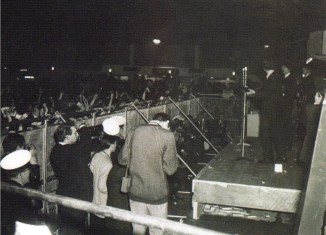
Caged Beatles perform at the Palais Wimbledon, Dec. 14, 1963
While they never played in a straitjacket, The Beatles did play from inside a “cage.”
Paul’s memory of a night in Wimbledon steered the conversation to a Beatles gig in late 1963, when they played a fan-club show that included a meet-and-greet with the 3,000 fans.
After these close encounters with the Fab Four, the fans were treated to a special stage show in the main ballroom area where an over-protective Palais management had constructed a high-walled metal cage inside which the group were to perform on an extended makeshift stage beneath a huge banner that screamed: WIMBLEDON PALAIS WELCOMES THE BEATLES. Welcomes? The cage didn’t make it look like that!
…
The Beatles threatened at first to walk out unless the whole intimidatiing barricade was demolished and there were mutterings about “prison conditions” and “more like a zoo than a dance hall”. Eventually, for the sake of their fan club members, they went on and gave an enthusiastic mini-concert. During this, as the crowd surged forward pinning those with a place in the front row against the cage, John remarked in a loud stage whisper: “If they press any harder they’ll come through as chips.”
At Twickenham, George remembers the night as “hell.” And no wonder Lindsay-Hogg is having a problem getting traction for a “different” kind of Beatles show, when their past is dotted with experiences like this.
Despite calling that night “terrible,” Paul offers an opening.
“But that kind of thing gave that particular show a different thing, because it was like playing to a hospital,” Paul says. “Playing to a thing. Like a fan club, like a hospital.”
“‘Jude’ to me is a tear-jerker the way we did it, with black and white and the postman and old mothers, and the children and the bellboy and the guy who adjusted his spectacles at one point. I think part of your music is tear-jerky.”
“Really would be great for us to get something, a serious intent,” Paul says. “Say we were all very charitable. Which we’re not, particularly. But say we were really sort of charity nuts…” And then the tape cuts off, before picking up after a roll announcement.
The group had in fact done a few shows for charity — the Royal Variety Performance most famously for its jewelry-rattling. It wasn’t until their solo careers when charity work and concerts became part of their fabric, led by George and his pioneering Concert for Bangladesh. Now, desperately searching for a catch, they stumble into the idea of playing for a greater cause merely because it would be a unique hook.
A remark by Lindsay-Hogg about pop-culture heroes sparks an animated monologue from Paul about a recent telecast of “Late Night Line-Up,” a live, late-night talk show with a focus on the arts that wrapped BBC2’s programming day. The particular episode — Paul described at once as “incredible” and “wasn’t very good, but it was pretty good” — saw students given the keys to the show, with one segment featuring the camera zooming in and out on a man watching himself on a monitor drinking tea as “Revolution” plays in the background.
Praising the anarchic quality of the show, Paul finds inspiration. “It’s that kind of opportunity we’ve got for an hour.”
The potential of doing a political broadcast — like “All You Need is Love” — appeals to George for the moment, but he realizes “whatever we have to say to do with anything is always incidental, hiding behind the chords of the tune.” Unspoken, it’s perhaps an acknowledgement the current crop of potential songs for performance lack the clear-cut message of “All You Need is Love.”
A joke from Paul about the potential of staging the show at the Houses of Parliament — “we tried for the [Rock and Roll] Circus; they didn’t go for it” was Lindsay-Hogg’s reply — led to another thought that was quickly passed over. But it foretold one of the greatest moments in popular music history, one which was only three-and-a half weeks away.
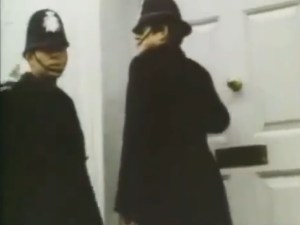
London police visit 3 Savile Row at the conclusion of Let It Be
“We should do the show in a place we’re not allowed to do it,” Paul suggested. “We should trespass. Go in, set up and then get moved, and that should be the show. Get forcibly ejected still trying to play numbers. And the police lifting you.
 Beautiful! The early timeline is clarified and confirmed: Five days from this is Jan. 12, a week before Jan. 19. Falling within the estimate drawn from their discussion the prior day —
 They May Be Parted