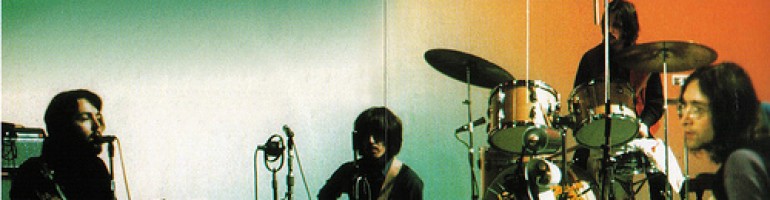
Tag Archives: White Album

TMBP Extra: Let it be first

Like so many of the outtakes on the “sessions” discs unearthed and unleashed on the most deluxe version of the Beatles eponymous double-album, this newest version of “Let It Be” — the oldest recording of the song — is acutely alive and profoundly captivating.

As performed on September 5, 1968 — the day after recording their iconic performance of “Hey Jude” for Frost on Sunday — here’s the world’s greatest tea-room orchestra:

Fifty years in the books, and Beatles history still has room for an edit.

In some ways, this one-minute, 18-second cosmic jam capturing the band in medias resbetween takes of “While My Guitar Gently Weeps” — is just what should be expected, even if its very existence is still something of a minor surprise. A White Album-era version of “Let It Be” felt apocryphal, despite established knowledge rooting it in fact. And so it is that the disjointed, driving performance sounds like it’s out of time — it was.

Let’s dig in on some finer points:
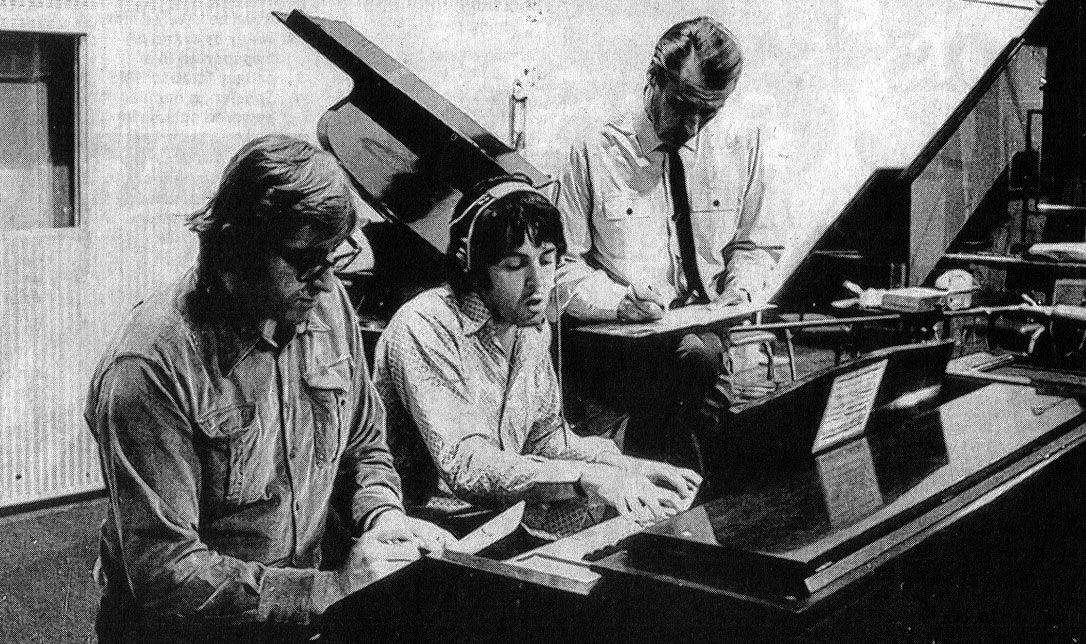
Brother Malcolm, Paul and George Martin during the White Album sessions in 1968

Brother Malcolm, Mother Mary and the lyrics of “Let It Be”
Notably, the lyrics of the song hardly advanced in the three months between September 5, 1968 and January 3, 1969, the first recorded performance of “Let It Be” at the sessions that would ultimately bear its name.

Here’s Paul grooving alone at the piano for the song’s debut on the Nagra tapes:

The lone addition, lyrically: “In my darkest hour, she is standing right in front of me.”

“She,” of course, is Mother Mary, who presumably was in the very original lyric sourced from Paul’s dream about his mother but was absent in the 1968 early attempt. That featured “Brother Malcolm,” a nod to do-it-all assistant Mal Evans. The reference to Mal was inconsistent over January 1969 but endured to the very end of the sessions. Here are the Beatles on the final day of the sessions, January 31, 1969:

It wasn’t until a few days into the sessions at Savile Row, on January 25, 1969, that most of the verses had been added. But Paul started teaching “Let It Be” to others in the band on January 8, when we hear Paul naming chords to the others to learn. That’s also when Paul disclosed that, even at this early stage, he planned to have Aretha Franklin cover the song.

Interludes
Students of the Beatles’ January 1969 sessions have heard this sort of thing several times before, someone in the group veering into an original, a cover, an improvisation between songs, during a transition during a rehearsal or purely as an aside.

Some of these drop-in songs were even the same for the White Album and Get Back/Let It Be sessions:

And just as future songs were sampled and explored during jams in 1968, they were in ‘69 too. And probably long before that as well. A few examples:

Divine intervention
This initial iteration of “Let It Be” may not have had “Mother Mary” but it did feature the hand of “God.”

The September 5 session of “While My Guitar Gently Weeps” was the one that featured Eric Clapton as the Beatles’ guest on lead guitar. That places Eric at the origin of “Let It Be,” and he can be heard adding a few guitar licks to the improvisation. (Listen to the very end and you can hear George close the track imploring his friend to don his headphones: “Cans on, Eric.”)

A full 31 years later Eric would get to play the song again, joining Paul on stage at the 1999 Rock & Roll Hall of Fame inductions. Paul was inducted for his solo career, but the show closed with, naturally, “Let It Be.”

Clapton didn’t take the solo — that’s Robbie Robertson of the Band, the group whose sound the Beatles sought to emulate during the Get Back/Let It Be sessions.

This same induction ceremony honored producer George Martin, who happened to miss the September 5, 1968, session whilst on vacation.

Times of trouble?
Even Paul called the White Album “the tension album.” John said worse in the early ’70s. Ringo literally left the band for a few weeks in the summer of ’68.  Four Beatles, each recording in a separate studio — we all know the stories.

But while history is static, perceptions are variable.

The 2018 reissue’s promotional campaign works to dispense with some of the darker sides of the session, from Giles Martin’s interviews to the numerous dismissals of dysfunction in the lovely hardbound book packaged with the deluxe edition. Indeed, there’s plenty of laughter and carefree spirit throughout the White Album outtakes. The outtake set even begins with laughter among John, Paul and Yoko, as if to hammer the point home.

The Get Back/Let It Be sessions inherit the same sour reputation, yet it would be very easy to compile 50 tracks from January 1969 filled with laughter, chatter and the indication that nothing could ever tear these guys apart. And I bet if and when we do see a formal reissue campaign of Let It Be (which I suspect will be attached to a larger Abbey Road/”Beatles in ‘69” re-release), we’ll see that very recalibration of Beatles history. More “Suzy Parker,” and not quite so many calls for a divorce.

And that’s OK. I’ve long posited that things weren’t necessarily so bad — or at least that much worse — for the Get Back/Let It Be sessions than in the period immediately before and after. Naturally, the reality lies somewhere in between. Neither the White Album nor Let It Be are outliers — that’s just how the group was post-1967.

On January 7, 1969, the day before the rest of the Beatles learned the chords to “Let It Be,” George Harrison made it clear: “Ever since Mr. Epstein passed away, it hasn’t been the same…  [the Beatles had] “been in doldrums for at least a year.” That takes the group to before their trip to India in February 1968.

Together at the beginning of that trip, the individual Beatles returned to England separately. For the final stage of their career, they produced enduring music, though they may be parted.
4 Comments

Filed under Extra

TMBP Extra: Oh what joy

With birthday posts previously produced for Paul McCartney, John Lennon and George Harrison, it’s about time we righted a wrong, and completed the set with the man born as Richard Starkey. Like the others and in the spirit of this blog, here’s a look at Ringo Starr’s life as it straddled the big days circled on the calendar in 1968 and 1969.

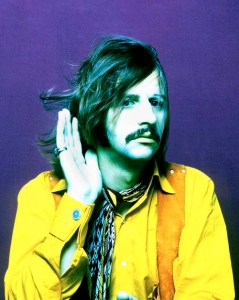
Ringo Starr, 1969

How did you spend your 29th birthday? Ringo Starr, the eldest Beatle, spent July 7, 1969, at EMI Studios on Abbey Road — like he spent so many of days in his 20s — laying down the drum track for “Here Comes The Sun.” We’ve all been stuck working on our birthdays, but this doesn’t sound like a bad gig, if you can get it.

Yet, 11 months earlier, Ringo gave up that gig, walking out on the Beatles during the White Album sessions.

From the Anthology book:

I left because I felt two things: I felt I wasn’t playing great, and I also felt that the other three were really happy and I was an outsider. I went to see John … I said, ‘I’m leaving the group because I”m not playing well and I feel unloved and out of it, and you three are really close.’ And John said, ‘I thought it was you three!’

So I went over to Paul’s and knocked on the door. I said the same thing: ‘I’m leaving the band. I feel you three guys are really close and I’m out of it.’ And Paul said, ‘I thought it was you three!’

I didn’t even bother going to George then. I said, ‘I’m going on holiday.’ I took the kids and we went to Sardinia.

He famously returned two weeks later after to a flower-covered drum kit as the sessions continued (they never stopped recording, with Paul filling in on drums for a few songs).

Still, Ringo’s time away was fruitful, spent on Peter Sellers’ yacht, where the captain told him stories about octopuses on the seabed.

A couple of tokes later with the guitar — and we had ‘Octopus’s Garden’!

Ringo’s relationship with Sellers — a member of The Goon Show, beloved by the teenage future Beatles, and whose novelty records had been produced by George Martin — dated back a few years and would benefit the drummer in several ways in the decade’s final years. In November 1968, Ringo took advantage of a Sellers’ market, moving into the actor’s former Brookfield House estate in Elstead, Surrey. Just a couple months later, the two would co-star in a movie. But first, Ringo had another movie to film with the Beatles.

Ringo’s resistance to go abroad during the Get Back sessions — he was most insistent of any of the Beatles — led to the beauty of the rooftop performance. This blog’s entire purpose is to tell that story.

Musically, Ringo did Ringo things in the January 1969 sessions, and as a songwriter, he continued work on “Octopus’s Garden” (as seen in the Let It Be film) and also brought a few unfinished songs to the table, too.

But the sessions were just a warm-up for what came next at Twickenham Studios, where Ringo — teamed up with Sellers — filmed The Magic Christian, his first true starring role (Ringo had a small part playing a Mexican gardener in Candy, which was released in this period, too). This took time, with filming running from February into May. The film would be released in December 1969.

Let It Be — the film and the record — wouldn’t see a release until 1970, a few months before Ringo turned 30. But the Beatles weren’t finished yet in the wake of those sessions. “Octopus’s Garden” would be formally recorded in April 1969, although recording for Abbey Road, to this point sporadic, wouldn’t get into full swing until July.

In December 1969, Ringo said in an interview with the BBC that “I want to be a film actor. I don’t want to be like Cary Grant or one of them who, like, really do the same performance in everything, and the story is the only thing that changes.”

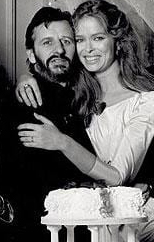
Ringo & Barbara at their wedding

That may be the biggest takeaway in the career of Ringo Starr between July 7, 1968 and 1969 — because he did look at life beyond, or at least in addition to, the Beatles and rock and roll. Without the songwriting gifts of John, Paul and George, Ringo applied his natural charm to film, and was finally able to step fully out into the spotlight and marquee, without other Beatles to his side, or front. And while he was successful in the early 1970s with his solo career, he remained active on the screen, too, even if it wasn’t to that same critical or commercial success.

If you judge success by the bigger things in life, however, Ringo’s foray into film couldn’t have been any more fruitful. A few months before his 40th birthday, in 1980, Ringo filmed Caveman, starring alongside model Barbara Bach. After meeting on the set, they would wed a year later, and have been together ever since.

2 Comments

Filed under Extra

TMBP Extra: Songs for everyone

It was only 100 hours before the Beatles would return to the studio together, and the charts on both sides of the Atlantic on December 29, 1968, were a perfect illustration of why there really wasn’t any rush for them to do so.

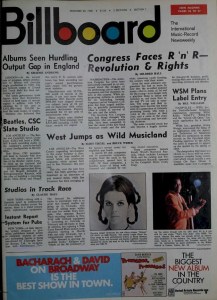
billboard_122868

Billboard, December 28, 1968

That day, The Beatles (White Album) retained the top spot in the British charts for the fifth straight week in the midst of a run that would see the double LP at No. 1 for seven consecutive weeks and eight of nine. After a few weeks’ climb, it hit No. 1 in the United States a day earlier, on December 28, taking a much slower slog to the top. That climb vaulted the Beatles past Glen Campbell’s Wichita Lineman LP, the previous week’s No. 1 that was sunk to the runner-up position, and one of four records the country music star had in the top 30.

The Beatles owned multiple shares in the Billboard album charts, too, with Sgt. Pepper’s Lonely Hearts Club Band (No. 63) and Magical Mystery Tour (85). The latter would provide the title track for Sergio Mendez’s Fool on the Hill LP that sat at No. 11 this week 48 years ago.

Even with the White Album entrenched atop the British charts, there was plenty of Beatle-related materials moving off the shelves, with the Best of Cilla Black (No. 21) featuring four Lennon/McCartney credits and Jose Feliciano’s Feliciano! containing three Beatles covers and sitting one notch behind the Liverpudlian chanteuse (and higher at No. 7 in the U.S.).

The first post-Christmas LP chart in the U.K. was predictably littered with greatest hits and other compilations, with about a dozen such records in the top 50. Four Simon & Garfunkel records were simultaneously on that chart, with a few soundtracks and two separate live LPs recorded at London’s Talk of the Town (Tom Jones and The Seekers).

On the U.S. singles chart, Motown dominated with the label holding the top three spots: Marvin Gaye’s “I Heard it Through the Grapevine,” Stevie Wonder’s “For Once in My Life” and Diana Ross & The Supremes’ “Love Child.” While Beatles smash “Hey Jude” may have been fading, dropping to No. 15, “Hey Jude” the soulful Wilson Pickett cover was rising, hitting No. 43 on its way to eventually peaking at 23. That’s Duane Allman with the epic lead guitar part.

Even though the Beatles didn’t release singles from their albums (a tradition scrapped in time for their final LPs, Abbey Road and Let It Be), their presence was made on the U.K. top 50 without charting a single song of their own (”Hey Jude” dropped out a week earlier). Marmalade’s sugary cover of “Ob-La-Di, Ob-La-Da” stood at No. 7 en route to the top spot the following week, while the Bedrock’s more authentically Caribbean-sounding version of the same song was at No. 30. That cover, produced by former Beatles engineer Norman Smith, would peak 10 notches higher a week later. On its way down the charts was Joe Cocker’s cover of “With a Little Help From My Friends,” dropping to No. 39 on its last week on the charts it had topped about six weeks earlier.

Apple Records artist Mary Hopkin fell to No. 24 in the U.K. with former No. 1 hit “Those Were the Days,” as produced by Paul McCartney (it was at No. 25 in the U.S., down from it’s peak at No. 2).

What held the top spot in the British charts? It was a song written by McCartney, but not that one.  Mike McCartney, Paul’s brother under his stage name Mike McGear, wrote “Lily the Pink” with fellow Scaffold members Roger McGough and John Gorman. The song remained at No. 1 for a second consecutive week, part of a run that saw the comedy folk song reign atop the charts for four of five weeks. “Lily the Pink” had no shortage of future and contemporary star power: Elton John, Graham Nash and Tim Rice provided backup vocals, while Cream’s Jack Bruce laid down the bass line.

The Beatles wouldn’t be absent from the British charts for too long. Exactly five months after December 29, 1968, “Get Back” — which Paul developed out of a jam on January 7, 1969, and was written in the studio throughout the month during the sessions that would bear its name — would debut at No. 1 in the U.K.

3 Comments

Filed under Extra

TMBP Extra: Since he fell out of the womb

Over the years, we’ve celebrated the birthdays of Paul McCartneyJohn Lennon and Ringo Starr, looking back at the periods straddling the big days in 1968-1969. Today it’s George Harrison’s turn. It may be the anniversary of George Harrison’s birth today, or it may be the day after the anniversary of his birth. With Liverpool under bombardment during World War II, keeping the records became confused that day in 1943. But February 25 is the day George celebrated, so it’ll be the day we mark, too.

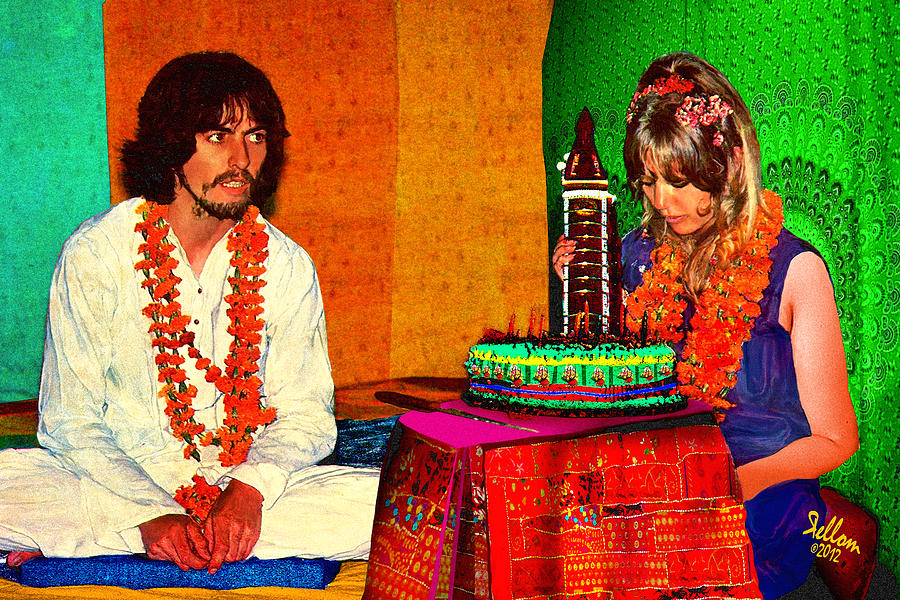
1968, in India. That's actually a cake for Pattie Boyd, whose birthday was a three weeks after George's.

India, 1968. That’s actually a cake for Pattie Boyd, whose birthday was three weeks after George’s.

George’s 26th birthday came just a few weeks after the Beatles wrapped up the Get Back sessions at Twickenham and Savile Row. It capped a remarkable year in his life and career, one that could fill a book, much less a blog post.

George’s 25th birthday was celebrated in India less than 10 days after the Beatles arrived to study Transcendental Meditation under Maharishi Mahesh Yogi. Their retreat lasted nearly two months (for George, who outlasted the rest of the Beatles), transforming the four men, their music and Western culture along the way.

Starting in May and lasting throughout the summer, the Beatles recorded The Beatles. The double White Album, featuring a career-high four compositions, would be released before the winter. In between, George produced Jackie Lomax and saw the release of his solo LP Wonderwall, which was recorded late 1967 and early 1968. (It’s really great, and worth infinite listens).

With Winter 1968 came another transformative overseas trip, this time on the other side of the earth from India, a journey that included a stop in upstate New York, where George spent an intimate holiday with Bob Dylan and the Band, playing and writing songs. They were not laying the groundwork for the formation of the Traveling Wilburys about 20 years later, but it’s worth the dream.

That brings us to January 1969, and you can read all about it here and in posts to come. It’s worth noting, George brought Billy Preston into the Beatles’ circle, and then later would produce him for Apple.

What happened next? George had his tonsils out a week after the rooftop concert, and was laid up for about another week.

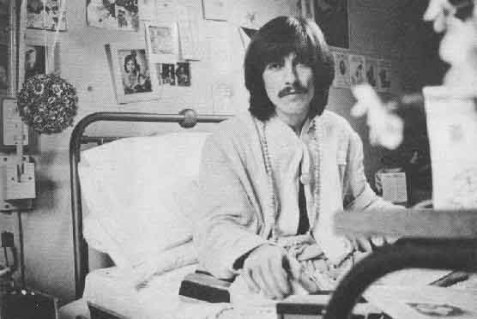
George breaks up with his tonsils, February 1969. Photo appears in his autobiography, I Me Mine.

George breaks up with his tonsils, February 1969. Photo appears in his autobiography, I Me Mine.

He joined the rest of the Beatles on February 22, 1969, to record the first 35 takes of “I Want You,” essentially beginning the Abbey Road sessions, and that about brings things up to his 26th birthday, on February 25, 1969.

Of course, that’s not it. What about the music? Check out this list of Harrisongs composed or at least worked on seriously between his 25th and 26th birthdays (listed alphabetically, with one obvious omission I’ll explain below): “All Things Must Pass,” “Badge” (with Eric Clapton), “Circles” (eventually released in 1982), “Dehradun,” “For You Blue,” “Hear Me Lord,” “I Me Mine,” “I’d Have You Anytime,” “Isn’t it a Pity,” “Long, Long, Long,” “Not Guilty” (left off the White Album, it was released in 1979), “Nowhere to Go” (All Things Must Pass LP outtake written with Dylan), “Old Brown Shoe,” “Piggies,” “Savoy Truffle,” “Sour Milk Sea” (written for Jackie Lomax), “Wah-Wah,” “While My Guitar Gently Weeps,” “Window, Window” (another All Things Must pass outtake). And there’s probably others we don’t know the origins of that would fall in this timeframe too.

Enjoy it all on this YouTube playlist (it’s not just “Badge” as the image implies — click around!):

Not too shabby. As a bonus, he finally had his first song to appear on a Beatles single — the mighty “The Inner Light” was on the flip side of the “Lady Madonna” single, released while they were in India.

Oh, he bought a Moog, too. More about that later in 1969.

George had a really good year, artistically. It was an important one spiritually, too, and he was expanding his professional horizons and stockpiling compositions. In many ways, he shaped the Get Back sessions by walking out and resetting the parameters under which the group would perform live, plus he brought Billy into the fold. His relationship with Dylan, developed when he was in New York, was a critical moment in his career and his own window into how other artists could interact, and reflecting everything that was wrong with the Beatles. While he was still not quite yet afforded the same global respect given to Paul and John, the Beatles’ junior member’s time would come in 1969, thanks in large part to something.

Sorry, I missed the punctuation and capitalization. That’s thanks in part to “Something.” 

There are lots of dumb ways to spend a birthday in your 20s, but recording a few demos at EMI Studios on Abbey Road isn’t one of them.  February 25, 1969, saw George cut solo acoustic versions of “Old Brown Shoe” (first debuted during the Get Back sessions) and “All Things Must Pass” (from 1968, and rehearsed extensively in January 1969). The final song he worked on that day was “Something”, the seeds of which were planted in 1968, but he hadn’t completed as late as the final days leading to the rooftop concert on January 30, 1969.

You can find takes of all three songs on Anthology 3, with a fleshier version also on the 2019 Abbey Road anniversary deluxe edition.

The commercial and critical success of the Abbey Road release of “Something” (finally, his first A-side) — earning high praise from Lennon and McCartney — plus the LP’s “Here Comes the Sun,” changed how George Harrison, Songwriter, was viewed. The time and efforts he spent between his birthdays in 1968 and 1969 propelled him to that point.

6 Comments

Filed under Extra

TMBP Extra: Celebrate anything you want

Three years ago in this space, we celebrated Paul McCartney’s 70th birthday with a brief look back at the period between June 18, 1968 and 1969, a stretch that straddled the Get Back/Let It Be sessions that we explore here. On the occasion of the diamond jubilee of John Lennon’s birth, we’ll do the same thing people have done for more than 50 years: compare John and Paul, and as usual, with much different results.

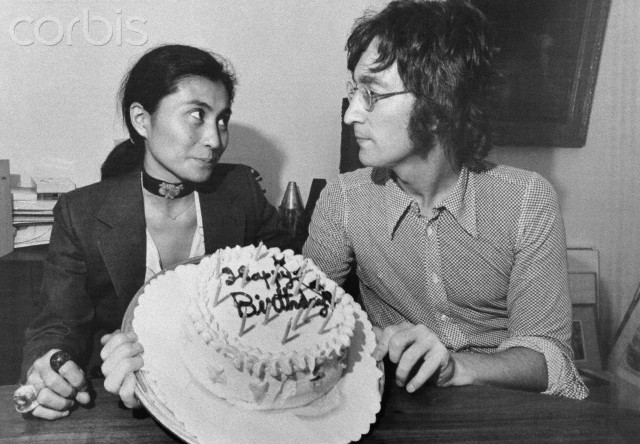
John Lennon and Yoko Ono with Birthday Cake

Smile, John, it’s your birthday!

Forty-seven years ago today — October 9, 1968 — was John Lennon’s 28th birthday. The Beatles were primarily in the mixing stage of the White Album. John was in the midst of a divorce with Cynthia. Nine days later — there’s that number that follows John around — he and Yoko were victims of a drug bust at their home as they were handling the difficult release of Two Virgins.

In the coming months, the White Album was completed and released, the Beatles assembled in January 1969 for a monthlong writing and recording session and they subsequently recorded and completed Abbey Road (along with other songs, like John’s “The Ballad of John and Yoko,” a No. 1 hit). Those achievements fell in the same period as between Paul’s 1968 and 1969 birthdays. So what’s different for John and in the time frame that’s shifted by four months?

Yoko, obviously, and her dramatically increased role in John’s life, replacing Paul as his primary collaborator. It wasn’t just her, but what she enabled John to be willing to do. John, with Yoko, created their own art and performance outside of the Beatles — bed-ins, experimental music, films, publications — all things that grew from being an outlet away from the band to becoming a full replacement for the band that Paul was expending his energy to keep together and internally manage. Like John and Yoko, Paul got married, too (less than 10 days earlier), and started his own life with Linda, increasingly spending time at his farm in Scotland. The Beatles had become his band, if it was anyone’s.

Three weeks before the Get Back sessions, John formed the Dirty Mac for the Rolling Stones’ Rock and Roll Circus in December 1968. His bed-in recording of “Give Peace a Chance” was released within weeks of “The Ballad of John and Yoko” in July 1969. Two weeks before the release of Abbey Road in September 1969, his first iteration of the Plastic Ono Band took the stage in Toronto.  Upon his return on Sept. 20, he told the rest of the Beatles he quit the group. He wouldn’t perform together with the other three Beatles again. Ten days later he recorded “Cold Turkey.”

All of the Beatles by this point had their own lives, marriages and projects outside the band.  For John, the Beatles had become the outside project in a wildly tumultuous period coinciding with his divorce, his immersion into Yoko, the use of harder drugs and his disengagement from Paul. All the factors are related. This may not have been John’s greatest period as a pop music songwriter, at least in volume, but given the variety of artistic pursuits and chances he was willing to take — including the biggest one of all, replacing Paul with Yoko — it was a remarkable period in John Lennon’s career and life.

On August 28, 1969, Linda gave birth to Mary, Paul’s first child. On October 9, John’s 29th birthday and the end of the period we’re recalling here, Yoko miscarried.  They would have their first child together, Sean, exactly six years later, on October 9, 1975.

3 Comments

Filed under Extra