Tag Archives: 1969

TMBP Extra: That road before

As a film, Let It Be has more backstory than story.

In Beatle-time, the 15-plus-month turnaround from the end of their January 1969 sessions until the film’s release in May 1970 was simply a glacial pace. Then from the moment it reached theaters, Let It Be has been treated as a snuff film.

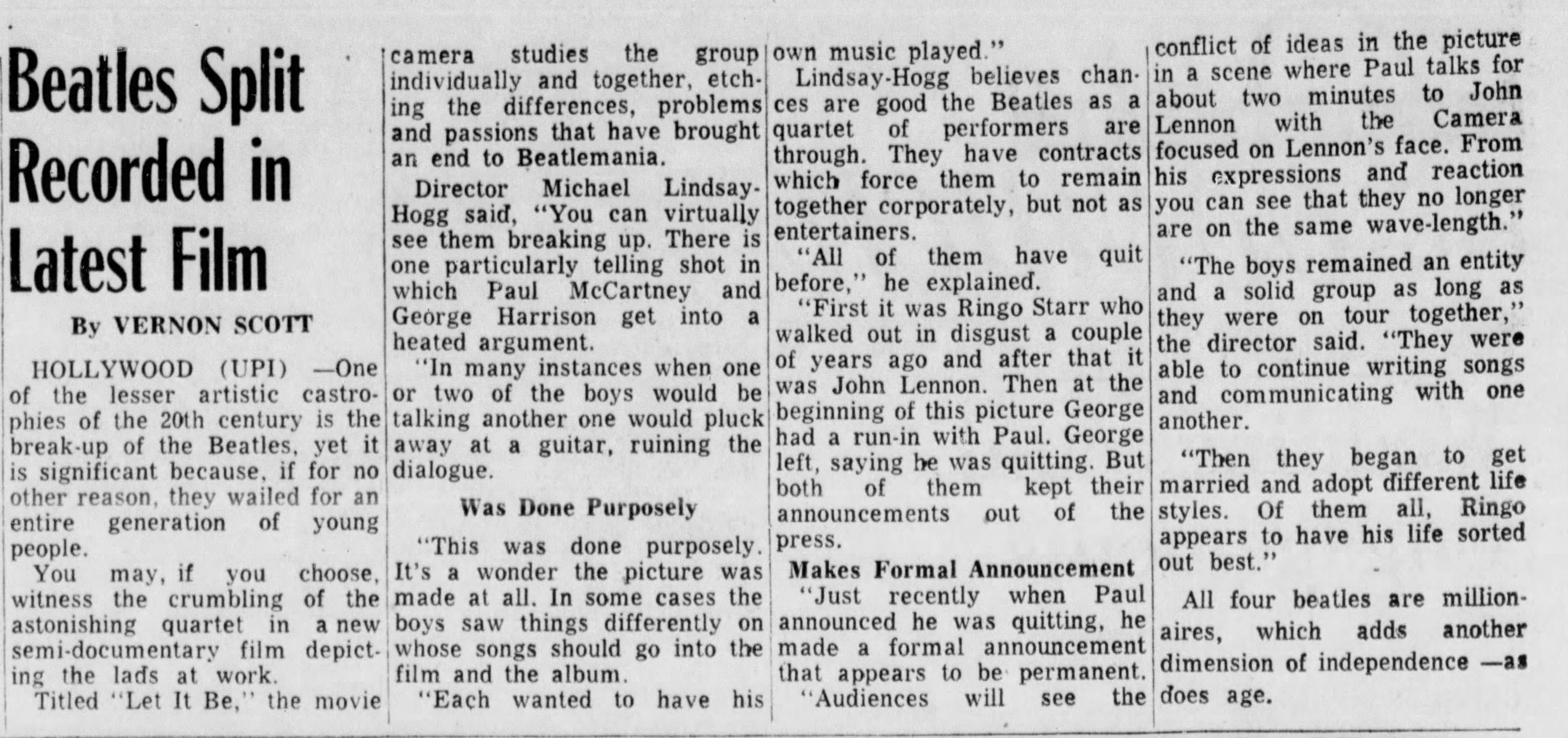
You can virtually see them breaking up … it’s a wonder the picture was made at all.

That’s director Michael Lindsay-Hogg, quoted in a syndicated wire story the week of the film’s release, ostensibly to promote the film. We’ll never know if he’d have said the same thing if the film come out in sometime in 1969 as originally planned, when it was provisionally titled Get Back.

It only took 51 years, but Get Back is about to be on television after all — a movie-turned-television-show, the reverse of Let It Be’s trajectory from TV show to feature film.

To put 51 years into context, it’s 11 more years than John Lennon spent in the material world. It’s about as far away from today as the release of Let It Be was from the Treaty of Versailles. It’s a relative eternity.

Let’s pick up this story after January 1969. The Beatles completed busy and fruitful winter sessions split between Twickenham Film Studios and their own basement recording studios at 3 Savile Row with dozens of hours of audio and video that would emerge as a TV show and springtime LP, their follow-up to the White Album.

The February 1969 issue of the Beatles Book, their fan club magazine, said that while there was “still no fresh progress” on the Beatles’ next film, it was a “priority job” for the new year. They hadn’t yet realized the film was already in the can.

For the next several months, a clear pattern emerged: The release of the album was delayed because the movie was hung up.

April 29, 1969: Melody Maker reported 68 hours of footage was about to be edited down, “from which two films will be produced.”

May 3, 1969: “This film … somebody’s editing that at the moment. It’s sixty-eight hours, and they’re trying to get it down to five for several TV specials. Or then, it might be a movie. I don’t know” — John, to Melody Maker

Early July 1969: The Beatles Book reported the release of the album and a companion book would be delayed because “the fellows would like the film to go on television in August so that everything comes together at the same time.”

July 12, 1969: “[The LP] is tentatively set for September release … to coincide with the screening of the group’s TV special. … If the TV show is delayed until later in the autumn, it is possible that an alternative album … will be released first. From all the many reels of film shot during their recording sessions, the Beatles are hoping to produce a three-hour cinema film, from which the two-hour TV special would then be extracted.” — NME

The Beatles and family, at the July 20, 1969, rough cut screening.

July 20, 1969: The same day mankind made a giant leap on the moon, the stars of the film sat in place for a while to view Michael’s working cut of the film, which at the time clocked in at about 2 1/2 hours. This was about three months after editing was reported to be getting under way.

July 21, 1969: The day after the screening, Beatles assistant Peter Brown phoned Michael, asking on behalf of the group just one required edit: Whack a half-hour of John and Yoko footage. In his 2011 memoir Luck and Circumstance, Michael wrote he was told, “Let me put it this way. I’ve had three calls this morning to say it should come out.”

July 29, 1969: Variety reported plans to screen a TV special to coincide with the release of the Get Back LP. “The TV show and a three-hour cinema version are still at the editing stage,” the magazine said.

Early August 1969: The Beatles Book said the Get Back LP will be pushed back again to coincide with the film, “probably towards the end of November.”

August 30, 1969: “There is still no news of release of the … ‘Get Back’ album. … It is understood that this will still be issued as a soundtrack album for the film, however, and that Christmas is a possibility.” — NME

September 1969: After screening a new cut at some point this month, the group signed off on the film to business manager Allen Klein, according to Michael. In what could simply be a coincidence, the same month also saw John announce to the others that he was quitting the Beatles. They released Abbey Road in September, too.

September 20, 1969: Six days before that very release, NME reported the 85-minute “Get Back” film would premiere early in 1970. The paper said the documentary had been edited from “five hours of film taken at the time,” quite the error of scale. The paper does say, however, that the movie is expected to be picked up by United Artists in order to fulfill their three-film commitment. The Beatles’ priority for the year, as mentioned in February, was now complete. This is definitely a scoop, with Variety reporting the same UA deal the following April.

October 1969: Counter to the NME story, the Beatles Book maintained the LP and film would come out in December. Elsewhere in this issue, in Steve Turner’s article on the Beatles’ effect on modern culture, the rumor that the Beatles may film a version of Lord of the Rings was revived.

November 1969: The Beatles Book was back to reporting a 1970 release with UA distributing.

On the very eve of the Let It Be’s ultimate release in May, we can catch a glimpse of contemporary opinions of the film.

Based on interviews conducted prior to the release of the McCartney LP, the traditional marker for the breakup of the Beatles, BBC Radio 1 broadcast a promotional special on May 23, 1970, in conjunction with the film’s wide release in the UK.

Paul compared the film to watching a painter fill his canvas, calling it a “good film” and “interesting.”

George, however, said he “can’t stand” seeing the “pure documentary of us slogging.

“But for other people who don’t know what we’re really about, who like to go in and see our warts, it’s very good. … It’s the complete opposite to the clinical approach that we’ve normally had.”

Of the album, he says “you can actually get to know us. It’s more human.”
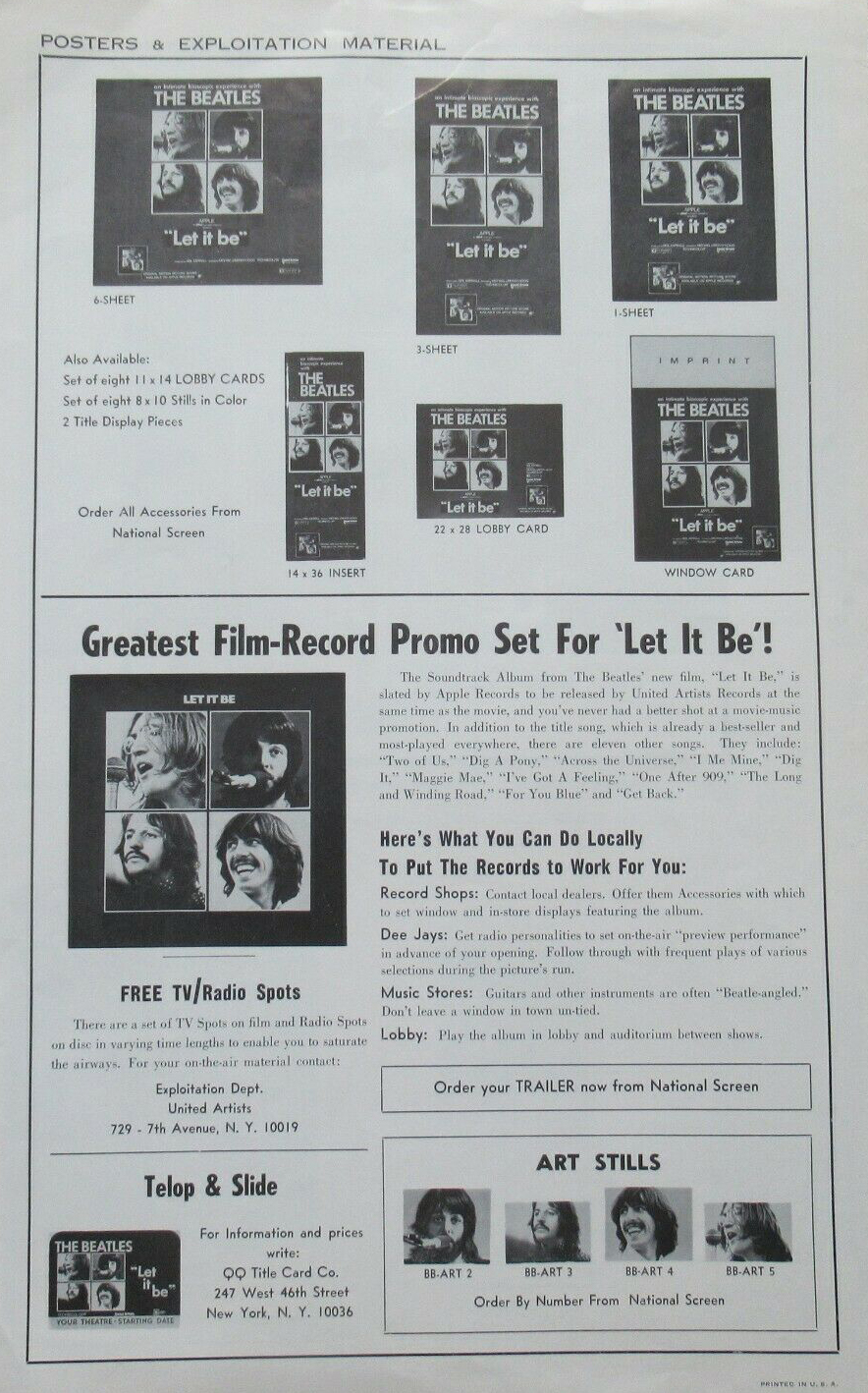
“Exploitation materials and posters” intended for theaters to use for promotion of Let It Be.

Speaking to Rolling Stone for a cover story on the eve of the release of his solo debut — the magazine is dated April 30, but the interview was clearly conducted prior to April 10 — Paul continued to point to the film, which he still referred to as Get Back, in positive terms.

“The Get Back film is a good film. And it is a real film. The troubles are in it as well as the happy moments.”

Paul went on to complain about the delays of the record’s release in interestingly prescient terms while blaming Klein for the holdup.

“The LP is looking to be a joke, for it is a bit of a cliff hanger. I would have liked to have seen it out there three months ago and now I don’t even remember making it.”

It’s tough to keep pace in Beatle-time. Paul’s point is clear, though, even with the tremendous exaggeration.

While the Beatles may have been in a difficult spot in early April 1970, it wasn’t the same spot — difficult or not — they were in January 1969.

When Let It Be was first shown to the public, on May 13, 1970, there was no glitz or red carpet. Instead the film was screened in ordinary theaters dotting the United States, not at a promoted premiere in New York as Apple had initially promoted.

A week later, May 20, the film received a more proper launch, premiering in London and Liverpool with the pomp missing stateside. In London, Beatle exes Jane Asher and Cynthia Lennon were among the guests, which also included Mary Hopkin, Lulu, Spike Milligan and other notables as thousands of fans showed up at the scene. Kevin Harrington, equipment manager at the time, wrote in his memoir that he took an Apple Scruff to the premiere. No Beatles were present, however.

At this moment, two key figures were across the globe, in Los Angeles. John Lennon was in Bel Air undergoing Primal Scream therapy while Michael Lindsay-Hogg was at work about a half-hour away in Hollywood (traffic pending).
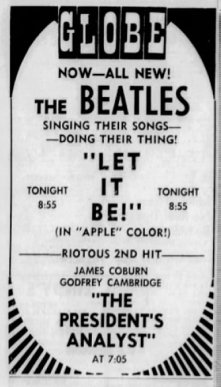
The most accurate review yet: “Singing their songs, doing their thing!” (From the May 13, 1970, Californian)

John and Yoko joined Rolling Stone chief Jann Wenner and his wife, Jane, for a showing Let It Be at a sparsely attended theater in San Francisco in the early part of June 1970.

“After the show — moved at whatever level, either as participants or deep fans — we somehow cried,” recalled Wenner.

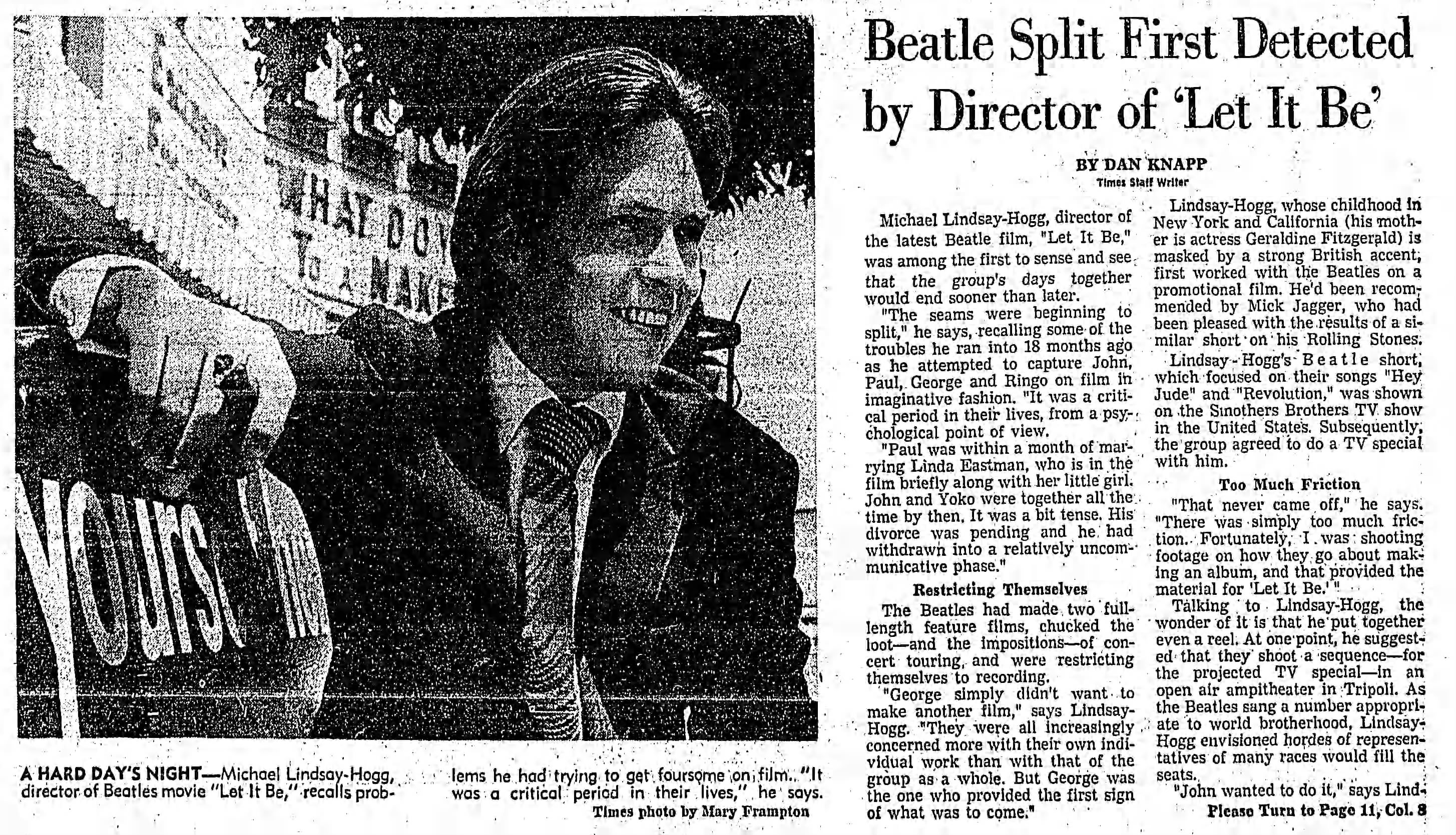
In a Los Angeles Times interview published just a few days after Lennon saw the movie, Michael again reflected on the difficulty of filming the sessions in terms dramatic enough the reporter remarked “the wonder of it is that he put together even a reel.”

In the June 10, 1970, article, Michael complained the group would disrupt “a lot of good, funny and antagonistic conversation” by playing music and moving microphones away. “I don’t think I got them when they were their most charming,” he said, essentially acknowledging they were never charming given the amount of footage he actually did get.

The article was memorable enough for Michael that he remembered his reaction to it decades later in his book.

… [I] was surprised, or concerned, that what had seemed clear to me when I’d said it had been reported without insight, with no recognition of irony or jokes. The Beatles were portrayed only as argumentative people, without extenuation, without subtlety.

The article prompted a further response, a phone call from fellow director — and father, as he later learned — Orson Welles, who asked Michael if he was happy with Let It Be.

“Some of it,” Michael replied. “It’s hard when your stars are your producers. And there were four of them. … A lot I liked got cut out. … But the footage was good.”

Let It Be arrived at theaters at various points in May 1970, but it was absolutely impossible to separate it and its impact from the April release of McCartney. Ringo’s late-March release of his solo debut, Sentimental Journey, wasn’t necessarily seen to have been as critical to the story as McCartney, but it simply piled on the narrative. Let It Be was the breakup film paired with a breakup soundtrack LP. Reviews of one usually paired with reviews of the other.

Variety’s review, published in their May 20 issue, called the movie “relatively innocuous, unimaginative piece of film. But the musicians are the Beatles, and coming hard on the group’s breakup, … [it’s] charged with it own timely mystique.

The fascination of “Let It Be” is that it is, in a sense, probably the last public appearance of Paul McCartney, John Lennon, George Harrison and Ringo Starr as a group, with all the gossip and speculation attending the split, reading between the spoken lines of the film becomes a game in itself.

Variety did wisely predict “McCartney … will probably emerge strongest as a major individual talent of the Seventies as a composer and singer.”

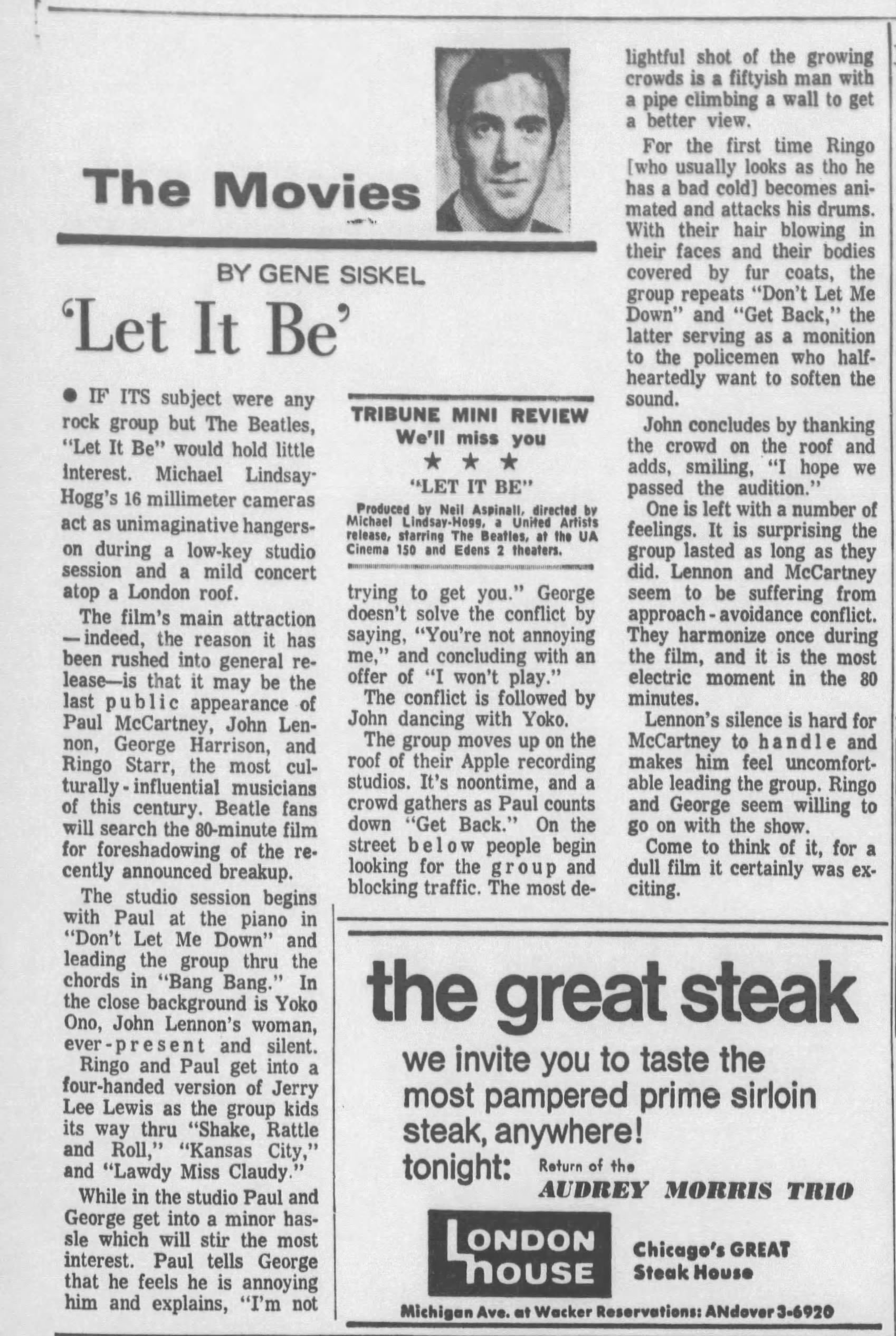
Chicago Tribune legend Gene Siskel gave Let It Be three stars, writing “Beatle fans will search the 80-miunte film for foreshadowing of the recently announced breakup.”

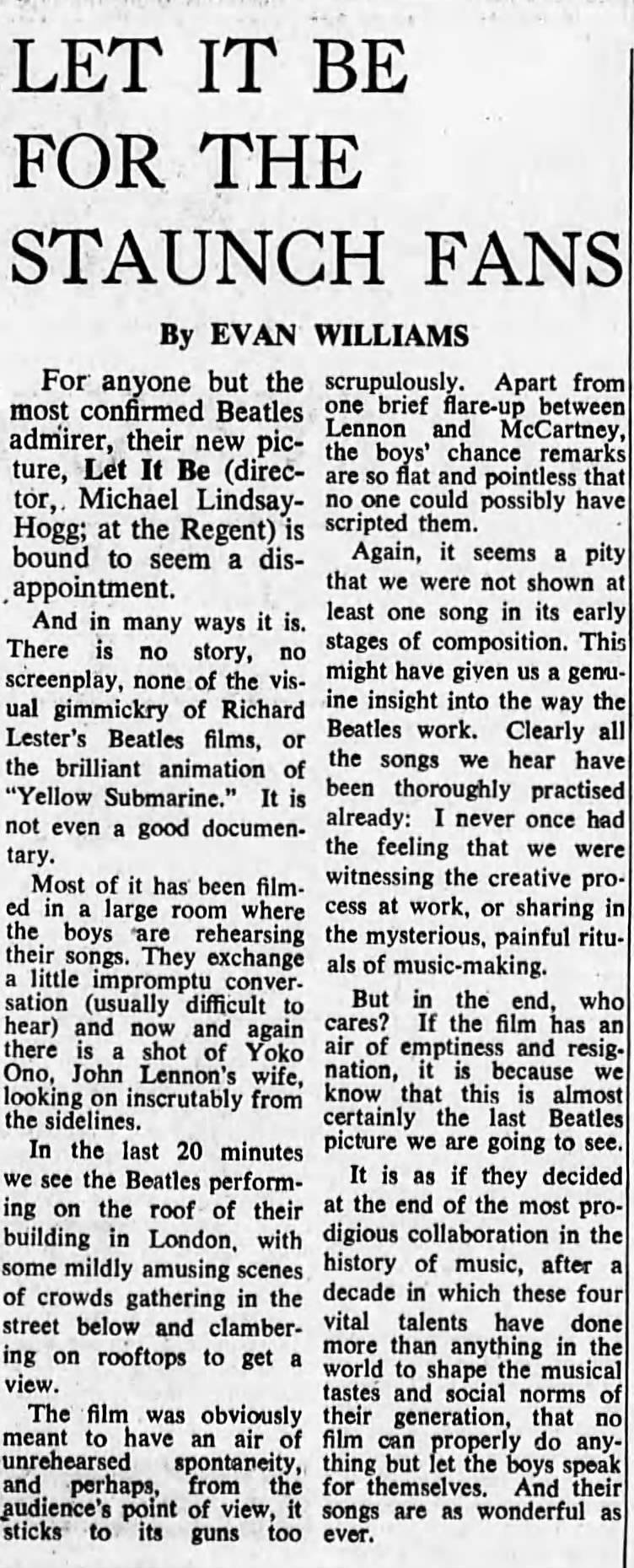
In the the Sydney Morning Herald’s review headlined “Let It Be For the Staunch Fans,” writer Evan Williams smartly noted:

It seems a pity that we are not shown at least one song in its early stages of composition. This might have given us a genuine insight into the way the Beatles work. … I never once had the feeling that we were witnessing the creative process at work, or sharing in the mysterious, painful rituals of music-making.

(This key point is something the 2021 Get Back film is set to get right).

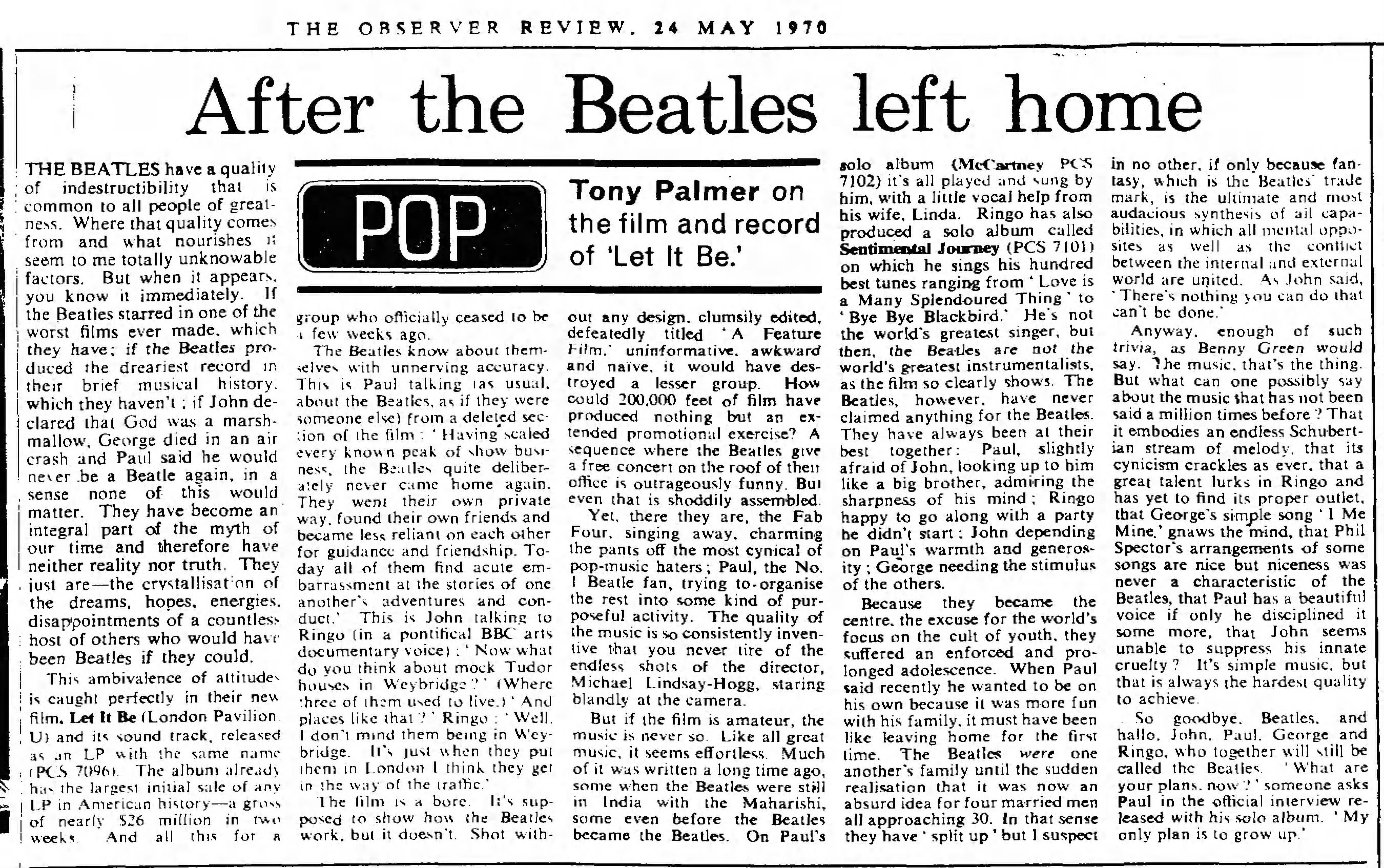
Tony Palmer gave a brutal takedown of the film in the Observer’s May 23, 1970, issue.

The film is a bore. … Shot without any design, clumsily edited, defeatedly titled ‘A Feature Film,’ uninformative, awkward and naive. It would have destroyed a lesser group. How could 200,000 feet of film have produced nothing but an extended promotional exercise?

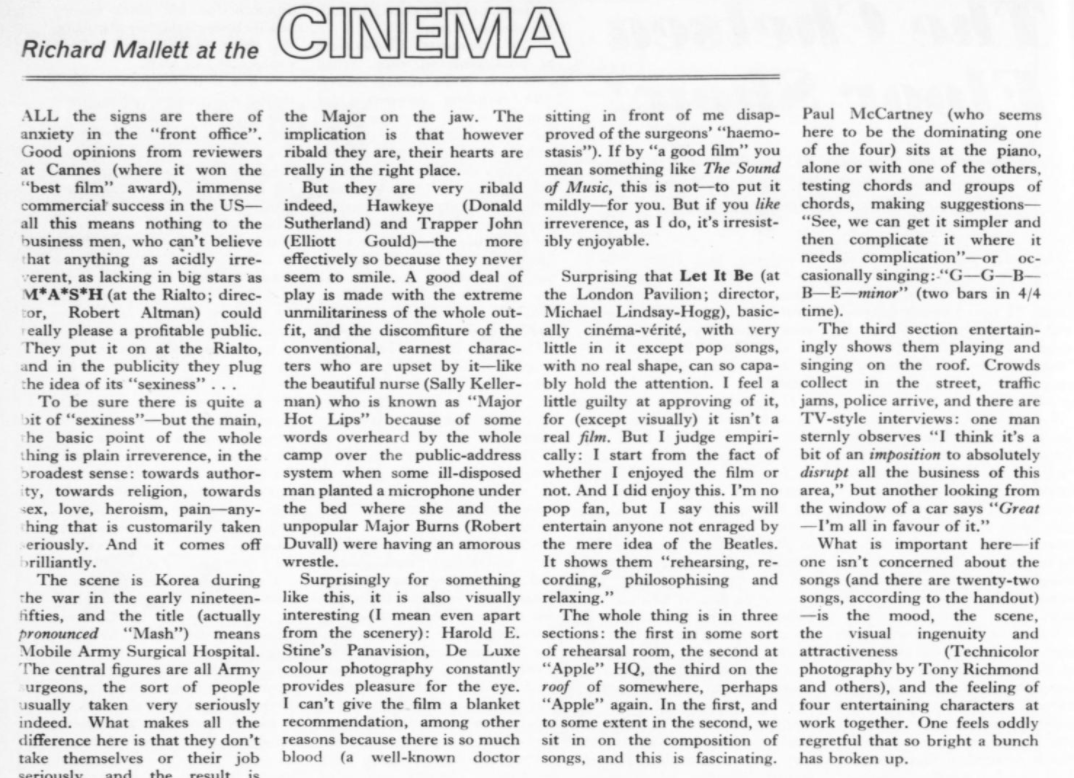
Writing for Punch magazine, Richard Mallett, who described himself “as no pop fan” called the film shapeless but wrote it “will entertain anyone not enraged by the mere idea of the Beatles.” He enjoyed the film’s mood, visuals and interplay of the four Beatles, concluding, “One feels oddly regretful that so bright a bunch has broken up.”
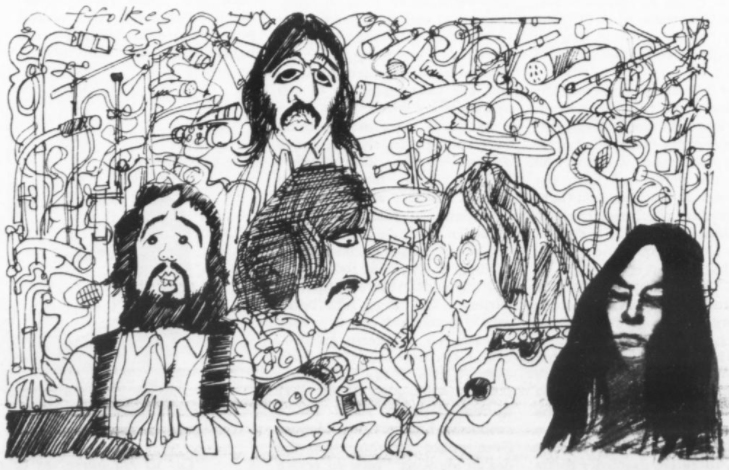
“The Beatles and Friend” – from Punch magazine

These are just a small sampling of reviews. I could have posted hundreds, but you get the idea.

The film performed OK at the box office, seeming to peak in Variety’s weekly rankings at No. 5 in its third week. Per those same rankings, it dropped from No. 8 to 41 on June 17 and then slowly vanished from theaters overall. The film ultimately won an Oscar for its score, but no there weren’t any Beatles around to pick up the trophy. 
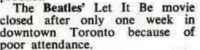
From Billboard, June 11, 1970

It’s an understatement to say the Beatles, especially John and George, piled on subsequent years, advancing and ensuring the film’s terrible standing.

Even Capitol Records eventually called out the film’s dim reputation. Remember Reel Music? (Don’t answer that). The 1982 compilation of Beatles movie songs promoted Let It Be like this:

Let It Be poignantly documents the group’s disintegration while capturing their inimitable songwriting technique.

For his part, Paul continued a working relationship with Michael, tapping him for a few promotional videos in the 1970s.

In July 1981, a decade after it was in theaters, Let It Be saw its first home release on VHS (it was later issued on Laserdisc). Again using Variety’s rankings, the tape debuted at No. 31 and kind of bubbled around the 20s, peaking at No. 19 before eventually falling out of the Top 40.
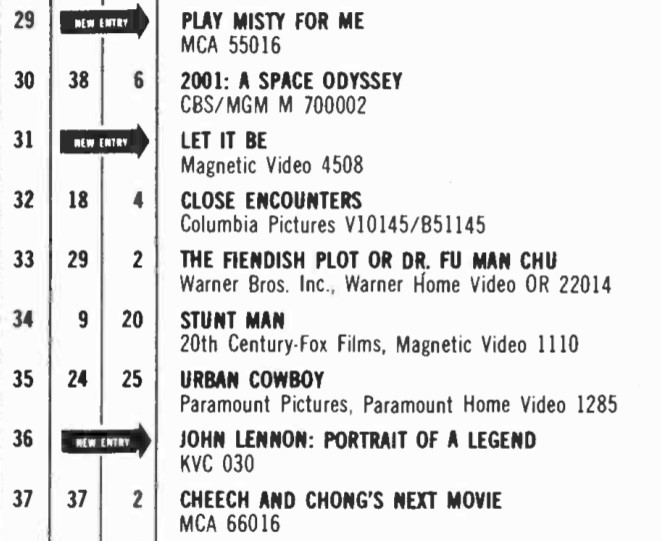
VHS charts, August 1, 1981, Variety.

That makes it 40 years since the movie was last issued for a home audience. In January 2022, “A Hard Day’s Night” is slated for a 4K Criterion Collection reissue. You could have bought that fab film on VHS, Laserdisc, DVD, Blu-Ray and streamed it online in that same period of time. It’s a big game of telephone, but Michael says that Paul told him George blocked the DVD release in the 1990s, while a planned DVD to be released in tandem with Let It Be … Naked in 2003 never materialized.

Footage from Let It Be trickled out officially on occasion, like in Anthology in 1995, when a whole new audience was exposed to George playing if Paul wanted him to play during the “winter of discontent.” On the flip side, part of the rooftop show ran during the credits of the 2014 documentary “Eight Days a Week,” a lovely — if strictly anachronistic — conclusion to a movie about the Beatles’ touring years.

But for all intents and purposes, the original Let It Be film had its reputation established by its release, with the breakup taking on a disproportionate stake. Decades of unavailability for mainstream viewers cemented the movie as a straw man for late-era Beatles. The only two views of it were “watch the Beatles break up” or “watch for the symptoms of the Beatles breaking up.” There was little middle ground. Maybe Michael Lindsay-Hogg offered up too much subtlety.

Or maybe we also lost some context along the way.

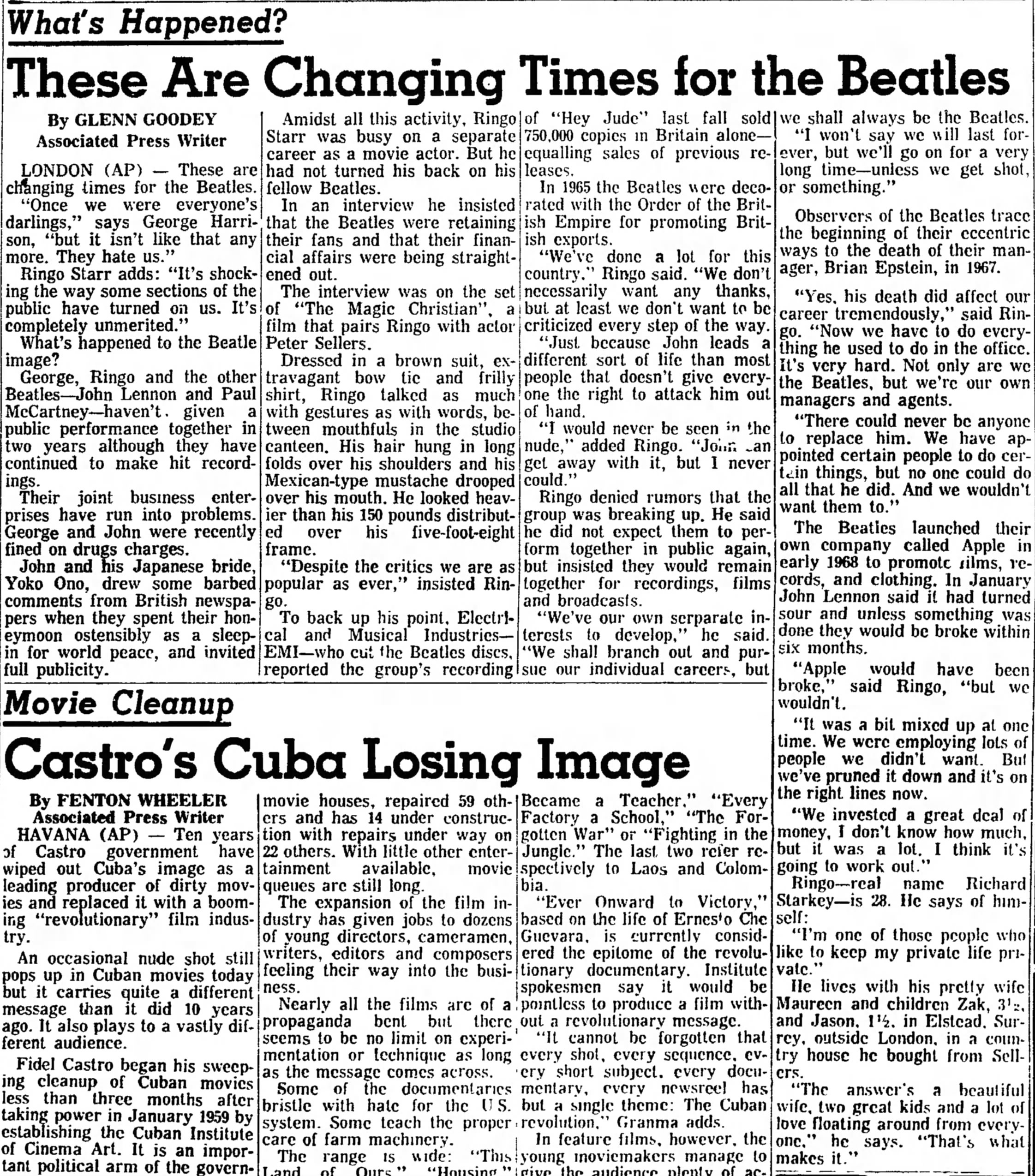
“Once we were everyone’s darlings,” George said in an interview published by AP. “But it isn’t like that anymore. They hate us.”

Ringo agreed in the same article. “It’s shocking the way some sections of the public have turned on us. It’s completely unmerited.”

Those quotes are from April 1969, a year before the band broke up.

It only took 51 years, but Let It Be is Get Back again. It’s out in conjunction with the release of the LP and a book (and within months of competing solo Beatles products). Yet with all this history behind it, it instead arrives with excitement from the band and fans alike, and it’ll draw upon its own blank slate.
6 Comments

Filed under Day by day, Extra

Jan. 12: Anyway, here’s Wonderwall

While the Apple Corps board meeting at Ringo Starr’s house is the obvious focal point to the Beatles’ January 12, 1969, there was more to the day’s agenda than the important aborted gathering.

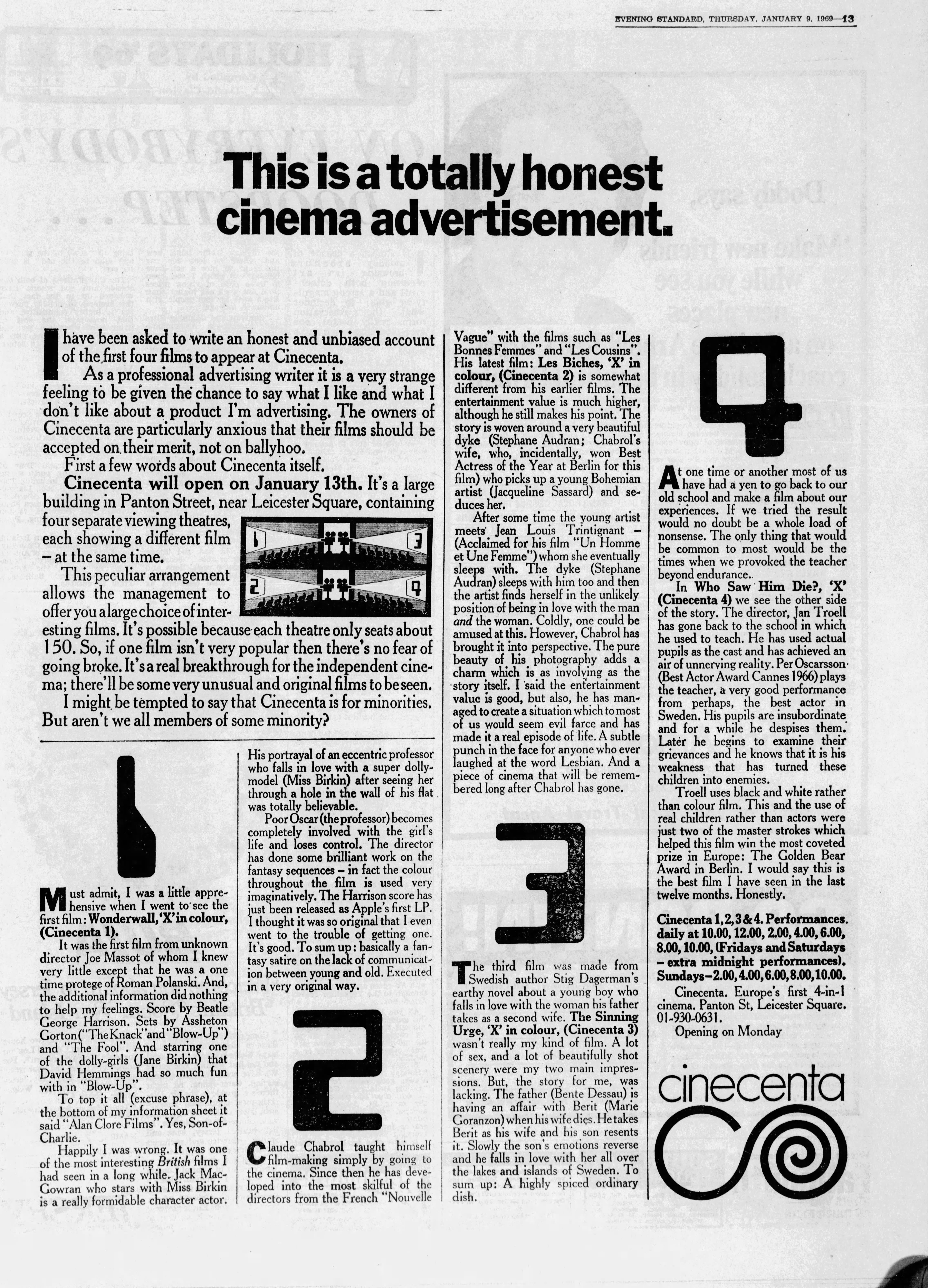
“This peculiar arrangement allows the management to offer you a large choice of interesting films” (from a January 9, 1969, ad for Cinecenta)

That evening, Wonderwall — the film which bore George Harrison’s excellent solo debut as its soundtrack — enjoyed its British premiere at London’s Cinecenta. George, who had walked out of the Apple meeting that day, didn’t attend the premiere, which also served as a sneak preview for the Panton Street theater, Europe’s first four-in-one cinema.

Rather, George spent the evening at the home of Apple press officer and close friend Derek Taylor, a fact detailed in George’s diary. Mal Evans, who did it all for the Beatles, whether it was running errands or helping with lyrics or banging silver hammers, went to the movies instead, presumably as George’s representative.

“I went to the premiere of Wonderwall last night,” Mal told the others, unprompted, early on the January 13 Nagra tapes. He said he liked the film, even though it  “really got slayed in the papers.”

Ringo, who in May 1968 joined George at the film’s world premiere at the Cannes Film Festival, added, “I like the film too. After a couple of times, is that what you were going to say? First time was a lot.”

After the film, which was screened in all four theaters, Mal — resplendent in bow tie — enjoyed the crowded reception, including ice cream afterward.

Celebration day
The Beatles’ communication breakdown put Glyn Johns’ Beatles gig in jeopardy at the same moment Led Zeppelin’s “Communication Breakdown” padded his resume.

Zeppelin’s self-titled debut LP hit American shops on January 12, 1969 (it came out in the UK in March), and that certainly would have made it a big day for Glyn, its engineer.

A few weeks after this date, after George had returned to the band and rehearsals shifted to 3 Savile Row, Glyn tried solicit the Beatle’s opinion on the fledgling Zep. George seemed more interested in lunch, but it’s still a neat moment in rock history.

At a 2014 Q&A to promote his memoir, Glyn said when he did finally get to play some of the LP for George, the Beatle “didn’t get one bar of it” (Mick Jagger wasn’t impressed either).

The Led Zeppelin release may not have even the biggest news for Glyn on January 12, although admittedly that’s just speculation. On the Nagra tapes recorded the next day, Glyn tells the others for the first time that he and his wife were expecting. So maybe she reached a certain point in a healthy pregnancy that weekend that made them feel comfortable to share the news starting Monday.

“Did I tell you my wife’s definitely confirmed pregnant?” he told Ringo, Michael and the other early arrivals.

Their son, Ethan, picked up his dad’s business decades later, producing, among other things, two tracks on Paul McCartney’s 2013 LP New.

Big brother is watching?
After the meeting at Ringo’s, Paul spent time with Apple head Neil Aspinall, discussing an explosive idea for the Beatles’ proposed live concert. Did Paul have time for someone else’s concert that same night?

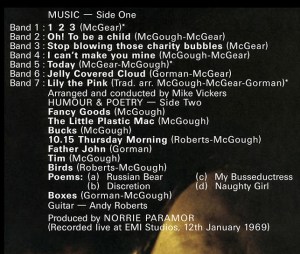
Some books place Paul at EMI Studios that night, but it’s hard to confirm just how many McCartneys were at the Abbey Road studios. There’s no question The Scaffold, featuring Paul’s brother, Mike McGear, recorded portions of their L. The P. album there that evening. There’s also no question Paul provided the guitar for two of that album’s tracks — and he recorded those in subsequent months. Side 2 of the LP, all humor and poetry, was recorded live before an audience of London University students that Sunday, and it’s feasible Paul was also in the crowd.

Paul lived a short walk from EMI, but it would be a surprise if he went the show yet didn’t mention it the next day on the tapes, considering how much detail of their lives they did share.

Sitting on a sofa on a Sunday
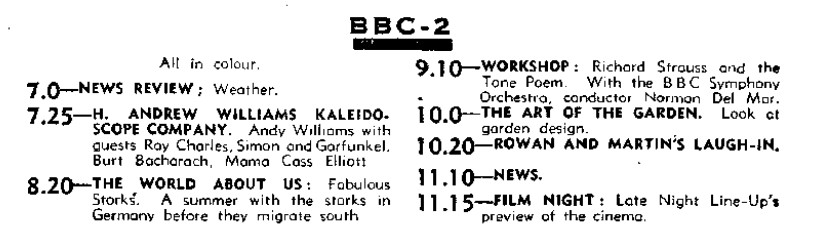
Michael Lindsay-Hogg was stuck to the television Sunday night, when he was tuned to the Andy Williams special on BBC-2. An hour-long show featuring several performers and beginning at 7:25 p.m., the “H. Andrew Williams Kaleidoscope Company” originally aired in the U.S. in April 1968, but was first-run to British audiences in January 1969.

From the January 4, 1969, New Music Express

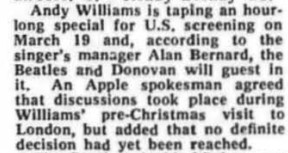
While Andy Williams featured a Beatles number in the dizzying opening sequence and was presently rumored to be in line to host the band on his TV show in the coming months (see the adjacent clipping from NME), the American crooner wasn’t discussed at all on the Nagra tapes the next morning.

Instead, Simon and Garfunkel, who had four LPs among the top 26 in the UK for the period beginning January 12, 1969 — including The Graduate, which sat at No. 4 — sparked the most conversation, again, primarily from Michael.

On Mrs. Robinson, they were camping it up, which I didn’t like, because Paul Simon is not that good at it,” Michael said, before continuing. “He’s got a great face, Art Garfunkel.”

“Is he the frizz?” asked Ringo.

Michael confirmed Garfunkel was the frizz, before unexpectedly offering that he had “a very long, involved story about how Paul Simon and I don’t get on, but it’s too long and involved. … It’s funny, I’ll tell you sometime.”

(We never hear the story, but their issues must have eventually been ironed out, because Michael directed the Simon & Garfunkel reunion in Central Park in 1981 and later got his big African concert, directing Simon’s historic 1987 Graceland concert before a huge audience in Zimbabwe.)

There was another act on the Andy Williams show that drew interest.

“Who saw Ray Charles?” Ringo asked.

It’s a good question, and one unfortunately left hanging, as they moved onto other topics before anyone answered.

If anyone had, in fact, seen Ray Charles’ segment, they could have caught a fleeting glimpse of his organist: Billy Preston.

2 Comments

Filed under Day by day

Jan. 10: See you ’round the clubs

On the afternoon of January 10, 1969, seven days into the Get Back sessions and nearly 10 years into his tenure with the band — a term that began when he was 15 years old — George Harrison quit the Beatles.

George: I’m leaving the band now.

John Lennon: When?

George: Now.

After a cut in the Nagra tapes, which captured the exchange, George casually continued: “Get a replacement. [Place an ad] in NME and get a few people.”

While the tapes don’t capture him saying “see you ’round the clubs,” it’s too good a line to be purely apocryphal (and it’s, in fact, alluded to by others on the tapes later in the day). George then briefly shared a few words with Mal Evans and was off, his boots echoing as he departed.

Likewise, for the sake of the complete record, there is simply no indication on the tapes of what happened between the final take of “Two of Us,” and George’s departure, the immediate spark of George’s decision (if there was any). Like the Beatles themselves, the tapes were out to lunch.

Film director Michael Lindsay-Hogg, so proud of his spy microphone hours earlier, had the right instincts and was prepared for this moment, but he probably should have upgraded to a better model.

“My bug had only picked up the sounds of cutlery banging on china plates, obscuring what the muffled voices had said,” Michael wrote in his 2011 autobiography Luck and Circumstance. In his “role as documentarian,” he had asked his sound engineer to mic the flowerpot on the dining room table as George encountered the band at lunchtime. Per Michael, George concluded by saying, “See you ’round the clubs.”

George grabs his coat on his way out of the utter sty that was the studio at Twickenham, as pictured on an earlier day. (Screen capture from Beatles Anthology)

What exactly happened over lunch is a source of legitimate dispute in Beatles history. Dig in — here are varied accounts that span 50 years.

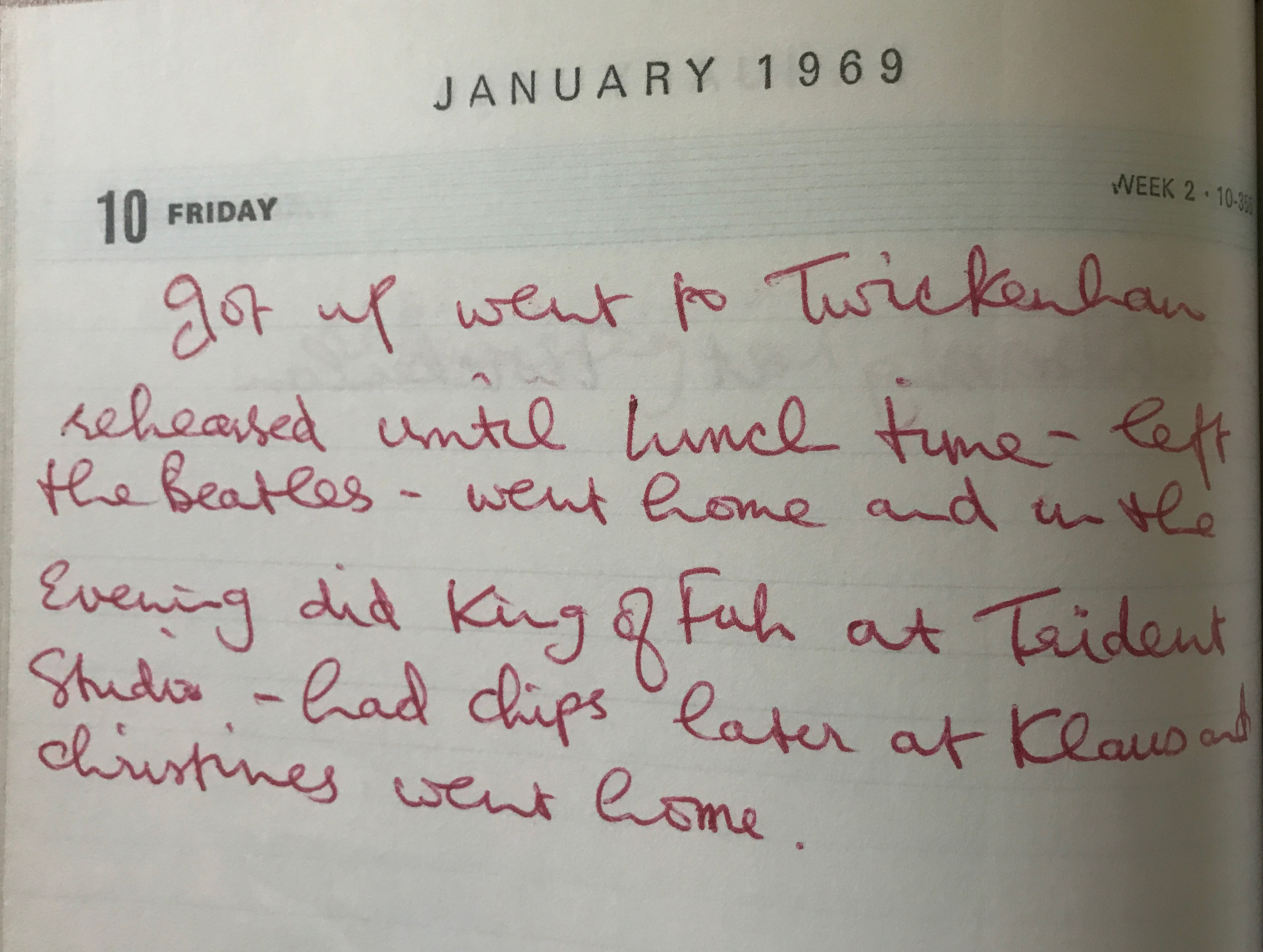
The most contemporary retelling of the events of January 10, 1969, comes from George himself, later that day, in his personal diary.

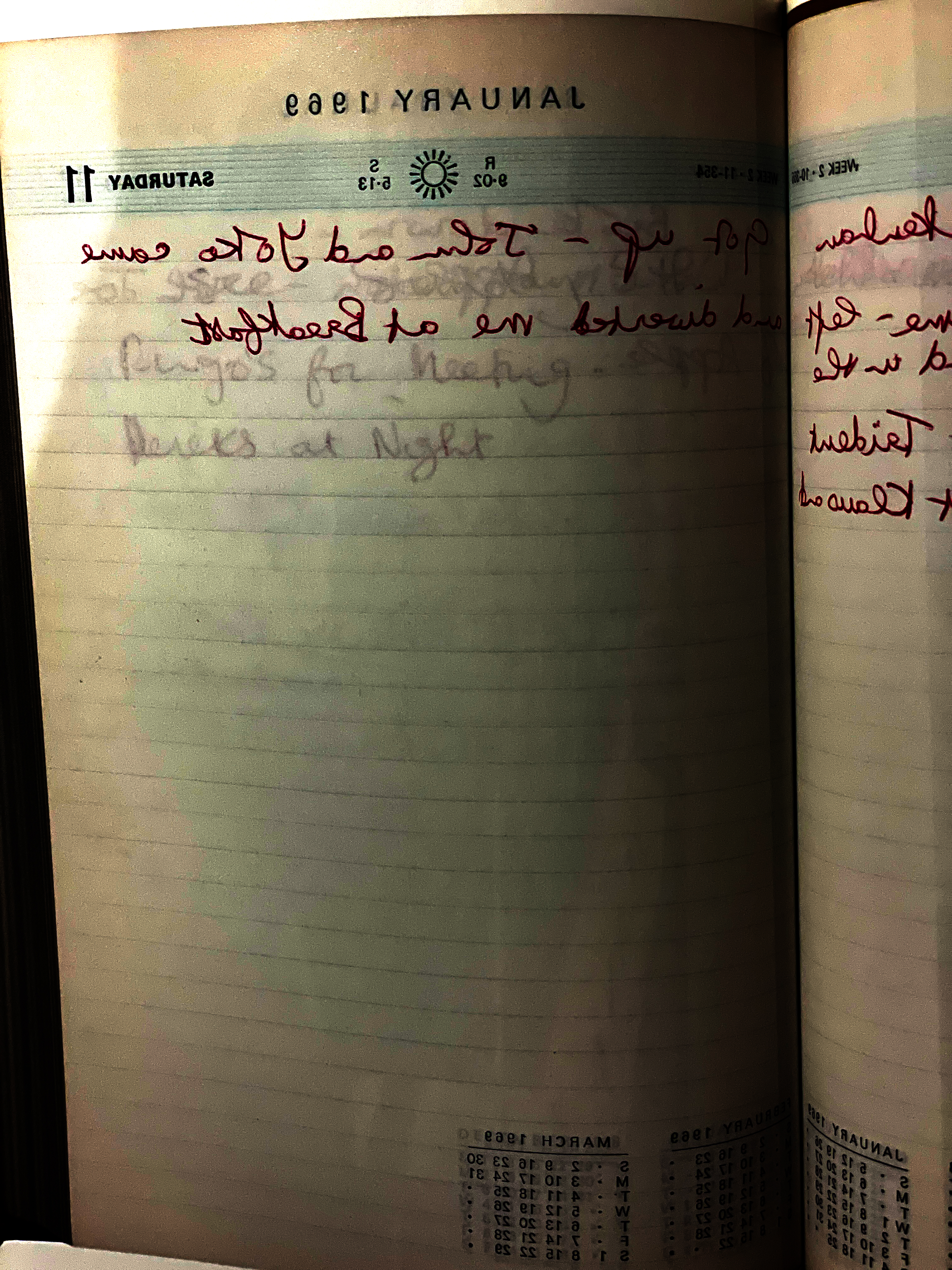
Got up went to Twickenham rehearsed until lunch time – left the Beatles – went home and in the evening did King of Fuh at Trident Studio — had chips later at Klaus and Christines went home.

George’s diary entry for January 10, 1969, as later published in the Living in the Material World book in 2011.

There wasn’t any Twitter in 1969 (although John and Yoko probably would have dominated the platform had it existed), so when George left the Beatles, it didn’t instantaneously go viral. But within days, George’s resignation was widely reported around the world — jumping off an original report by the Daily Sketch (more on their reporting to come in a subsequent post) — though he was already back with the band by the time those reports came out.

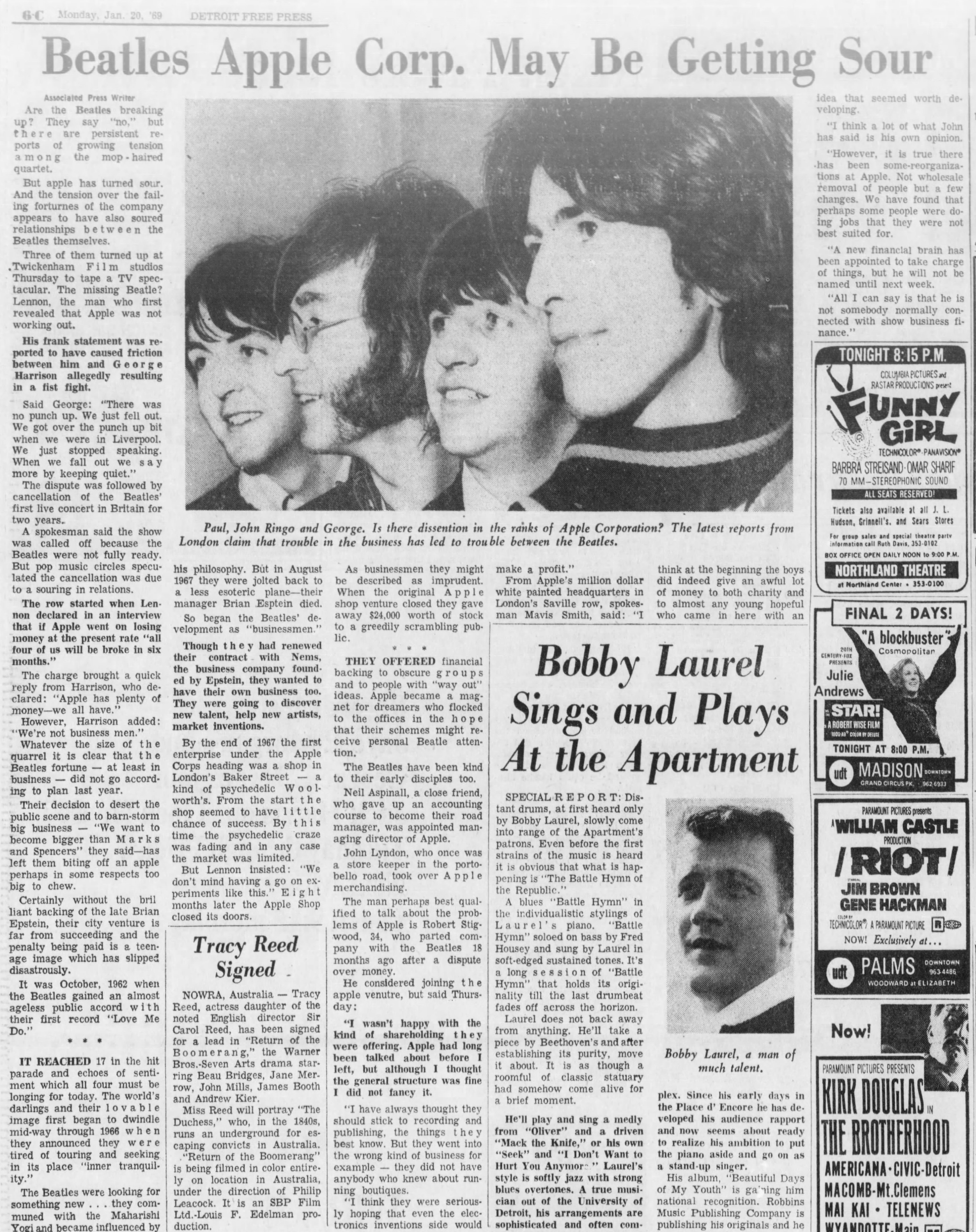
It wasn’t just that George left the Beatles. Word was out that that things got violent.

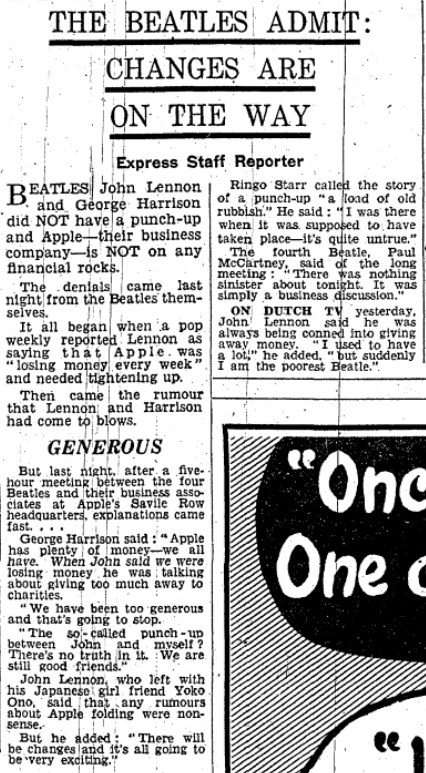
From the Daily Express, January 16, 1969:

Beatles John Lennon and George Harrison did NOT have a punch-up and Apple — their business company — is NOT on any financial rocks.

The denials came last night from the Beatles themselves.

It all began when a pop weekly reported Lennon as saying that Apple was “losing money every week” and needed tightening up.

Then came the rumour that Lennon and Harrison came to blows.

But last night, after a five-hour meeting between the four Beatles and their business associates at Apple’s Savile Row headquarters, explanations came fast.

“The so-called punch-up between John and myself? There’s no truth in it. We are still good friends.”

Ringo Starr called the story of a punch-up “a load of old rubbish.” He said: “I was there when it was supposed to have taken place — it’s quite untrue.”

A few days later, on January 21, Ringo told BBC’s David Wigg that “there’s that famous old saying, you’ll always hurt the one you love,” when he was asked if the group was still close. But he spoke without any specifics regarding George’s departure, just generic reconciliatory language.

“[W]e all love each other and we all know that,” Ringo said. “But we still sort of hurt each other, occasionally. You know… where we just misunderstand each other and we go off, and it builds up to something bigger than it ever was. Then we have to come down to it and get it over with, you know. Sort it out. And so we’re still really very close people.”

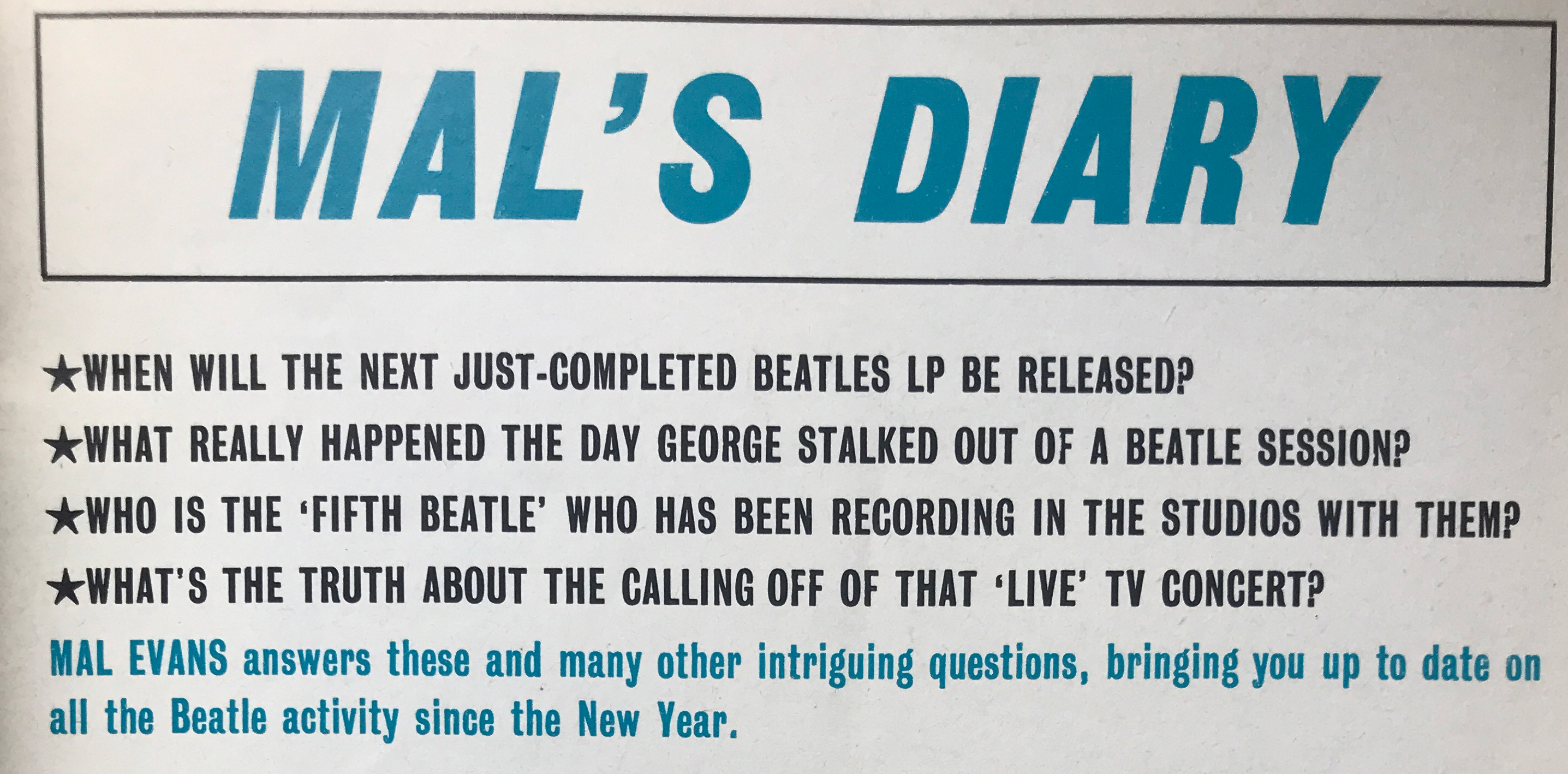
One of the Beatles’ official mouthpieces, the Beatles Book Monthly fan club magazine predictably poured cold water on the idea of a physical altercation in its March 1969 issue. In his diary feature, Mal Evans went as far to write there wasn’t any argument at all when George “stalked” out.

Matching the account on the tapes, Mal said George simply came over during lunch to “quietly” say he was going home. “There WASN’T a fight, physical or verbal,” Mal wrote. “There WEREN’T any tempers or shouting. I just couldn’t believe it when I saw the press afterwards.”

George Harrison maintained in subsequent interviews that no punches were thrown. But another George had another memory.

“They actually came to blows,” George Martin told Phillip Norman in his 2008 biography John Lennon: The Life. “You’d think it would have been with Paul, but it was John. It was all hushed up afterwards.”

Here’s where the retelling of the day’s events descends more deeply into farce.

According to a separate account from EMI engineer Dave Harries, a frazzled Martin only arrived at Twickenham that day as Harrison departed from the studio.

As related in Ken Womack’s Martin biography Sound Pictures:

I remember that George Martin had just backed across the car park in his Triumph Herald and knocked a dent in the door of George Harrison’s Mercedes and he didn’t have time to tell him he’d dented his car before George walked out in a huff and drove off.

Just hours after engaging in passionate car talk, this wasn’t George’s finest hour.

While George Martin was around to some arguable degree that morning (and at the sessions overall), there was no doubt fellow producer Glyn Johns was there on January 10. He was an active participant on the day’s tapes.

Johns, too, wrote of his recollections of that day in his 2014 autobiography Sound Man:

I have a very clear memory of sitting outside in the bleak surroundings of the soundstage at Twickenham on that cold gray afternoon with Denis [O’Dell], the line producer for the film, both of us praying that the elation of being employed for a project with the most successful artist in the world was not about to come to a grinding halt after two days.

It is not my place to discuss any detail of what happened, but it is common knowledge that George left the band and was persuaded to return a couple of days later.

While an implication is there, Glyn wouldn’t spill the beans. Although in Graeme Thompson’s 2015 George Harrison biography Behind the Locked Door, Glyn conceded there may not be too many beans to spill:

When it became apparent that there was going to be a bit of an argument those of us who weren’t in the band left the room. It was clear that it would be intrusive for us to remain. So what actually was said and and what went on I don’t know, but I do know that George left the band that day. The whole thing was very uncomfortable, and it was very embarrassing for me and others who were not in the band to be close by while this was going on — to have to watch this begin and be there in the immediate aftermath. It was very unpleasant and I felt really awkward.

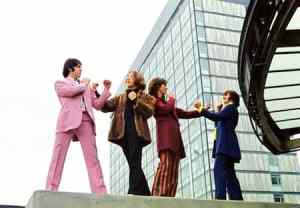
The Beatles pre-enact their January 10, 1969, fistfight more than five months before it probably didn’t happen. (From the Mad Day Out photo session in 1968).

More than 50 years after the fact, what we know with absolute certainty is that George Harrison quit the Beatles the afternoon of January 10, 1969. Everything else — most prominently whether there was a physical altercation — is ultimately speculative.

It’s not just what happened that’s in question, but the why. We’ll never unearth that last straw, the specific reason George quit when and how he ultimately did on January 10. There’s just too much open to interpretation, and as long as the tapes of the day are considered complete, there is simply no smoking gun, no spark that broke George. The conversation with Dick James, the rehearsals of “Get Back” and “Two of Us” — these moments lacked an obvious trigger beyond what were usual pockets of growing frustration.

It’s worth mentioning the other three Beatles openly discussed their feelings and opinions in the wake of George’s departure on the Nagra tapes, directly addressing his growing sense of frustration as a junior member of the group. They were aware of this, and their conclusions were consistent with much of what is discussed below.  I’ll examine those specific conversations, which also touch on off-site meetings, however, in future posts when we reach those days on the blog’s timeline.

Still, by rewinding many of the same sources we examined above in this post to construct what happened, we can put together a loose reasoning as to why George left the Beatles. Notably absent from each of these recollections is the one mentioned specifically in the original flurry of news reports — George’s fury with John over the latter’s comments about Apple’s difficult financial situation. George and John even had light-hearted discussions about business earlier in the day. It seems clear the Apple finances excuse for George’s departure was a leap of faith by the media. Musical and personal differences were responsible.

Back to Mal’s Diary in the March ’69 Beatles Book Monthly:

Singing and playing together would always be fine with [George] and the last thing he was suggesting was any break-up of the Beatles. So that day, January 10, George didn’t want to stay at Twickenham rehearsing for a show he couldn’t believe in.

And what — or who — could make George an such an unbeliever? In published interviews over the subsequent decades, George was at least consistent on why he left: His famed filmed argument with Paul (“I’ll play, you know, whatever you want me to play“) gave him a moment of clarity.

From George’s 1980 memoir I Me Mine:

I remember Paul and I were trying to have an argument and the crew carried on filming and recording us. Anyway, after one of those first mornings I couldn’t stand it. I decided this is it! — it’s not fun any more — it’s very unhappy being in this band — it’s a lot of crap — thank you I’m leaving.

His Anthology interviews, conducted in the early 1990s and first broadcast in 1995, yielded similar memories:

They were filming us having a row. It never came to blows, but I thought, “What’s the point of this? I’m quite capable of being relatively happy on my own and I’m not able to be happy in this situation. I’m getting out of here.’

Everybody had gone through that. Ringo had left at one point. I knew John wanted out. It was a very, very difficult, stressful time, and being filmed having a row as well was terrible. I got up and I thought, ‘I’m not doing this anymore. I’m out of here.’

Paul wanted nobody playing on his songs until he decided how it should go. For me it was like: ‘What am I doing here? This is painful!”

In other words, George’s recollections were colored by the Let It Be movie. He’s just like the rest of us!

George elevated the “I’ll play” argument in a way that other recent encounters, which were also filmed but not included in the final release, did not.

“I’ll play, you know, whatever you want me to play. Or I won’t play at all, if you don’t want me to play. Whatever it is that will please you, I’ll do it.”

Even Paul had the self-awareness to admit his role in George’s departure, saying in the Anthology book with a hilarious parenthetical: “These things had been going down in Let It Be. George leaving because he felt he was being told what to do (I think that’s why he left).”

Ringo was more certain of the reason, going way back. He corroborated George’s accounts in 1971, telling Melody Maker:

George had to leave because he thought Paul was dominating him. [H]e was, because Michael Lindsay-Hogg liked Paul I would think more than the rest of us.

Indeed, George called for a divorce one day after the “I’ll play” argument, but a move to actually leave was delayed. This, as George continued to match Paul in productivity (or come close) during the sessions, certainly lapping a creatively spent John. But it was George’s own songs that were afterthoughts and that treatment deeply affected him.

Paul, though, was not the lone accused party.

Yoko Ono has unjustifiably been blamed for a lot of terrible things over the last half-century. Among the dramatis personae of the Get Back sessions, she was largely out of the spotlight to this point on the tapes, often speaking for John but not fighting for overall attention, certainly not as the group actually made music. And, perhaps by the filmmaker’s design, Yoko was usually off-mic. But since the White Album sessions, she was a disruptive figure to the other three Beatles. While Paul earned his share of the blame, Yoko drove George out of Twickenham, too.

“[S]uperimposed on top of that was Yoko, and there were negative vibes at that time,” George later said in interviews for Anthology. “John and Yoko were out on a limb. I don’t think he wanted much to be hanging out with us, and I think Yoko was pushing him out of the band, inasmuch as she didn’t want him hanging out with us.”

The accusation of bad vibes wasn’t something John quickly forgot. From his famously raw Lennon Remembers interview for Rolling Stone, conducted in December 1970:

George, shit, insulted her right to her face in the Apple office at the beginning, just being ‘straight-forward,’ you know that game of ‘I’m going to be up front,’ because this is what we’ve heard and Dylan and a few people said she’d got a lousy name in New York, and you give off bad vibes. That’s what George said to her! And we both sat through it. I didn’t hit him, I don’t know why.

(Emphasis added.)

George had a stubborn memory, too, to the point of remembering things that didn’t quite happen. From a 1977 interview in Crawdaddy:

There’s a scene [in Let It Be] where Paul and I are having an argument, and we’re trying to cover it up. Then the next scene I’m not there and Yoko’s just screaming, doing her screeching number. Well, that’s where I’d left.

A few years later in I Me Mine, George references “the time in the film where John and Yoko were freaking out screaming.”

There’s only one problem with George’s accounts: There is no scene in Let It Be where Yoko is performing and “freaking out screaming.” She’s hardly in the movie at all, really. But the event in question — Yoko sitting in with the other three Beatles and “doing her screeching number” is an event that did happen.  The original, longer rough cut of the Let It Be film did feature Yoko jamming with the other Beatles, per Peter Jackson, and it appeared in the unreleased pre-Anthology documentary “The Long and Winding Road” (which George was not only aware of, but shared a copy with Eric Idle with as source material for The Rutles).

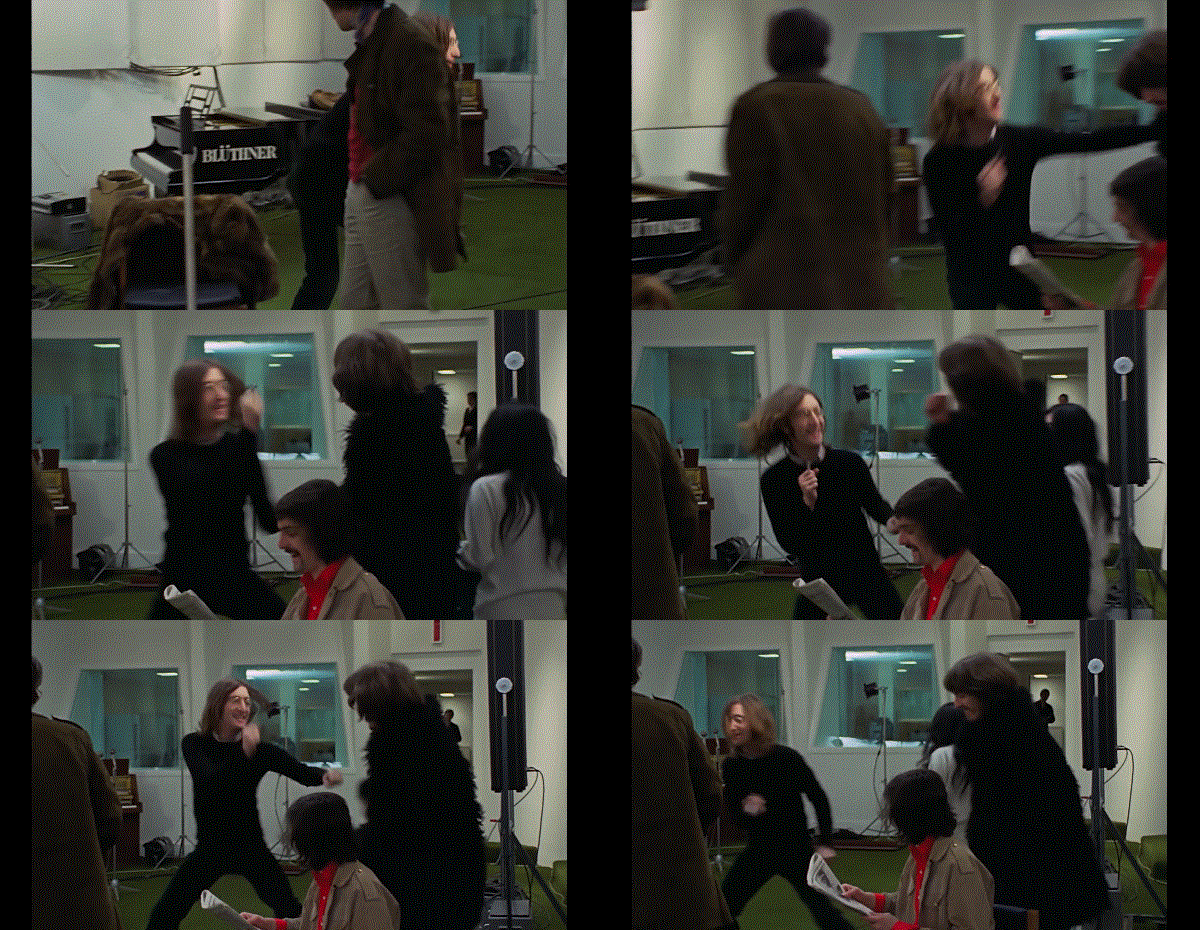
Playful punch-up: John and George at Savile Row after discussing — and denying — any fight between the two. Footage from Peter Jackson’s Get Back.

To the surprise of absolutely nobody who has closely followed the group’s history, the combination of the four Beatles, their associates and the passage of a half century makes for a most compelling but absolutely terrible narrator. Barring the emergence of additional footage or audio, we’ll never know the trigger for George’s departure.  Maybe Yoko did do something specific to put him over the edge (the digestive biscuit episode allegedly happened later, so that wouldn’t be it). Or it could have been something John said — or didn’t say, leaving his opinions to Yoko. Maybe the “I’ll play, you know, whatever you want me to play” argument between George and Paul really did change everything.

Or maybe John had it all figured out for an interview he gave for Earth News in 1976 — a quote later used to great effect in Anthology:

[L]ike people do when they’re together, they start picking on each other. It was like, ‘It’s because of youyou got the tambourine wrong — that my whole life is a misery. It became petty, but the manifestations were on each other because we were the only ones we had.

George’s domestic situation at this precise moment is essential to the story yet is generally ignored. For the duration of the Twickenham sessions, he was estranged from his wife, Pattie, and involved with 20-year-old Charlotte Martin — Eric Clapton’s ex-girlfriend — who was living at Kinfauns with him for the duration of their brief affair.

After George left the Beatles on January 10, 1969, he drove back to his Esher home, ended the affair and began his reconciliation with Pattie. Oddly, those decisions didn’t reach the threshold of snacking with the Voormanns’ to make his diary. It wasn’t a choice of the Beatles or Pattie, but like John suggested, perhaps George’s musical issues were amplified by his marital issues.

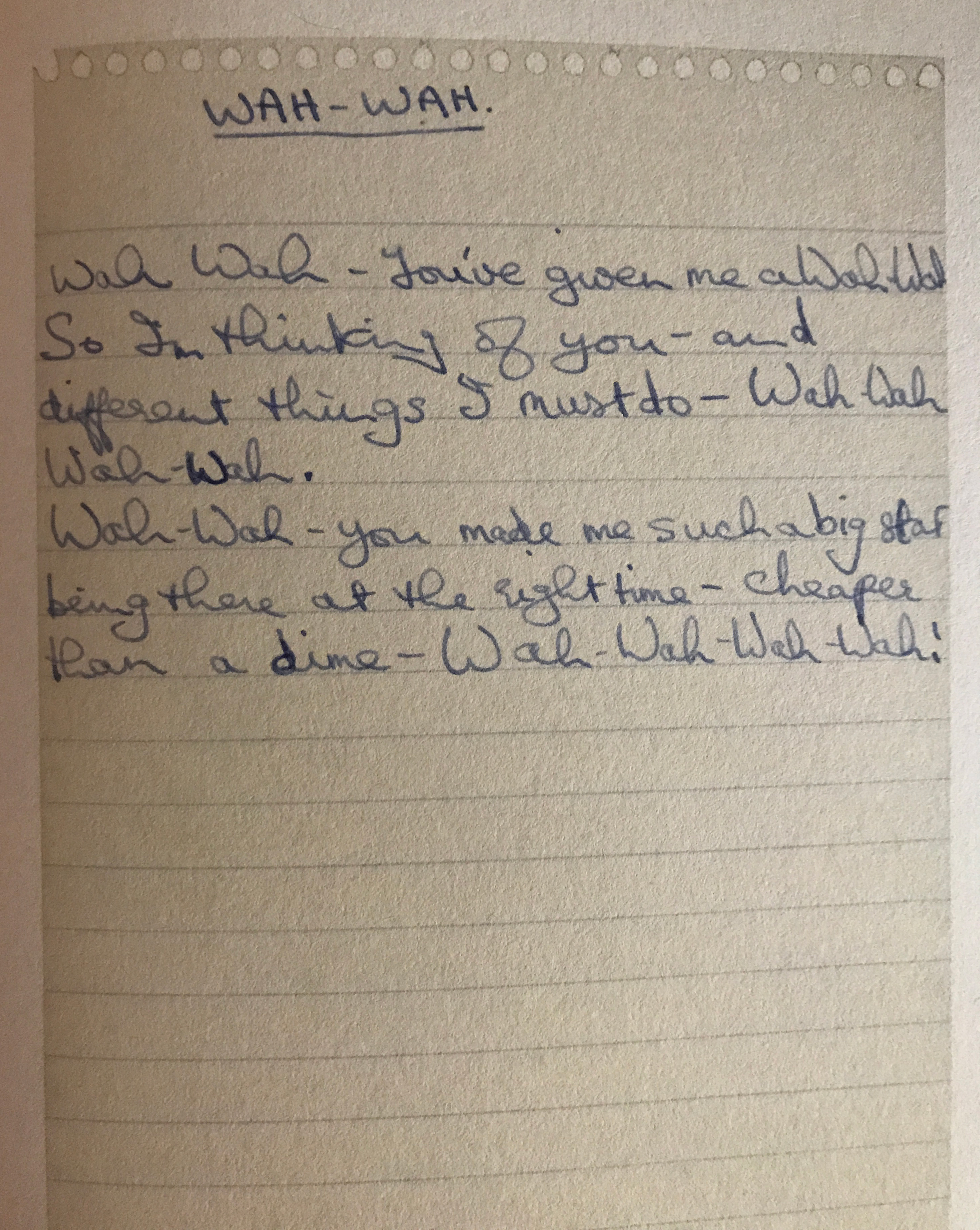
George wasn’t working for the Beatles anymore that afternoon, but he remained on the clock. In his first act as a temporarily liberated solo artist, George played, you know, whatever he wanted to play, and he wrote “Wah-Wah,” which later appeared on the All Things Must Pass LP and was the opener of his first solo performance, at The Concert For Bangladesh. George couldn’t have found  a more symbolic beginning to his stage debut as a solo headliner, opening with a song born from his first independent moment.

“‘Wah-Wah’ was a ‘headache’ as well as a footpedal,” George later wrote in I Me Mine.

George’s hand-written lyrics to “Wah-Wah.” (Published in I Me Mine)

“It had given me a wah-wah, like I had such a headache with that whole argument,” George told Crawdaddy in 1977.

“It was such a headache.”

Professional clashes with Paul, personnel issues with Yoko (and John), personal crises with Charlotte and Pattie — these were all reasons George left the Beatles. If Paul wasn’t so pushy, maybe it would have made dealing with Yoko and the problems at home easier. If Yoko wasn’t so ubiquitous and John withdrawn, maybe George could work more easily with Paul with one less work distraction. If George’s marriage was fine, maybe he could have slogged through the work day, more easily accepted his continued junior role and at least had an opportunity to unwind and unload in a relaxed home.

But each of those factors played off the other. He’s just like the rest of us.

38 Comments

Filed under Day by day

Jan. 9: Crossroads he’s standing at

During a brief transition immediately preceding the extensive “Let It Be” session late on January 9, 1969, George Harrison opened himself up to significant, retrospective armchair psychoanalysis in just five minutes of music.

He also became a human bootleg.

Everybody’s got somebody to lean on: Lucky and Nelson, November 1968.

Bob Dylan’s Basement Tapes with the Band (a huge influence on the Beatles’ Get Back sessions) had been privately circulating since 1968, and the first true rock bootleg — Great White Wonder, which featured two LPs of his music that stretched back to as early as 1961 — surfaced in record shops starting in July 1969.

But this January 9, George — just a few weeks removed from his first collaboration with Dylan — seized a few moments of spotlight and shared a few of his friend’s songs, and ones that the others in the room hadn’t likely heard.

“I Threw It All Away” was so fresh a cut, Dylan wouldn’t record it for his forthcoming “Nashville Skyline” until Feb. 13, precisely two weeks after the Beatles’ rooftop performance and while George was in a London hospital recovering from a tonsillectomy.

Dylan first shared the song with George and wife Pattie Boyd around Thanksgiving 1968 at his home in upstate New York. George retained quite a bit of the song in performing at Twickenham, injecting intensity in his solo acoustic take.

George didn’t perfectly nail the lyrics, but he captured guts of the chorus and parts of the verses — “No matter what you think about it, you just can’t do without it. Take a tip from one who’s tried … And I threw it all away.”

The performance seamlessly went into “Mama, You Been On My Mind,” written in 1964, but to that point another unreleased Dylan track.

Perhaps it’s the color of the sun cut flat
An’ cov’rin’ the crossroads I’m standing at
Or maybe it’s the weather or something like that
But mama, you been on my mind

When you wake up in the mornin’, baby, look inside your mirror
You know I won’t be next to you

There could be no reason at all George plucked these songs out of thin air this Thursday afternoon, as meaningless as the group’s brief forays into “Tennessee” or “Slippin’ and Slidin‘” within the same hour. He’d been playing Dylan throughout the sessions, after all.

Or …

Maybe the songs reflected George’s mood as he was less than 24 hours from quitting the group. Paul transparently sang the blues about the Beatles in “The Long and Winding Road,” “Let It Be” and “Golden Slumbers,” so why wouldn’t George do likewise? It’s not a significant stretch to consider George was speculating about what he was throwing all away, at these crossroads he was standing at.

Without question, those two Dylan songs did hit home with George.

But …

Maybe it wasn’t necessarily only for the reasons we’ve always supposed.

The January 9 tapes begin with the Paul’s muse, Linda Eastman, visiting the studio. John’s girlfriend, Yoko Ono, had been a Beatles session fixture for months, and this day was no different.

George’s wife, Pattie, was very much not hanging around Twickenham. And when she looked inside her mirror, George wasn’t next to her, because she had walked out on him. But that didn’t mean he was alone at his Kinfauns home.

From Pattie’s autobiography Wonderful Tonight:

I was friendly with a French girl who was going out with Eric Clapton. She was always flirtatious with George, but so were a lot of girls and he, of course, loved it. Then she and Eric broke up — Eric told her to leave — and she came to stay with us at Kinfauns.

It was January 1, 1969, and George and I had seen in the new year at Cilla Black’s house. … We arrived home in good spirits but then everything went swiftly downhill. The French girl didn’t seem remotely upset about Eric and was uncomfortably close to George. Something was going on between them, and I questioned George. He told me my imagination was running away with me, I was paranoid.

Soon I couldn’t stand it so I went to London to stay with Belinda and Jean-Claude. Six days later George phoned me to say that the girl had gone and I went home.

The French girl was 20-year-old Charlotte Martin, and she had been dating Eric for more two years. Eric has since said he left Charlotte because of his growing feelings for Pattie. Why, you can almost say George tried to give her consolation when her old man let her down.

George’s fling was in its final day on January 9 — and after leaving the Beatles the next day, he asked Charlotte to leave Kinfauns, ending the affair.  He would  reconcile with Pattie, and separately, with the rest of the Beatles shortly thereafter.

The two Dylan songs George touched on wouldn’t drift far from his consciousness. Sixteen months after this date, George joined Bob in New York City, where they recorded both “I Threw It All Away” and “Mama, You Been On My Mind,” and the sessions have since surfaced on bootlegs.

George continued to show love for “Mama, You Been on My Mind,” laying down a solo studio version in the 1980s; this was still before Dylan’s first authorized release of the song in 1991. George’s recording would get a proper release in 2012 on Early Takes, Vol. 1.

From Giles Martin, who produced the compilation:

He recorded it at home in Friar Park at some point during the ‘80s, and it originally had programmed drums and loads of keyboards on it, and George had overdubbed himself for a three-part vocal harmony.

I asked [George’s widow] Olivia if it would be OK to break it down a bit, I thought it sounded a lot better stripped to its bones. You can still hear a bit of the drum sound in the background, because there was bleed on the tape — probably coming through from George’s headphones.

George did his own three-part harmonies in the ’80s, but his first vocal partners, John and Paul, were silent on the tapes during George’s brief Dylan set on January 9, 1969.  Walking out on the group, George silenced himself the next day, not only because of his increasingly tense relationship with John and Paul, but with trouble surrounding his marriage, as well.

***

Charlotte Martin remained in rock-and-roll’s inner circle. In a coincidence of the calendar, exactly one year after her last day involved with George, on January 9, 1970,  she met Jimmy Page after a Led Zeppelin concert. The couple would maintain a relationship into the 1980s. Their daughter, Scarlet Page, is a rock photographer of note; she’s shot Paul McCartney and contributed to the Visions of Dylan photo exhibition in 2007.

11 Comments

Filed under Day by day

TMBP Extra: Oh what joy

With birthday posts previously produced for Paul McCartney, John Lennon and George Harrison, it’s about time we righted a wrong, and completed the set with the man born as Richard Starkey. Like the others and in the spirit of this blog, here’s a look at Ringo Starr’s life as it straddled the big days circled on the calendar in 1968 and 1969.

Ringo Starr, 1969

How did you spend your 29th birthday? Ringo Starr, the eldest Beatle, spent July 7, 1969, at EMI Studios on Abbey Road — like he spent so many of days in his 20s — laying down the drum track for “Here Comes The Sun.” We’ve all been stuck working on our birthdays, but this doesn’t sound like a bad gig, if you can get it.

Yet, 11 months earlier, Ringo gave up that gig, walking out on the Beatles during the White Album sessions.

From the Anthology book:

I left because I felt two things: I felt I wasn’t playing great, and I also felt that the other three were really happy and I was an outsider. I went to see John … I said, ‘I’m leaving the group because I”m not playing well and I feel unloved and out of it, and you three are really close.’ And John said, ‘I thought it was you three!’

So I went over to Paul’s and knocked on the door. I said the same thing: ‘I’m leaving the band. I feel you three guys are really close and I’m out of it.’ And Paul said, ‘I thought it was you three!’

I didn’t even bother going to George then. I said, ‘I’m going on holiday.’ I took the kids and we went to Sardinia.

He famously returned two weeks later after to a flower-covered drum kit as the sessions continued (they never stopped recording, with Paul filling in on drums for a few songs).

Still, Ringo’s time away was fruitful, spent on Peter Sellers’ yacht, where the captain told him stories about octopuses on the seabed.

A couple of tokes later with the guitar — and we had ‘Octopus’s Garden’!

Ringo’s relationship with Sellers — a member of The Goon Show, beloved by the teenage future Beatles, and whose novelty records had been produced by George Martin — dated back a few years and would benefit the drummer in several ways in the decade’s final years. In November 1968, Ringo took advantage of a Sellers’ market, moving into the actor’s former Brookfield House estate in Elstead, Surrey. Just a couple months later, the two would co-star in a movie. But first, Ringo had another movie to film with the Beatles.

Ringo’s resistance to go abroad during the Get Back sessions — he was most insistent of any of the Beatles — led to the beauty of the rooftop performance. This blog’s entire purpose is to tell that story.

Musically, Ringo did Ringo things in the January 1969 sessions, and as a songwriter, he continued work on “Octopus’s Garden” (as seen in the Let It Be film) and also brought a few unfinished songs to the table, too.

But the sessions were just a warm-up for what came next at Twickenham Studios, where Ringo — teamed up with Sellers — filmed The Magic Christian, his first true starring role (Ringo had a small part playing a Mexican gardener in Candy, which was released in this period, too). This took time, with filming running from February into May. The film would be released in December 1969.

Let It Be — the film and the record — wouldn’t see a release until 1970, a few months before Ringo turned 30. But the Beatles weren’t finished yet in the wake of those sessions. “Octopus’s Garden” would be formally recorded in April 1969, although recording for Abbey Road, to this point sporadic, wouldn’t get into full swing until July.

In December 1969, Ringo said in an interview with the BBC that “I want to be a film actor. I don’t want to be like Cary Grant or one of them who, like, really do the same performance in everything, and the story is the only thing that changes.”

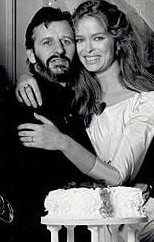
Ringo & Barbara at their wedding

That may be the biggest takeaway in the career of Ringo Starr between July 7, 1968 and 1969 — because he did look at life beyond, or at least in addition to, the Beatles and rock and roll. Without the songwriting gifts of John, Paul and George, Ringo applied his natural charm to film, and was finally able to step fully out into the spotlight and marquee, without other Beatles to his side, or front. And while he was successful in the early 1970s with his solo career, he remained active on the screen, too, even if it wasn’t to that same critical or commercial success.

If you judge success by the bigger things in life, however, Ringo’s foray into film couldn’t have been any more fruitful. A few months before his 40th birthday, in 1980, Ringo filmed Caveman, starring alongside model Barbara Bach. After meeting on the set, they would wed a year later, and have been together ever since.

2 Comments

Filed under Extra