Tag Archives: Glyn Johns

Jan. 13: Picasso’s last words

At the conclusion of the 1956 French documentary “Le Mystère Picasso,” the grand old painter splashed his iconic signature on a print and announced (translated to English), “That’s the end.” He wasn’t bargaining with director Henri-Georges Clouzot, himself considered a master in his field. It was a declaration: This film was over.

Pablo Picasso’s paintings and his exhaustive creative process were the focus of the film, his hand usually invisible as it brushed across a transparent screen, at times in black and white, and at others in vibrant color. In the film, Picasso produced several completed paintings, and we catch occasional glimpses of him at work, creating art out of nothing in an spartan studio while holding an occasional dialogue with the film’s director. This should sound familiar.

Paul McCartney had a few occasions to come across the film. It was screened in Liverpool in June 1958, when Paul turned 16 and was nearly a year into his creative partnership with John Lennon. But odds are Paul saw it sometime between late January and March 1967, when the film was shown at the Academy Two in the West End, about 2 1/2 miles from where the Beatles were recording Sgt. Pepper’s Lonely Hearts Club Band and a very short walk from other frequent haunts like the Saville Theater and the Bag O’Nails. (The documentary was broadcast on BBC-2 in May 1968, as well, but Paul was in New York at the time).

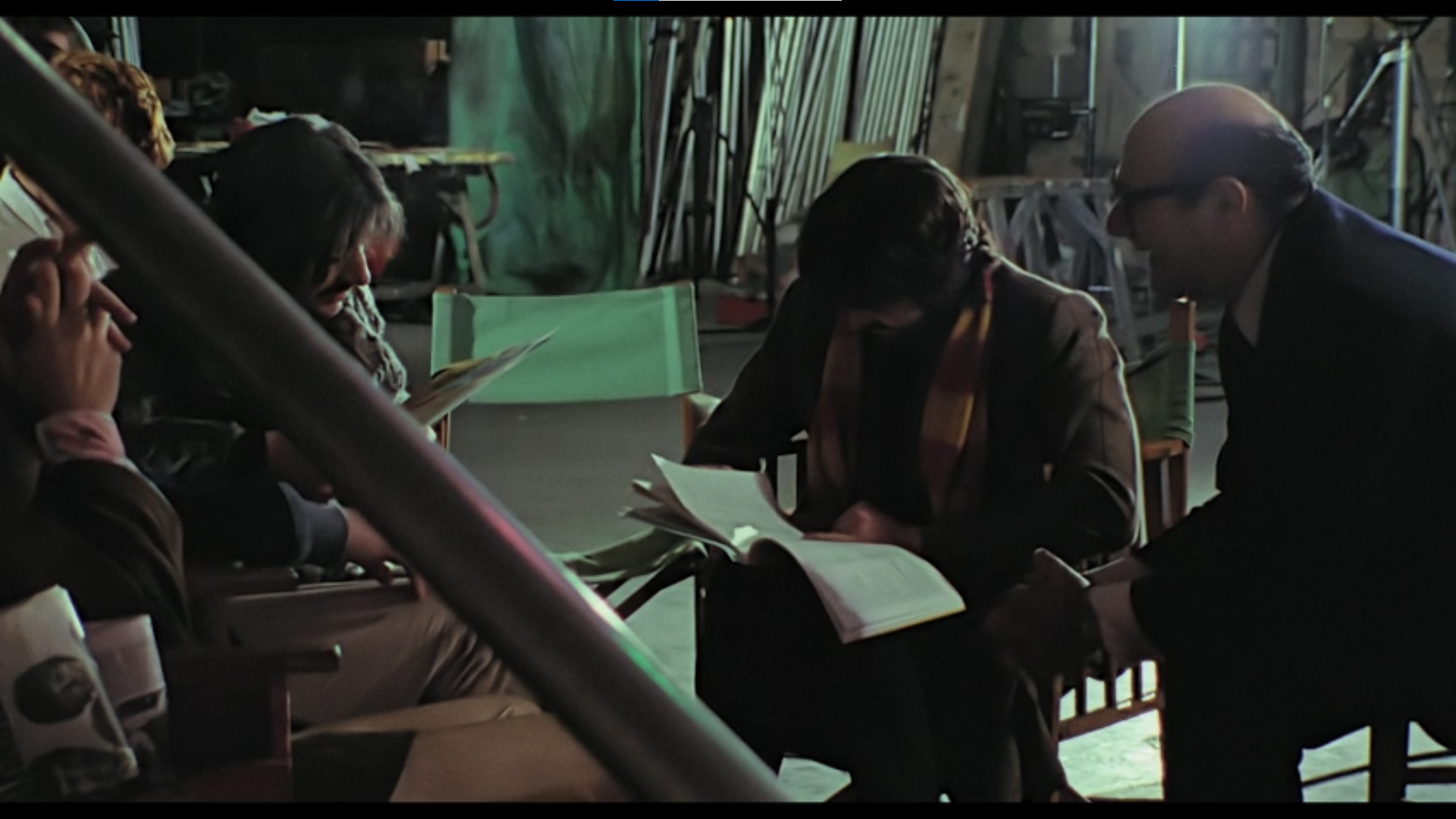
One of several films considered a reference point in the early afternoon of January 13, 1969, “Le Mystère Picasso” was mentioned by Paul as an inspiration to Michael Lindsay-Hogg, who was in the midst of directing what became known as the Beatles’ Get Back project.

“They don’t sort of fast-cut the paintings,” Paul said to Michael. “And these songs are going to be our paintings at the end of it.”

The endgame for the Beatles’ documentary of the creative process was unclear even as the documentary was underway. And unlike Picasso, here the creative powers continuously bargained with the director.

That Paul, with a comparatively quiet Ringo Starr, would even waste time debating with Michael speaks to the confidence the band had to to see out this project.

Yes, yes, and then there were two. So what, the show must go on. And that’s why the Beatles were at Twickenham Film Studios to start 1969, after all: to stage a show. The rhythm section was in tow relatively early that Monday. Of the missing half, one member had already decisively quit while another was frustratingly unreachable.

Having recapped the previous day’s difficult meeting that saw George Harrison ultimately walk out in large part due to the disruptive dynamic between John and girlfriend Yoko Ono, the present conversation only looked ahead.

This initial sequence first appeared on film in the 2021 Get Back docuseries.

“If we were going to take a ship’s pool on what our communal life is going to be in the next two weeks, what are we all betting?” Michael, in his imitable way, asked Paul and Ringo.

Paul shared his hopes the current state of limbo would only be temporary. “I think we see the end of this week out,” he said. “And something will have happened, definitely. … Then we’ll say that we don’t come in next week and we sort of chuck it. Or, we come in next week, and .. make it next week.”

“Then we send the guys off to Africa,” Michael chimed in, to laugher.

Paul continued, laying out the actual logistics.
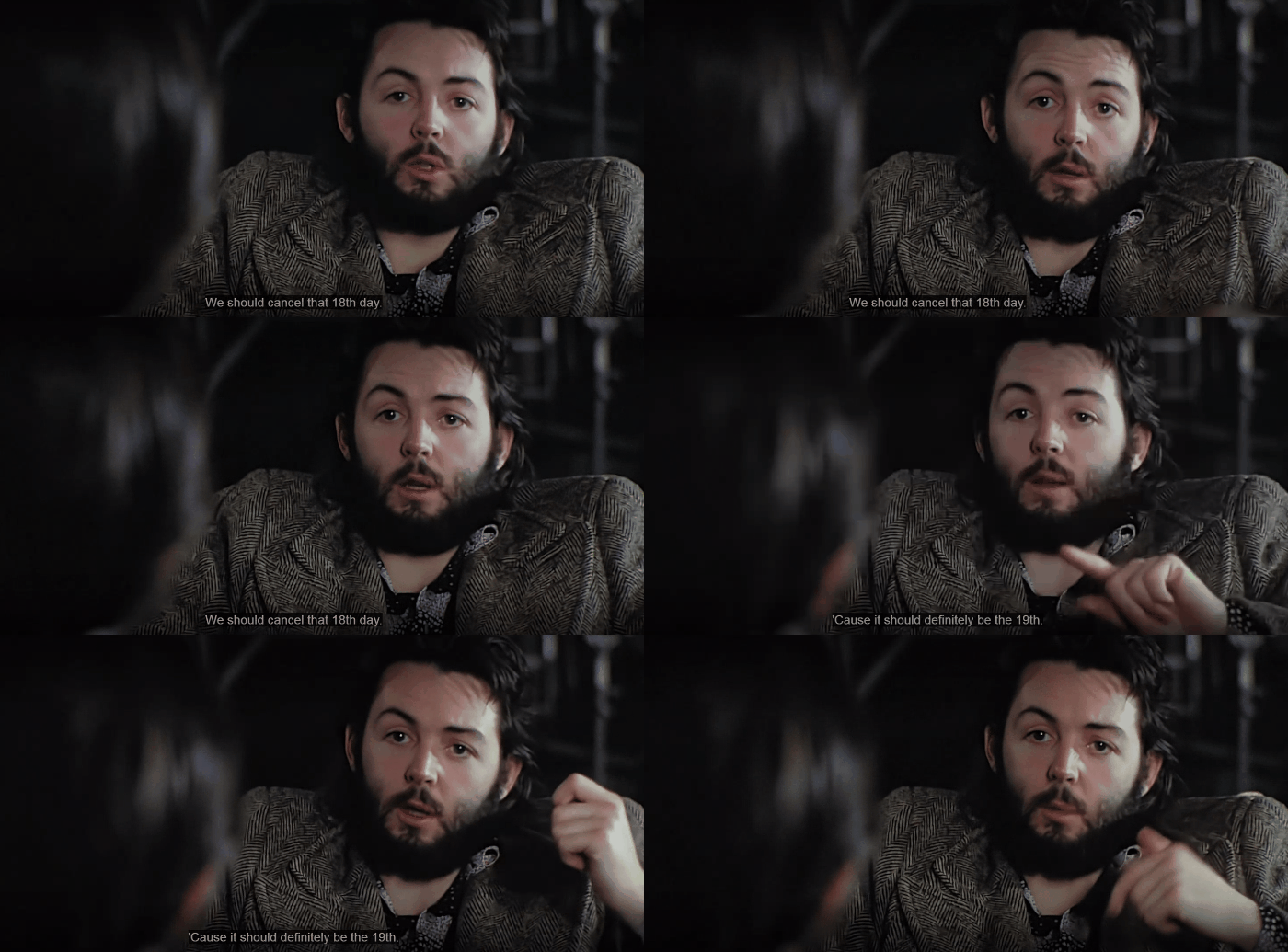
“We’ve got to stop the clock while this is all going on. Like, this isn’t counted. We should cancel that [January] 18th date, ‘cause it should definitely be the 19th already, ‘cause we’re going to lose today.”

Timing mattered, and so did location.

“We should do it here,” said Ringo, again. His desire to stay in England was a true constant in January 1969, and he only briefly toyed with the idea of traveling a few days earlier. But that was then, and now, there seemed to be true consensus on staying put at Twickenham or nearby — and that included the better halves.

Paul: I don’t really see any point anymore [in going overseas].

Ringo: There were eight of us who didn’t see any point.

Paul: And luckily we’re the Beatles, who don’t see any point.

As had been the case for nearly two weeks, while they may not have known what they wanted out of the show, they knew what they didn’t want. At least Paul knew, speaking on behalf of Beatles present and otherwise unavailable.

At once a touchstone and a millstone, the Rolling Stones’ Rock and Roll Circus was filmed a month earlier in London under Michael’s direction and with John as one of the performers. Paul, who had seen an early cut of the film — it wasn’t released commercially until 1996 — made clear the fast-moving Circus wasn’t a format he wanted to follow, continuing to deflate Michael.

“It didn’t look right,” Paul said. “I know it was a bad print. But like, I didn’t ever get into any one of the Who. Ever. It was the event all the time. And no one digs that. That’s over, that sort of event, I think. It really is now, if you’re trying to show him, I just really say just stick [the camera] on him.”

A “study.”

That’s what Linda Eastman suggested, and Paul repeated.

Here’s where the conversation turned to “Le Mystère Picasso” — it showed up as “The Picasso Mystery” in British movie listings. Anecdotally, Paul called it “Picasso Paints.”

Michael contended the documentary the Beatles were filming — not the grand finale concert, wherever it may be, but this ongoing build-up — was the study, but Paul suggested the examination should extend into that live performance. He saw “Le Mystère Picasso” as analogous to this Beatles concert.

“They didn’t sort of fast-cut the paintings or anything,” Paul said to Michael, who was also familiar with the film. “He just sort of painted them. They showed how he built up, and they stayed on it.”

There’s a bit of a straw-man argument going on, since Michael never contended he should litter the film with quick cuts. To the contrary, he complained about that very technique in the recently broadcast Cream Farewell Concert.

Paul brought it back to the Circus, and justifiably, as it was Michael’s most recent production and featured fellow A-listers.  It wasn’t just contemporary, but it was competition. (And perhaps moreso personally so for Paul, with John having been a Circus performer). January 1969 had seen a lot of wandering discussions on where a Beatles concert should be. Here Paul — speaking over Michael — explained how he thought it should look, regardless of location.

“Very, very bright lights, so you see every detail about [Ringo], instead of moody things. Really totally bright-lit, it hardly needs scenery or anything. Really should be about him and his drum kit. … Says it all.

“And then John: his amp, his guitar. Actually sitting there, doing it at that minute. I think if you start going in that direction, then, I think you might think of a great idea. ‘Oh, incidentally, we think it all should be done in a black bag or something.’”

Michael pushed back, saying the Circus had a very deliberate design.

“You can’t compare the two,” Michael said. “The Circus was designed as an event. It was a different concept. The Rolling Stones needed a family show, and Mick [Jagger] wanted a family show. Mick said he wanted Ed Sullivan without Ed Sullivan.”

I’ll leave the analysis of Mick’s motivation to the Rolling Stones writers and researchers (free blog name suggestion: “Traps for Troubadours”). Those intentions, though, eventually impacted the Beatles’ decision-makers.

“You don’t go off Ringo,” Paul clarified. “Don’t go off into the scenic backgrounds. Or the audience. Or the moon. It’s not necessary.”

Swept up in the vision, Linda said, “God, you have it. Ooh.” Overwhelmed by the very thought of the Beatles, she quickly giggled before regaining her composure. Linda wore her love of the Beatles on her sleeve. It went beyond her personal affection for Paul.
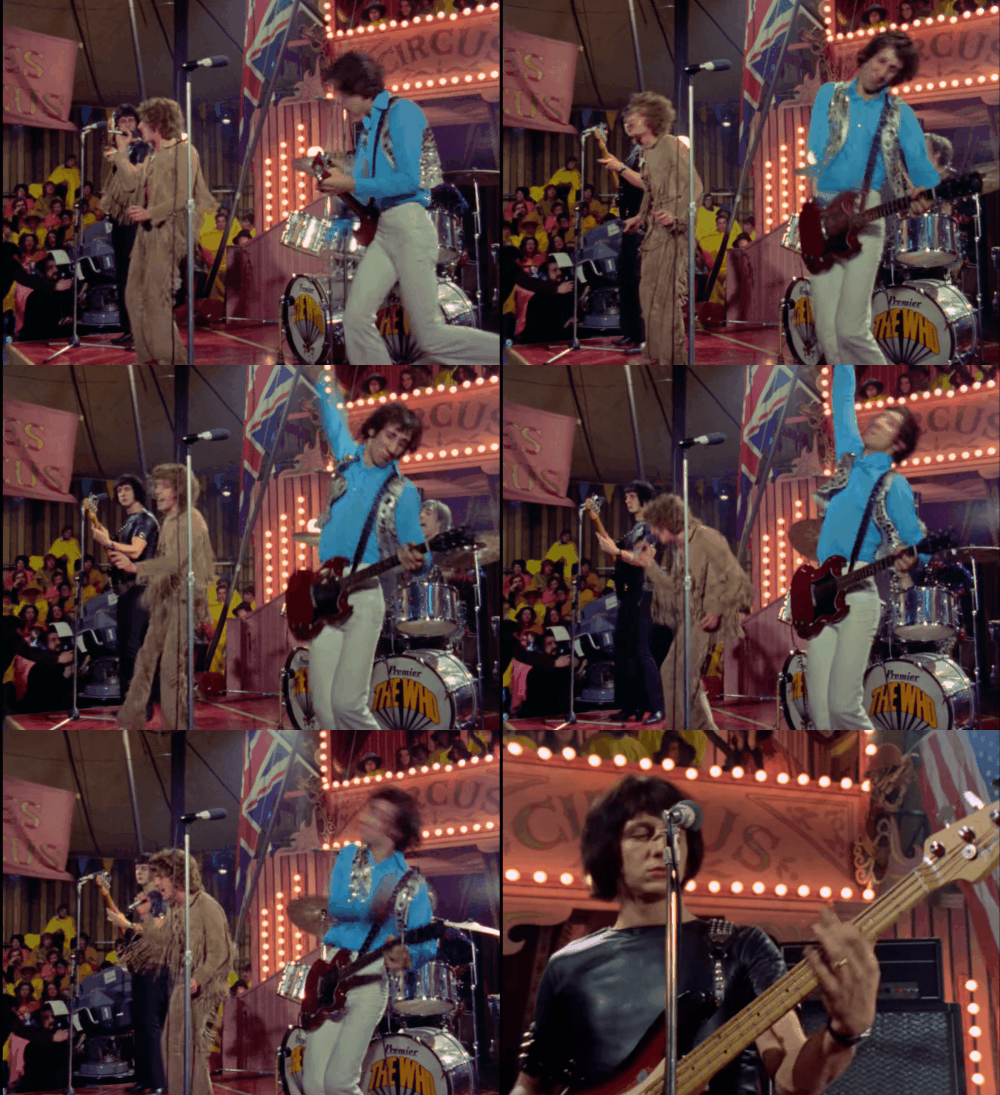
Paul’s right: Michael did cut away from Pete Townshend as soon as he finished the windmill. (From Rock and Roll Circus)

“I missed a lot of that Who thing the other day,” Paul continued, with Linda occasionally interjecting and overlapping her agreement. “Pete Townshend, I never saw him. I’d really like to look at him for a long time cause he fascinates me. … I’d like to really just see what he looks like after he’s done that thing (presumably his windmill guitar move). …

“You know, [I’d like to see] Keith Moon just sort of jabbering away on the drums, just for a whole number almost. OK, so you’re going to have to cut between the four of them. But it’s just that thing, really sticking with it. And I think that’s the point of this show, for us.”

Paul evoked the news again.

“The really good coverage is the shot of the fellow with the gun to a head, and the fellow who got that [camera] shot, that was the man who covered the event,” Paul said a few moments earlier. “The fellow who got the guy on the ground afterwards with the blood coming out of his head missed it. And with all that fast-cutting, [you missed it].”

Less gruesome comparisons continued. It emerged as the best way for the director and the talent to triangulate an acceptable idea for their own production:

Top of the Pops: Michael said “they never help the act. … If you just take a wide shot of [the Who] doing their act, with no particular response from the audience, they do look like they’re lunatics, but the wrong kind of lunatics.”

Ringo brought up a recent appearance from Crazy World of Arthur Brown, whose single “Fire” hit No. 1 in Summer 1968, to prove this point. “The camera needs to do something. And Arthur Brown, every time he came on … he’s so wild, and the camera’s going wild so you didn’t see anything.”

The “Hey Jude” promo film: “The comment about ‘Jude’ was that when I was doing those high bits, you didn’t see me doing them,” Paul complained to its director.

Michael, for his part, expressed regret at how the sequence turned out.

“I physically couldn’t get a camera onto you because they couldn’t hear the talk-back,” he said, referring to communication with his crew. “I should have been ready for that, but it was a mistake.”

An excerpt from “an old film” on TV the night before (probably something shown during Film Night on BBC-2): “They came down on the rooftops of Paris,” Paul said, with Glyn and Michael saying they saw the same sequence, too, at 11:15 p.m.

“And that’s really where this should all be at Twickenham. This should totally be built like those film sets. So that you can glide all over the place like on tracks and everything with your cameras, go to places that TV cameras don’t go. So you can come down out of that roof, on one long shot, right from the back there, and just come down on a thing. Slowly, like a chair lift, right down, right into Ringo’s face on the one shot, from right back from there. It’s like the old films, and have all sorts of cranes and lifts and stuff for your cameras to float around us. And just all that flowing movement. And then the songs, you know? And just really stay with us. And then that’ll create your sets then, you’ll have cameras hanging all over the place.
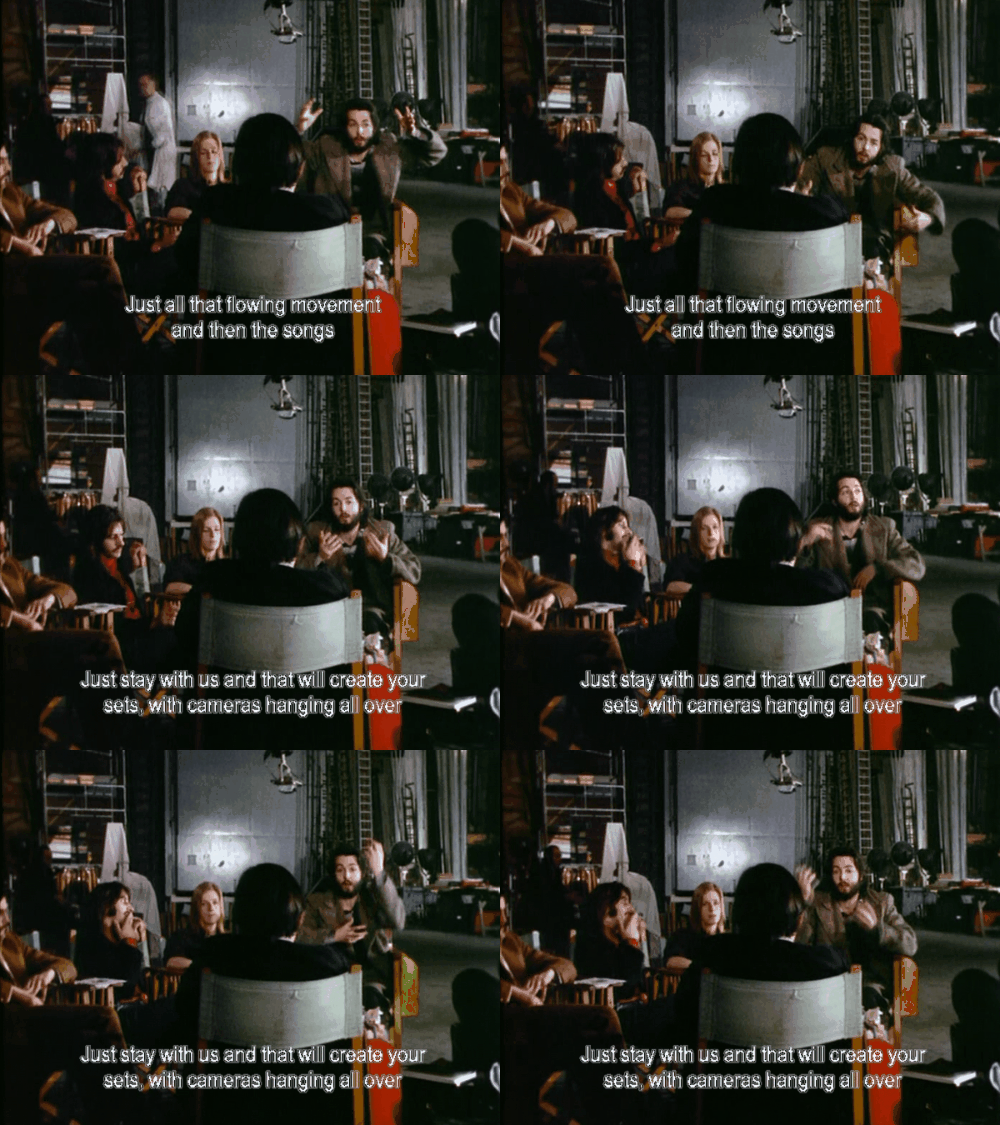
From Anthology

If that sequence sounds familiar, it should: It was included in the 1995 Beatles Anthology documentary. It was not included in Get Back more than a quarter-century later.

Linda continued to be unable to resist the Beatles on film, even as she sat with them in person. “Mmm, but just them,” she said.

Andy Warhol’s Empire: This was a cautionary tale. It’s one thing to linger on Ringo’s drum kit for a three minutes. It’s another to have a single, black-and-white shot of the stationary Empire State Building for eight hours.

“That idea of slowly getting into the thing and being careful not to miss anything … I really do think you’ll find the pace is there without you having to put it there,” Paul tried to explain. “It’s like with Warhol’s things is that he does go right in to the other extreme. He reckons his pace in that Empire State [sic]. But I wouldn’t agree with him, I’d think he’d be boring, but I see his point.”

Glyn does too, but he falls in with Michael, arguing that a slow study could work for a few songs, but not for a 52-minute show.
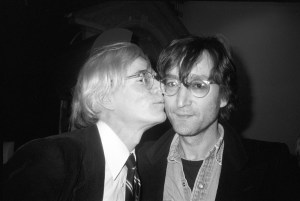
Andy and John, 1978. (Photo by Christopher Makos)

“If we’re doing that, then I really think we should do galloping horses and really go the whole hog and really have an epic,” Paul replied. “But if we are going a bit towards the Beatles, I really think get the close-up lenses and get right into one of John’s eyes. Can you do that? Look in that direction rather than trying to get a picture of John and the moon or a big amphitheater.”

It was at this moment — not Paul’s “and then there were two” line but around 15 minutes later — Paul exits the stage to speak to John on the phone.

Deep as the Nagra tapes go, and despite Michael’s prep to bug the phones, we don’t know what was said on the call. We do know the conversation continued without Paul. The top storyline coming out of the meeting at Ringo’s the day before was the frustration of Yoko speaking for John. Here, in Paul’s absence, Linda doesn’t just speak in line with Paul, but she advocates for herself, too. This sequence appears in part in Get Back.

“I have never seen a study of any musical event,” Linda said. “You want to be there, that’s the thing. (Speaking forcefully) And if I were there, I’d be staring at them. I’d never look around me once. I’d be staring at them if I were sitting in the audience. It’s like you see in the theater. Why can’t the camera be you sitting there?”

Linda’s tone is outspoken and sincere, and something that was needed to move the conversation forward, her viewpoint as an artist and a fan. It clearly put Michael at unease and somewhat on the defensive in what emerged as something of a tense, sarcastic exchange that didn’t go unnoticed 52 years later in Get Back.

MLH: I saw their last concert at Hammersmith … and I was totally aware of not only them, and they were 40 miles away [sic], but the audience, the screams, the lights.

Linda: We looked at Help! the other night again and Hard Day’s Night. And that was them playing.

MLH: Right, but it was them over an hour and a half and 30,000 [feet high]. If it is an Andy Warhol picture …

Linda (fed up and combative): Oh, don’t take the other extreme! Andy Warhol, that’s not you! .. I’m speaking like a fan! I really am.

MLH: I am too. I’m a bigger fan than you are (said laughing, and with complete sincerity)

Linda (gruffly): Oh, OK should we fight about it?

MLH: I can do it any way. But being the fan I am, I gotta keep saying I think you’re all wrong.

Linda: You want to be too sophisticated.

MLH: We ran the Circus the other night, and it’s so simple. I’m the least pretentious director you’re going to meet.

While Michael said that last line straight, it was met with laughter around the room.
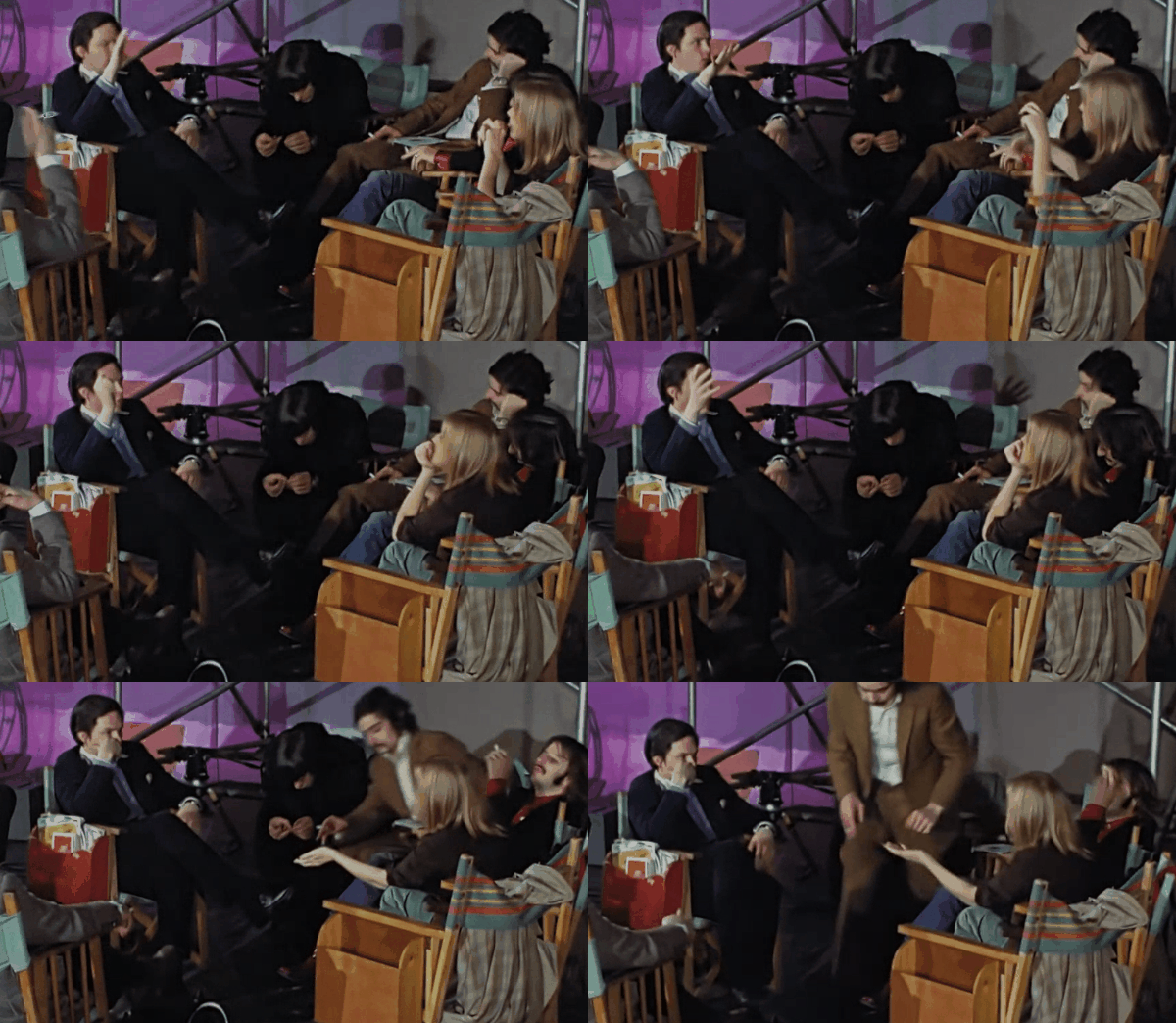
Let’s just watch on a loop Linda’s body language while she talks to Michael. (From the Get Back docuseries)

This is a real argument between two artists, a photographer and a film director, with legitimate differing visions. And no one held a higher status. Linda was just 27 (older than Paul and Ringo). Michael was 28. Each had about the same amount of professional experience at their respective trades, only a couple of years.

Paul returned after a phone call that couldn’t have lasted more than two minutes. Seeing his return, as shown in Get Back, is one of the great revealing moments in the documentary and something you never could have heard in a lifetime studying the Nagra tapes.

To this point, Paul spent the morning still in his overcoat. At any point, everyone could have called it a day and cut their losses. George wasn’t coming back. But when Paul dramatically — and joyously — removed his coat, revealing his magnificent black shirt, it was clear John wasn’t a issue.

“He’s coming in,” Paul said simply.

It’s a big deal, and the visual — of which we are now aware — really brings it to the forefront (if you’re looking for it). The Nagra tapes tell a lot, but audio alone can’t tell everything.
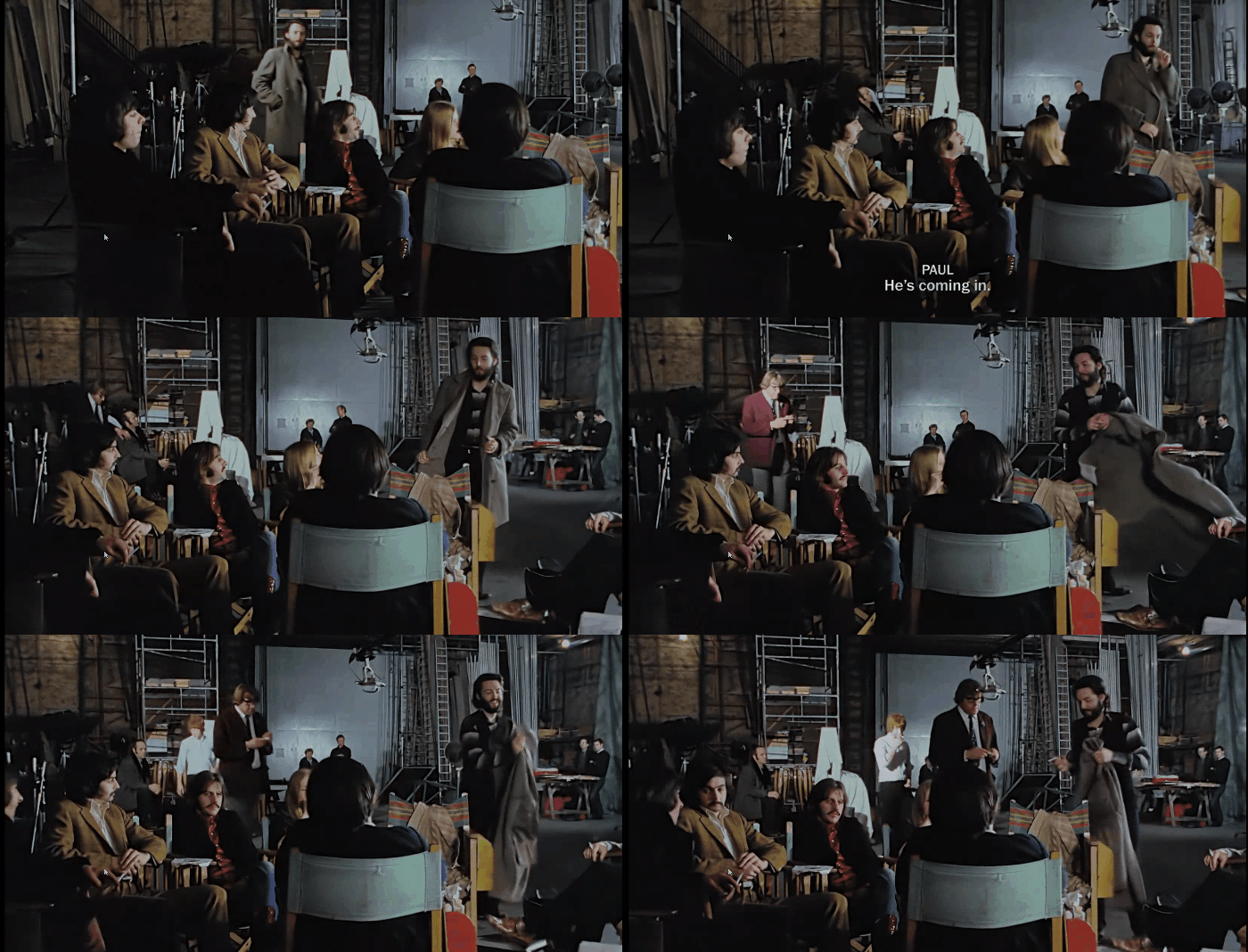
Through Paul’s return, Michael remained bold.

“You see, Paul, I was telling Linda when you were out, I could do it any way. Except I got to keep saying you’re wrong when I think you’re wrong.”

“Yeah, sure, great,” Paul replied, beaming and about to light a celebratory cigarette. “I’ll just keep saying I’m right when I think I’m right.

The daily circular discussion returned — again — to a pitch for Africa by Michael, one that was more quickly dismissed by Paul and Ringo than it had been, with the unspoken allegation of a trip being used as a crutch and gimmick.

Paul shared another idea he said he conceived the day before. That may have been a Sunday, but Paul’s brain had no days off.

“There’s another idea for a set: Instruments. You need a grand piano for one number, then for ‘Maxwell’s Silver Hammer’ … we should get a bit of a honky-tonk [piano]. So then you start to get the whole place just littered with instruments we could move around from. And it’s like a big game of musical chairs. Moving around on that amp, on that guitar, and it’s really planned. A whole computed setup … and then Ringo gets off and goes onto his congas for that one. That kind of sort of thing, then you get scenery, almost.

“You’re thinking of linking numbers,” Michael replied.

There were more shows used as points of reference — these guys absorbed so much TV:

The Potter’s Wheel: “They made a pot before your very eyes,” Paul explained. “Just one shot held, and it took about five minutes or something. And it was great, because you never felt bored. [I] always [watched it].”

Allow yourself the luxury of imagining a tween Paul McCartney soaking up these brief BBC interludes to the point of reminiscing about them at a moment he’s crafting on his own creative work at the height of his powers.

If the process should be the focal point, as Paul argued, it’s not enough for the instruments to create the scenery. Presaging the production of Get Back in 2021, he suggested the crew act as the supporting cast.

“Like [Glyn] switching everything over, you know, to taking all the top out of that on this track, ‘cause we want want a very biting guitar sound on this track.”

“I think that’s the documentary,” Michael argued, “because I think to go away to Glyn as opposed to a camel is distracting from you, because I think we’re getting into you. I think the documentary, we got all this in the documentary.”

Paul “totally” disagreed. “I think he’s a lot more to do with this show than a camel.”

After Neil jumped in to say Glyn was really a performer, too, Paul continued.

“That’s it! You’re going to miss him live. There he is. The camel won’t be doing anything live. Chances are it won’t even be looking at us or anyone. It won’t be looking at your camera, it will just sort of shit in front of you. Be lucky if it does, would be a bit of action.”
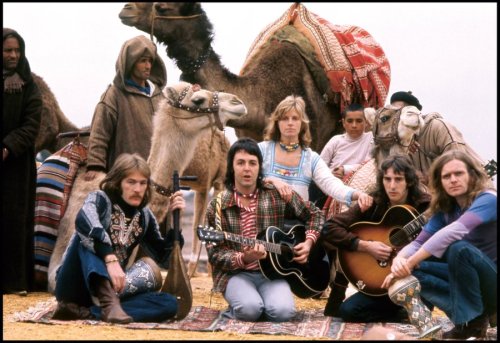
Camels with Wings. “Chances are it won’t even be looking at us or anyone.” (Photo from Paul’s Twitter).

Michael was truly exasperated, interrupting Paul who had continued his pitch, off the camel but back onto the fluidity of camera movements.

“See what I wanted to do in the desert,” Michael said, “was really make to the most dramatic thing of all time.”

Michael deserves credit for a lot of things having to do with his work in January 1969, including his real desire to create something exceptional and his willingness to exchange ideas. Here, he turned his attention back to the Beatles’ past, asking what was the band’s most successful and enjoyable TV appearance. Paul said “Around the Beatles,” an answer met with consensus from the others but unfortunately there was never any follow-up questioning to ask exactly why.

Still, it was yet another inspiration. Just like …
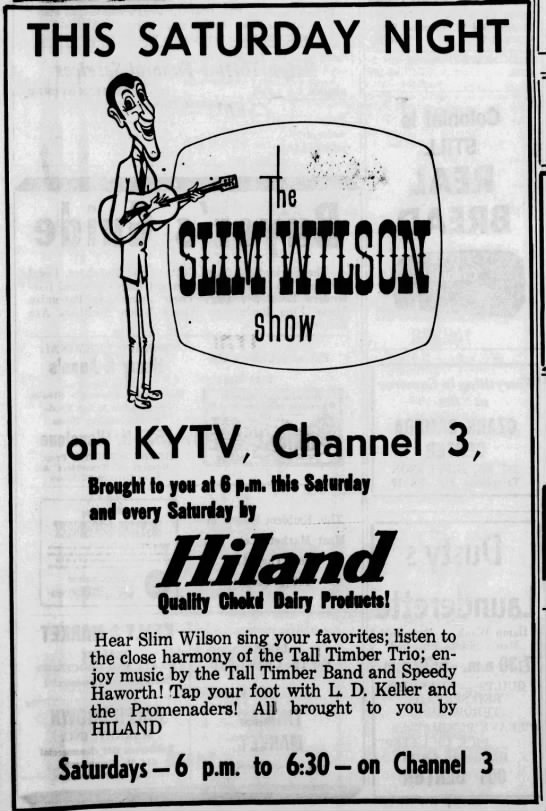
Some country music TV show Paul and Ringo “saw at the ranch”: Sparked off a comment from do-everything assistant Mal Evans, Paul and Ringo recalled a country music show. The “ranch” is certainly Reed Pigman’s in Alton, Mo., where the Beatles stayed Sept. 19, 1964. That would likely make Slim Wilson’s local country music show the memory. It was on at 6 p.m., right before “Flipper” — which the rancher’s son explicitly remembered watching with Ringo.

“There’s just one camera, and they all walked into it.” Paul recalled, describing Wilson’s show.

Ringo continued: “If it was the guitarist’s bit, he’d just step in and do it there. They’d all take the center, and if it was violin, he’d just walk in and do his bit, and he’d get back wherever he was. They acted all the movement.”

One memory sparked another, as often happens.

Unrealized Apple promotional film: “We were thinking of doing this once for an Apple thing, getting James Taylor, Mary Hopkin,” Paul remembered.

“We were going to get our home video things and set them up. And then have an area of the room which was lit, and that was it.. And then you came in, you did your thing and then if you wanted to say anything in close-up, you’ve walked up to the camera and you said it in close-up. Then you ducked out and someone else came in, in close-up and then walked into long shot and then did his dance.”

“So we can do a switch on this,” Paul said. “Get us to do the movement. Get us to go to the camera,”

Michael sought to punch holes in the idea, saying that if you were playing piano, movement was limited.

When Paul accused Michael of just being negative, Glyn said that was a “slight” contradiction.

“We’re all contradicting ourselves,” Michael said. “It’s the only way we ever get an idea.”

It was at this point Paul estimated John would arrive in about an hour, and with that news, the stage emptied out as everyone headed to lunch.

***

As an artist, Picasso announced when his film was complete — there was no haggling in a search for a conclusion. Sure, Picasso and Clouzot probably planned things out a little better before filming.  It’s arguable the fluid state of the Beatles’ finale concert was expected to be an unspoken initial plot point of the Let It Be film, but if so, it was never pursued in the original film, only exploited later in Get Back. Maybe there’s something important to the relative age and experience of Picasso and Clouzot compared to the Beatles and Michael, too, in how it all played out.

The revealing debate between Linda and Michael justifiably reached the small screen in Get Back, but so much of the rest of this lengthy sequence remains left to the beautiful losers who labor to listen to the Nagra tapes in full. None of the revealing TV and movie comparisons above were featured in Get Back the docuseries or the book published in 2021.

Before the Let It Be film even came out, though, that sequence owned prime real estate. The very first page of dialogue in the original Get Back bookthe one originally packaged with the Let It Be LP — spans this discussion. While the transcription is sloppy and incomplete, it’s there to set the tone for the text portion of the book, despite being from Day 8.

It’s absolutely no surprise the Beatles found inspiration in literally anything they encountered in film or television, whether it was something incredibly proximate, like the Rock and Roll Circus, or a pottery interlude they watched as kids or a rural country music show they caught just once. That’s how they synthesized their musical influences too. How George — absent for the discussion on the 13th — developed “I Me Mine” from watching a waltz on TV is a perfect example of all of this.
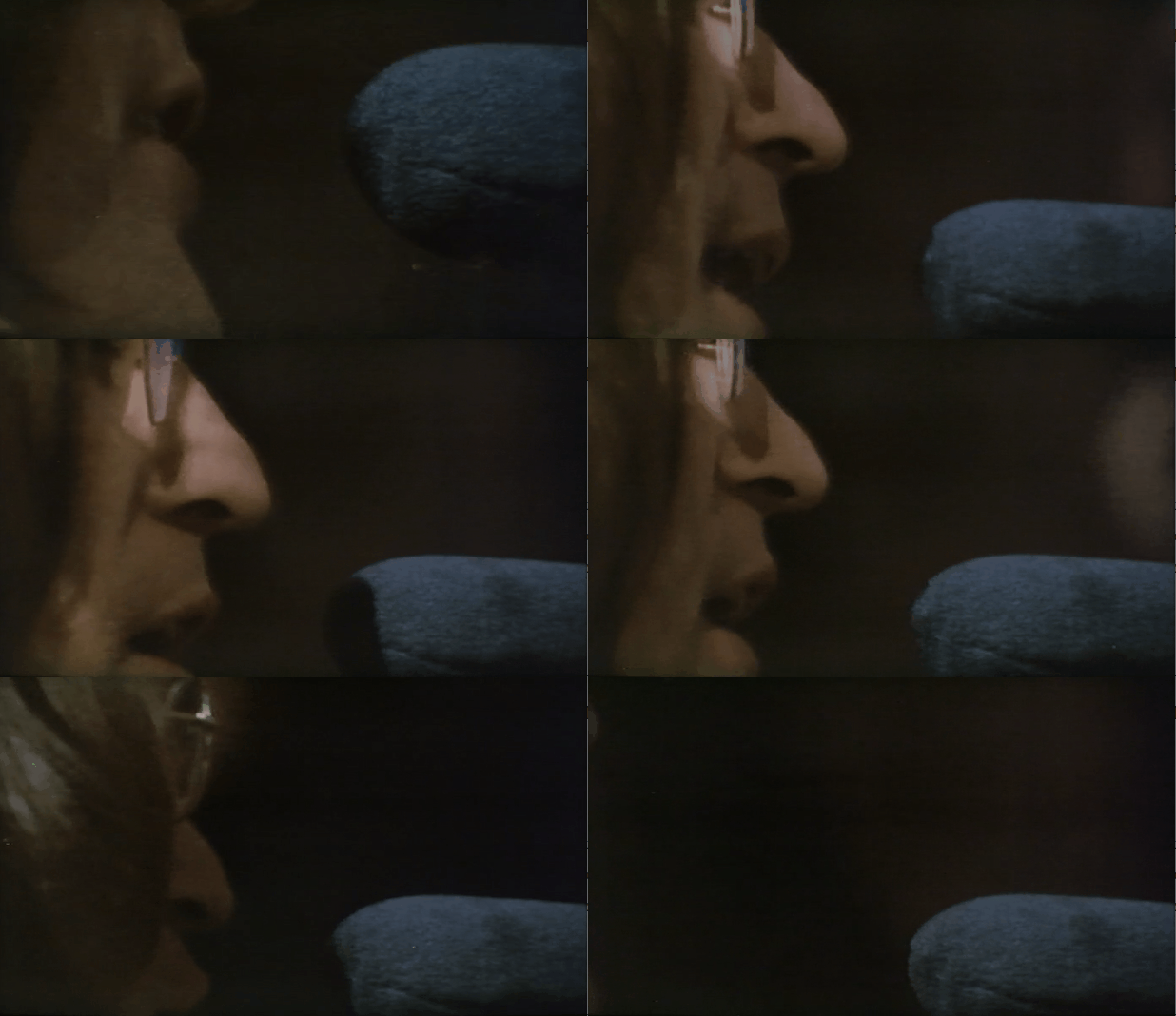
“Get right into one of John’s eyes,” almost.

Michael Lindsay-Hogg filmed a lot a footage in 1969, and most of us didn’t really know what that meant from 1970 through late 2021. Let It Be, from 1970, was nothing like Get Back in 2021, the latter deliberately not following the former’s model. But did conversations like those on January 13, 1969, inform some of Michael’s decisions of how to build his documentary?

“Get right into one of John’s eyes,” Paul suggested. And sure, we get a few seconds here and there of extreme close-ups in Michael’s Let It Be, but these are hardly studies. That’s where the luxury of an eight-hour palette benefitted films like Warhol’s 1965 Empire — and Get Back in 2021.

Michael was clear that a “wide shot … with no particular response from the audience” was the wrong route. The success of the “Hey Jude” promo — with the band surrounded by the audience — was rooted in this strategy. It may have been the unspoken reason behind the affinity for Around the Beatles, too. And perhaps it’s why the rooftop performance in Let It Be was punctuated and interrupted consistently by street-level interviews. Otherwise, the Beatles were just playing on a very tall stage (which would have worked for me, but I’m not a filmmaker).

Still, the rooftop on January 13, 1969, was simply the top level of 3 Savile Row, not The Rooftop. Inspirations, open minds and contradictions were how they got to an idea.
8 Comments

Filed under Day by day

Jan. 12: Anyway, here’s Wonderwall

While the Apple Corps board meeting at Ringo Starr’s house is the obvious focal point to the Beatles’ January 12, 1969, there was more to the day’s agenda than the important aborted gathering.

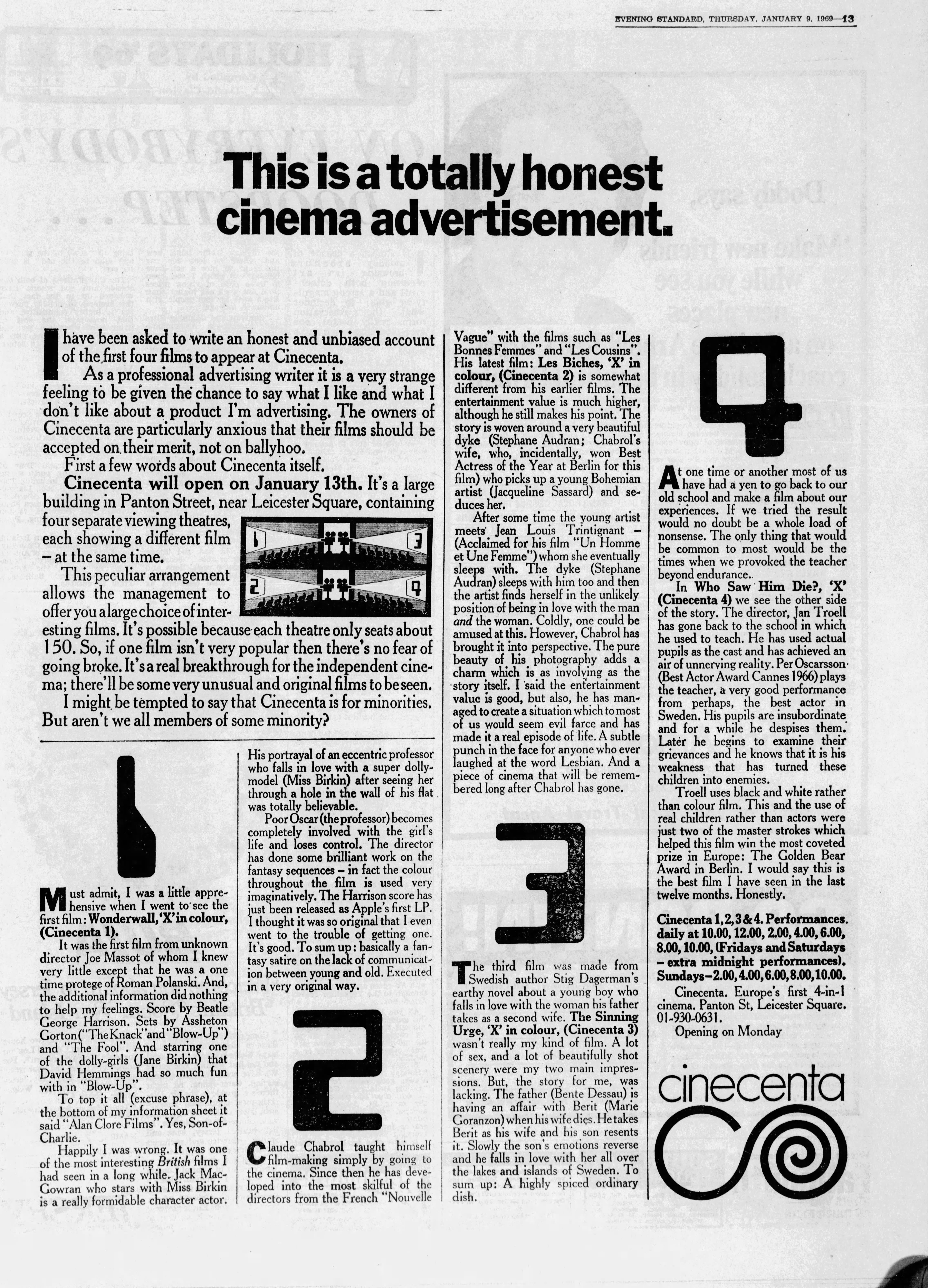
“This peculiar arrangement allows the management to offer you a large choice of interesting films” (from a January 9, 1969, ad for Cinecenta)

That evening, Wonderwall — the film which bore George Harrison’s excellent solo debut as its soundtrack — enjoyed its British premiere at London’s Cinecenta. George, who had walked out of the Apple meeting that day, didn’t attend the premiere, which also served as a sneak preview for the Panton Street theater, Europe’s first four-in-one cinema.

Rather, George spent the evening at the home of Apple press officer and close friend Derek Taylor, a fact detailed in George’s diary. Mal Evans, who did it all for the Beatles, whether it was running errands or helping with lyrics or banging silver hammers, went to the movies instead, presumably as George’s representative.

“I went to the premiere of Wonderwall last night,” Mal told the others, unprompted, early on the January 13 Nagra tapes. He said he liked the film, even though it  “really got slayed in the papers.”

Ringo, who in May 1968 joined George at the film’s world premiere at the Cannes Film Festival, added, “I like the film too. After a couple of times, is that what you were going to say? First time was a lot.”

After the film, which was screened in all four theaters, Mal — resplendent in bow tie — enjoyed the crowded reception, including ice cream afterward.

Celebration day
The Beatles’ communication breakdown put Glyn Johns’ Beatles gig in jeopardy at the same moment Led Zeppelin’s “Communication Breakdown” padded his resume.

Zeppelin’s self-titled debut LP hit American shops on January 12, 1969 (it came out in the UK in March), and that certainly would have made it a big day for Glyn, its engineer.

A few weeks after this date, after George had returned to the band and rehearsals shifted to 3 Savile Row, Glyn tried solicit the Beatle’s opinion on the fledgling Zep. George seemed more interested in lunch, but it’s still a neat moment in rock history.

At a 2014 Q&A to promote his memoir, Glyn said when he did finally get to play some of the LP for George, the Beatle “didn’t get one bar of it” (Mick Jagger wasn’t impressed either).

The Led Zeppelin release may not have even the biggest news for Glyn on January 12, although admittedly that’s just speculation. On the Nagra tapes recorded the next day, Glyn tells the others for the first time that he and his wife were expecting. So maybe she reached a certain point in a healthy pregnancy that weekend that made them feel comfortable to share the news starting Monday.

“Did I tell you my wife’s definitely confirmed pregnant?” he told Ringo, Michael and the other early arrivals.

Their son, Ethan, picked up his dad’s business decades later, producing, among other things, two tracks on Paul McCartney’s 2013 LP New.

Big brother is watching?
After the meeting at Ringo’s, Paul spent time with Apple head Neil Aspinall, discussing an explosive idea for the Beatles’ proposed live concert. Did Paul have time for someone else’s concert that same night?

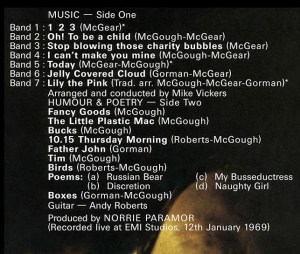
Some books place Paul at EMI Studios that night, but it’s hard to confirm just how many McCartneys were at the Abbey Road studios. There’s no question The Scaffold, featuring Paul’s brother, Mike McGear, recorded portions of their L. The P. album there that evening. There’s also no question Paul provided the guitar for two of that album’s tracks — and he recorded those in subsequent months. Side 2 of the LP, all humor and poetry, was recorded live before an audience of London University students that Sunday, and it’s feasible Paul was also in the crowd.

Paul lived a short walk from EMI, but it would be a surprise if he went the show yet didn’t mention it the next day on the tapes, considering how much detail of their lives they did share.

Sitting on a sofa on a Sunday
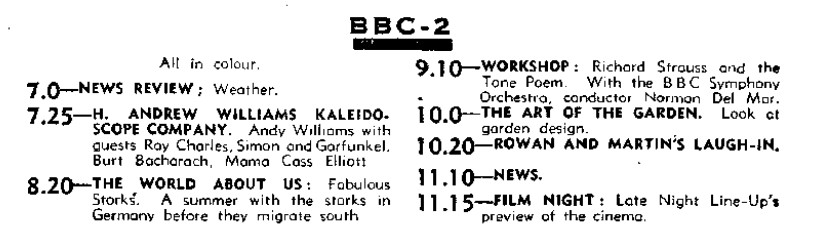
Michael Lindsay-Hogg was stuck to the television Sunday night, when he was tuned to the Andy Williams special on BBC-2. An hour-long show featuring several performers and beginning at 7:25 p.m., the “H. Andrew Williams Kaleidoscope Company” originally aired in the U.S. in April 1968, but was first-run to British audiences in January 1969.

From the January 4, 1969, New Music Express

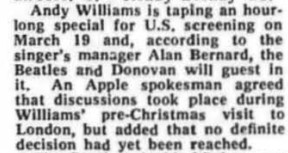
While Andy Williams featured a Beatles number in the dizzying opening sequence and was presently rumored to be in line to host the band on his TV show in the coming months (see the adjacent clipping from NME), the American crooner wasn’t discussed at all on the Nagra tapes the next morning.

Instead, Simon and Garfunkel, who had four LPs among the top 26 in the UK for the period beginning January 12, 1969 — including The Graduate, which sat at No. 4 — sparked the most conversation, again, primarily from Michael.

On Mrs. Robinson, they were camping it up, which I didn’t like, because Paul Simon is not that good at it,” Michael said, before continuing. “He’s got a great face, Art Garfunkel.”

“Is he the frizz?” asked Ringo.

Michael confirmed Garfunkel was the frizz, before unexpectedly offering that he had “a very long, involved story about how Paul Simon and I don’t get on, but it’s too long and involved. … It’s funny, I’ll tell you sometime.”

(We never hear the story, but their issues must have eventually been ironed out, because Michael directed the Simon & Garfunkel reunion in Central Park in 1981 and later got his big African concert, directing Simon’s historic 1987 Graceland concert before a huge audience in Zimbabwe.)

There was another act on the Andy Williams show that drew interest.

“Who saw Ray Charles?” Ringo asked.

It’s a good question, and one unfortunately left hanging, as they moved onto other topics before anyone answered.

If anyone had, in fact, seen Ray Charles’ segment, they could have caught a fleeting glimpse of his organist: Billy Preston.

2 Comments

Filed under Day by day

TMBP Extra: Leave me waiting here

Had the phrase been in vogue in May 1970, a record review would have called Let It Be a “hot mess.”  I absolutely love the record, but I get how it’s a little off-kilter, off-putting and, frankly, a little bewildering. 

Apple Corps announced the 51st anniversary reissue of the Beatles’ final LP on Thursday, and befitting the record’s legacy, it’s complicated and conflicted. 

I say this as a sincere apologist of the original Let It Be. It’s a bizarre compilation album that’s nothing like anything they had done previously: Part-live, part-studio. Re-recorded and remixed older tracks, and songs written on the spot during the sessions. Novelty songs sequenced adjacent to their deepest statements. A rich overproduction of a loose session that wasn’t initially meant to be an album at all.  Packaged along with a rich book of photos and dialogue and in conjunction with the film, Let It Be was a true, albeit helter-skelter multimedia experience.

Before getting to 2021, let’s first take a quick spin at the long and winding road (ugh, sorry) that got us here, just for the sake of background. It’ll be fun!

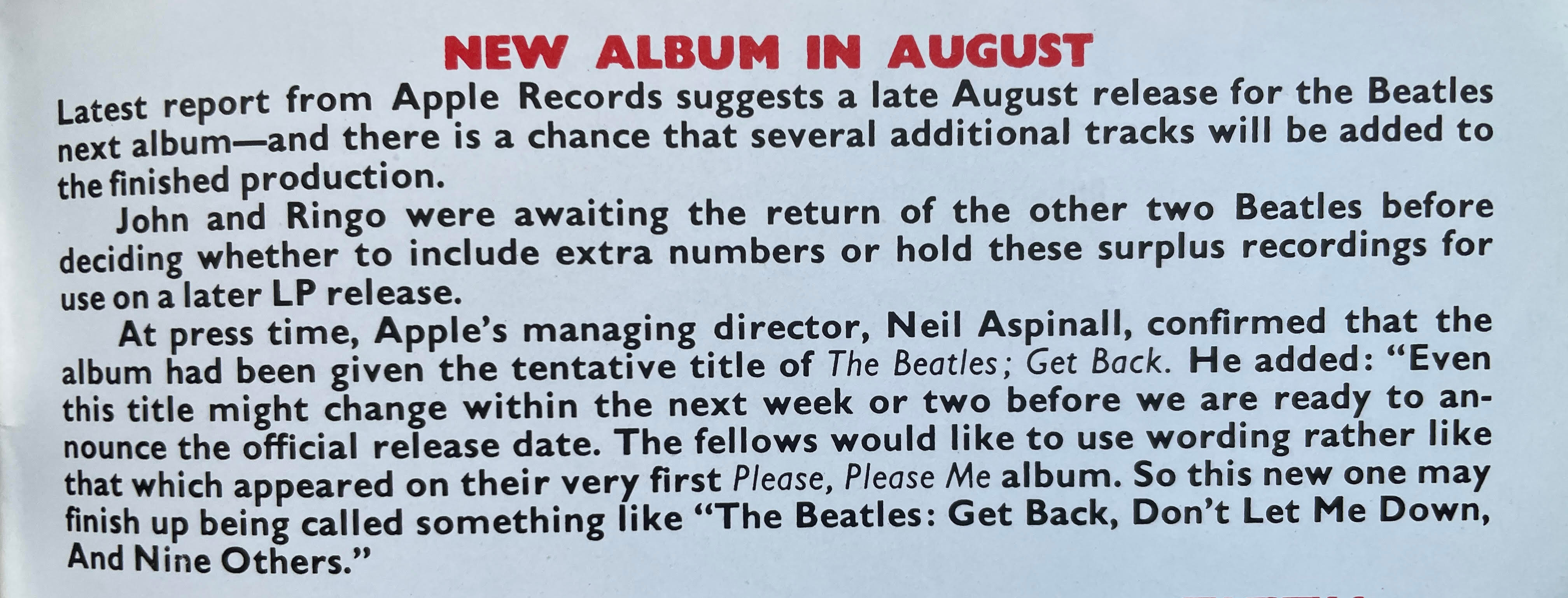
After spending January 1969 split between Twickenham Film Studios and Apple Studio at 3 Savile Row (see this fabulous blog for more on that history), the Beatles themselves were never unanimously satisfied with the record pulled together over the subsequent months. Glyn Johns, ostensibly the producer/arranger at the sessions, mixed and sequenced multiple versions of a Get Back LP throughout 1969, and told the story of his first compilation in his 2014 memoir Sound Man, outlining what became the “concept” of the album.

Having no real end in sight for the album, one evening after our session at Savile Row, I took it upon myself to take the multitrack recordings I had made during our rehearsals to Olympic Studios to mix and edit what I thought could be an idea for the album. This was to show in an audio documentary what I had witnessed in the previous days, as a “fly on the wall” insight to the four of them interacting, having fun, jamming, taking the mickey, stopping and starting and creating some wonderful music, warts and all. I had five acetates cut the following morning and gave one each to the band, keeping one for myself, saying it was just an idea and and asking them to take a listen. The next day I got a resounding NO from each of them, which I completely understood and had fully expected.

By May 1969, the Beatles reconsidered, delivering Johns a pile of multitrack tapes from the sessions, asking him to create a mix from their recordings at Savile Row on his own, without the group’s input. He wrote that he “soon realized that the real reason had to be that they had lost interest in the project.”  

“We let Glyn Johns mix it,” John Lennon said in 1970. “We didn’t want to know.”

From the June 1969 Beatle Book

After multiple postponements and revisions to the mix — delays in part because of film delays — the Get Back LP (d)evolved into the Let it Be album as John and George Harrison tasked Phil Spector to produce the final version of the record in late March 1970. 

We all have opinions on Phil Spector’s Let It Be, and I’m not here to judge.

John said Spector “worked like a pig” on the production, which used Glyn Johns’ mix as a starting point. “When I heard it, I didn’t puke,” John said.  Ringo Starr likewise kept in his lunch, going as far as saying in the Anthology book, “I like what Phil did, actually.”

Paul McCartney, meanwhile, literally sued the other Beatles over Spector’s production of “The Long and Winding Road” (among other things, of course) on the last day of 1970.  Macca has since made a cottage industry of rerecording and reissuing non-Spector versions of the song at every opportunity. 

Bootlegged since before Let It Be was even released, the first raw recordings from the sessions were officially released in 1996 on Anthology 3, with a somewhat randomly selected 12 tracks culled for the collection.

Glyn Johns (as pictured in the Peter Jackson’s Get Back trailer)

By the time Let It Be … Naked was released in 2003, half the band was dead (although George had previously given his approval to the project). Its existence is primarily owed to Paul’s wishes to avenge Spector’s production (although the addition of “Don’t Let Me Down” to the rest of Let It Be is welcome and it sounds great, even if the collection completely lacks the occasional humor of the original, stripping it of the between-song banter). It’s other saving grace is the addition of the “Fly On the Wall” disc, a little starter set for the Nagra-curious, compiling all manner of song and conversation snippets from the sessions.

And that pretty much brings us to this very glorious day, when we formally learned what would be on the “Special Edition” of Let It Be. 

This is a great time to be a fan of this era, with the Get Back book of photos and dialogue coming out October 12, the album coming out just three days later and the new six-hour Get Back documentary series by Peter Jackson streaming  November 25-27. That’s a lot of product for a period that the Beatles couldn’t stop bashing for several decades, and that we see from the start was something they weren’t really enthusiastic to release in the very first place.

The transformation of the Beatles’ Winter of Discontent in the upcoming Fall of Rehabilitation seems built around the documentary, the apparent centerpiece of the revival. 

We can guess what will be in the film (and I tried to guess — check out the above!) but now we know for sure what a Let It Be deluxe entails. Beyond the Giles Martin/Sam Okell remixed version of the original album — “guided” by Phil Spector’s version — the box will contain:

  • Glyn Johns’ mix of the Get Back LP (looks like his third compilation) 
  • An EP featuring two unreleased 1970 Johns mixes (“Across the Universe” and “I Me Mine”) and two 2021 remixes (“Let It Be” and “Don’t Let Me Down” singles) 
  • 27 “previously unreleased outtakes, studio jams, rehearsals” 

It’s easy to welcome the release of the Glyn Johns mix, a historic document and true “lost album.” It’s a natural and expected addition to the set, even if all four Beatles nixed it more than half a century ago.  The two lost 1970 Johns mixes make sense as add-ons. As for the 2021 remixes … sure, why not. 

That leaves the outtakes.  Oh, the outtakes. While a microscopic fraction of what was captured at Twickenham and Savile Row, it could well be representative in a remarkably scaled down fashion. But until we hear more selections, read more reviews or get dates, even, of some of the tracks, they’ll be a bit of a mystery until we put the record on. What’s in mono (sourced from the Nagras) and what’s in stereo (recorded on multitrack) gives a hint where certain tracks were recorded, but that’s one of the very few clues for you all. 

The track list

For instance, what is “I Me Mine (rehearsal)”? The Nagra reels have more than an hour of the song being rehearsed, over more than 40 tracks.  

Every track that ultimately appeared on the original Let It Be is represented by at least one outtake/rehearsal version.  That’s not a bad thing. Some songs that dominated the sessions did not surface — like “Maxwell’s Silver Hammer,” a significant Twickenham work-in-progress. “All Things Must Pass” seems to be represented by one of these early takes, but only this one.  That’s not a good thing.

It’s nice to have the origin story of “Something” and “Octopus’s Garden” (as seen in the Let It Be film) as links to Abbey Road and an early working rehearsal of “Gimme Some Truth” as a tie to their future solo career. This is a great introduction to a wider audience to the concept that the January 1969 sessions were creatively sprawling and carried a legacy beyond Let It Be alone.

All of this needs to be in there. But every track draws attention to missed opportunities of every scale. The tapes record Paul debuting “Golden Slumbers” and “Carry That Weight” on separate occasions and then later linking them together alone at the piano, but these are left to the bootlegs alone. George and Paul introduce numerous future solo tracks during these sessions, but we don’t get “Here Me Lord” or “Another Day,” to name just two examples.

The set features two Savile Row versions of “Get Back,” but the signature song of the sessions and its 2021 reboot was written while the cameras were rolling over the course of early January 1969. We hear the song spring from a jam and later become a foray into politics (“No Pakistanis”)  before Paul and John work together to finalize the lyrics we know today. To those who know the takes, those earlier, nascent versions are conspicuous by its absence.

To me the development of these songs represent the essence of the January 1969 sessions. It’s what makes this collection have the potential to stand out from the others (Sgt. Pepper, White Album, Abbey Road), in which the songs arrived in the studio mostly formed. The songwriting build should be central to the bonus content, but it doesn’t appear to be. 

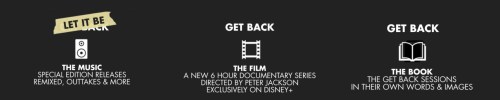
Over the course of the Peter Jackson documentary, I would guess we’ll get such moments. And maybe this is where Let It Be and Get Back separate after 50 years of sharing the same exact space.  You almost get a sense that’s what the group is doing, when you look at the Beatles’ homepage, and the image promoting the set: “LET IT BE” is “taped” over “GET BACK,” making clear this thing is different.


To its credit, this box feels too narrow to be seen as revisionist. There’s just not enough material to redefine any narrative (barring whatever’s in the accompanying book). That job will likely be left to the documentary.

I know I’m spoiled. I’ve heard 80-something Beatles hours from January 1969. I want it all, with better sound, in a fancy box I can put on my shelf and not let my kids touch until they wash their hands twice. That beats having of a partition on my hard drive filled with MP3s.

(I’m also spoiled as a Prince fan and have been using the incredible Sign O’ The Times deluxe reissue as a point of reference, too. That had 45 unreleased studio tracks in addition to singles, remixes and different concerts on two CDs and one DVD. It’s a sexy beast of a box set.)

The thing is, how do you compile a widely satisfactory version of the Get Back/Let It Be sessions?

Obviously, it’s impossible to market and widely release dozens of takes of “Maxwell’s Silver Hammer” or nine hours of “Get Back” (the song) sessions. I may like to hear George kvetch about having to be on a boat with Beatles fans or Paul tell John to sing louder or Ringo discuss his dog, but it’s hardly a selling point to a mainstream audience and it’s most certainly not re-listenable (unless you’re literally me or a few other dozen people doing this kind of thing).  I’m not convinced what we’re getting is sufficient either, though.

So what would have been the right way to do this? 

At one point I posited that a “Beatles ’69” super-duper deluxe would have been a possible out-of-the-box box-set approach, combining Let It Be with Abbey Road, something that makes quite a bit of sense when you see how many songs from the latter were essentially demoed at the former’s sessions.

But one gigantic box was never going to happen, the Abbey Road and Let It Be “brands” would never be — and probably shouldn’t be — diminished. I get that. But we’re left with something a little halfway right now. Disc 3 of this set has five eventual Abbey Road numbers. Yet there are another seven that could have been included, but weren’t, and I’m not sure what the rationale was to select which made the cut. 

• Further, if the original Let It Be film is to be dead and buried, this box should have been its final resting place. Mark it up another $20, that’s fine, lots of us will pay it. 

And that would be another way to delineate Let It Be from the forthcoming Get Back, identical twins who finally grew up to lead separate lives. At some point, on one of my appearances on Something About the Beatles, I suggested perhaps the Get Back series should get an actual soundtrack. That would be another — albeit confusing way, to less dedicated fans — to get us to buy another box set with more of what’s missing here.

• We really could have used the originals and curios that they never did anywhere else: “Suzy Parker,” “Oh Julie, Julia,” “Because You Know I Love You So,” “Penina,” “Taking a Trip to Carolina,” “Watching Rainbows,” “There You Go, Eddie,” “Maureen” — that’s half a disc there, and I’m stopping myself from listing more.

• Likewise, there’s more than enough material to have stuffed a CD or two of oldies (beyond the medley on the Glyn Johns mix). These sessions are known for those oldies performances, and that’s something Mal Evans even broached in 1969, writing as much in Beatles Book 72, published that June.

• Given the consistent on-site song building, they could have easily taken the same approach used on the Sgt. Pepper deluxe with several songs, tracing the progression of “Get Back,” “I Me Mine,” “Don’t Let Me Down” and beyond. It’s very easy to sequence tracks to show these songs’ evolutions. This was so unique for this period, where we can literally hear in the studio, a song’s origin as a piano vamp or a guitar jam, and follow it to the end.  

• If they insisted on having an EP, one of George playing Dylan songs throughout the sessions would have been lovely.

• It pains me there’s no recorded document of the “fast” version of “Two of Us.” But that is one of the drawbacks of many of the outtakes from throughout January 1969: Not everything recorded is a complete take of a song. In fact, quite the opposite.

• We need more Billy Preston, but we always need more Billy Preston. The Beatles certainly were better for it.

The addition of Billy Preston just improved this post.

• I don’t know if we need more Yoko Ono, but I was hoping — though not necessarily expecting — her jams with the group on January 10, 1969, after George walked out. It’s a piece of history, too, regardless of what you think of Yoko’s voice.

• A dozen songs already appeared on Anthology 3. Like the other recent box sets there are a few redundancies. I credit the new set for having something different the January 1970 Threetles session, but it would have been something to have more than just the single track.

• One of the great oddities of the Beatles catalogue, “You Know My Name, Look Up the Number” needed to have a home on this set. It’s timeline was split between Sgt. Pepper and Abbey Road, but as the B-side to “Let It Be,” this is where it belongs (especially as it’s not packaged with either of those deluxes).

• The definitive musical moment of the sessions — the rooftop performance — is featured raw on only one track in the new set. This would have been the obvious spot to offer the whole collection for the completist and as a companion to the Get Back documentary, which includes the whole thing.

***

So to ask again, how do you compile a widely satisfactory version of the Get Back/Let It Be sessions? I don’t think you can. There’s really no suitable middle ground. I — and many others like me — crave everything, a horrible idea for a mainstream audience. I feel the new box goes partway in the right direction with the addition of the Glyn Johns mix and some of the outtake tracks, but it doesn’t go as far as it should as a historic resource. 

That puts some pressure on the documentary, but six hours of unreleased Beatles is a long time. And like the original record, it’s only fair to treat the entire package — records, documentary, books — as a singular, albeit helter-skelter, multimedia unit.  

And in true Beatles tradition, we don’t have to agree on it anyway.

2 Comments

Filed under Extra

Jan. 10: See you ’round the clubs

On the afternoon of January 10, 1969, seven days into the Get Back sessions and nearly 10 years into his tenure with the band — a term that began when he was 15 years old — George Harrison quit the Beatles.

George: I’m leaving the band now.

John Lennon: When?

George: Now.

After a cut in the Nagra tapes, which captured the exchange, George casually continued: “Get a replacement. [Place an ad] in NME and get a few people.”

While the tapes don’t capture him saying “see you ’round the clubs,” it’s too good a line to be purely apocryphal (and it’s, in fact, alluded to by others on the tapes later in the day). George then briefly shared a few words with Mal Evans and was off, his boots echoing as he departed.

Likewise, for the sake of the complete record, there is simply no indication on the tapes of what happened between the final take of “Two of Us,” and George’s departure, the immediate spark of George’s decision (if there was any). Like the Beatles themselves, the tapes were out to lunch.

Film director Michael Lindsay-Hogg, so proud of his spy microphone hours earlier, had the right instincts and was prepared for this moment, but he probably should have upgraded to a better model.

“My bug had only picked up the sounds of cutlery banging on china plates, obscuring what the muffled voices had said,” Michael wrote in his 2011 autobiography Luck and Circumstance. In his “role as documentarian,” he had asked his sound engineer to mic the flowerpot on the dining room table as George encountered the band at lunchtime. Per Michael, George concluded by saying, “See you ’round the clubs.”

George grabs his coat on his way out of the utter sty that was the studio at Twickenham, as pictured on an earlier day. (Screen capture from Beatles Anthology)

What exactly happened over lunch is a source of legitimate dispute in Beatles history. Dig in — here are varied accounts that span 50 years.

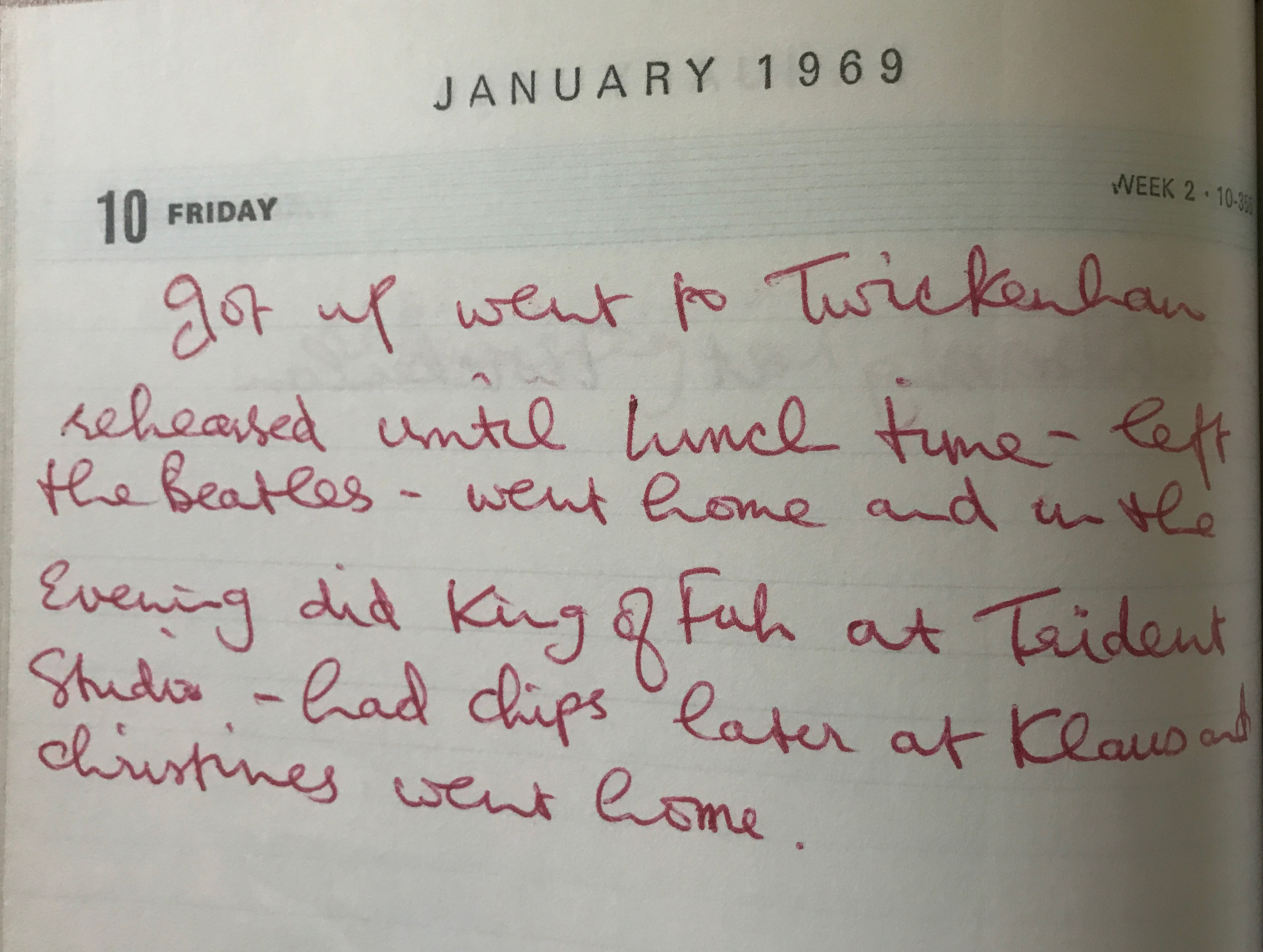
The most contemporary retelling of the events of January 10, 1969, comes from George himself, later that day, in his personal diary.

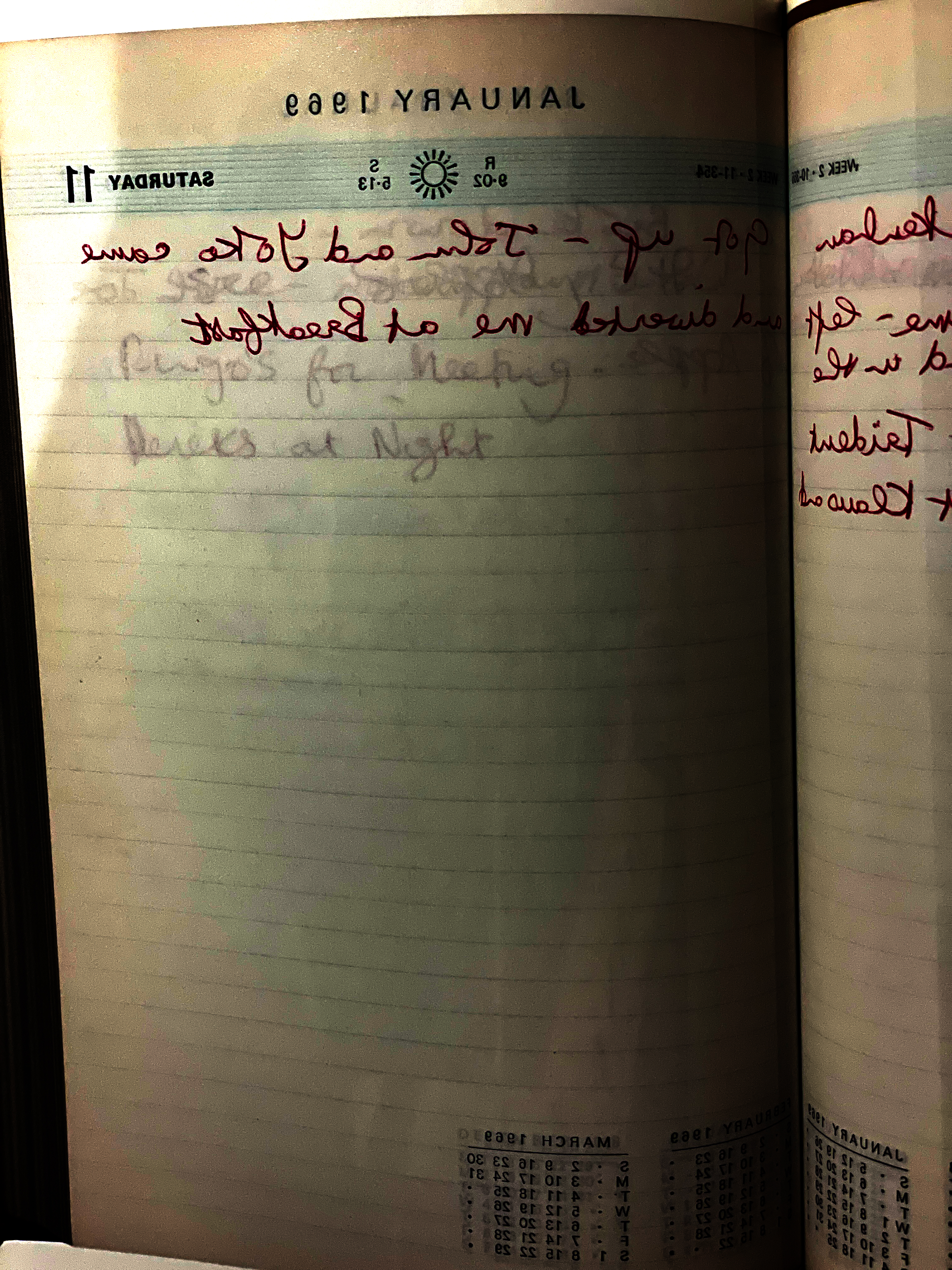
Got up went to Twickenham rehearsed until lunch time – left the Beatles – went home and in the evening did King of Fuh at Trident Studio — had chips later at Klaus and Christines went home.

George’s diary entry for January 10, 1969, as later published in the Living in the Material World book in 2011.

There wasn’t any Twitter in 1969 (although John and Yoko probably would have dominated the platform had it existed), so when George left the Beatles, it didn’t instantaneously go viral. But within days, George’s resignation was widely reported around the world — jumping off an original report by the Daily Sketch (more on their reporting to come in a subsequent post) — though he was already back with the band by the time those reports came out.

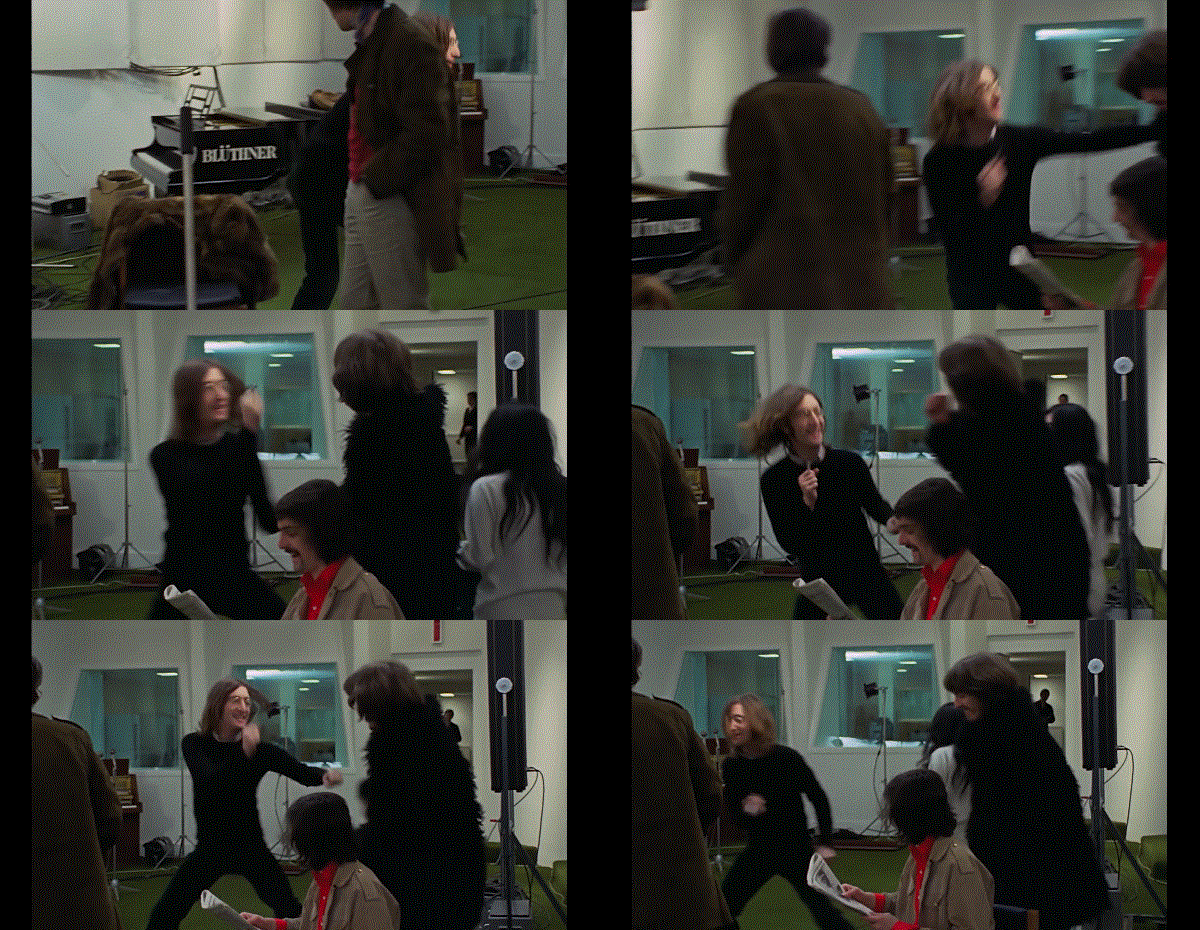
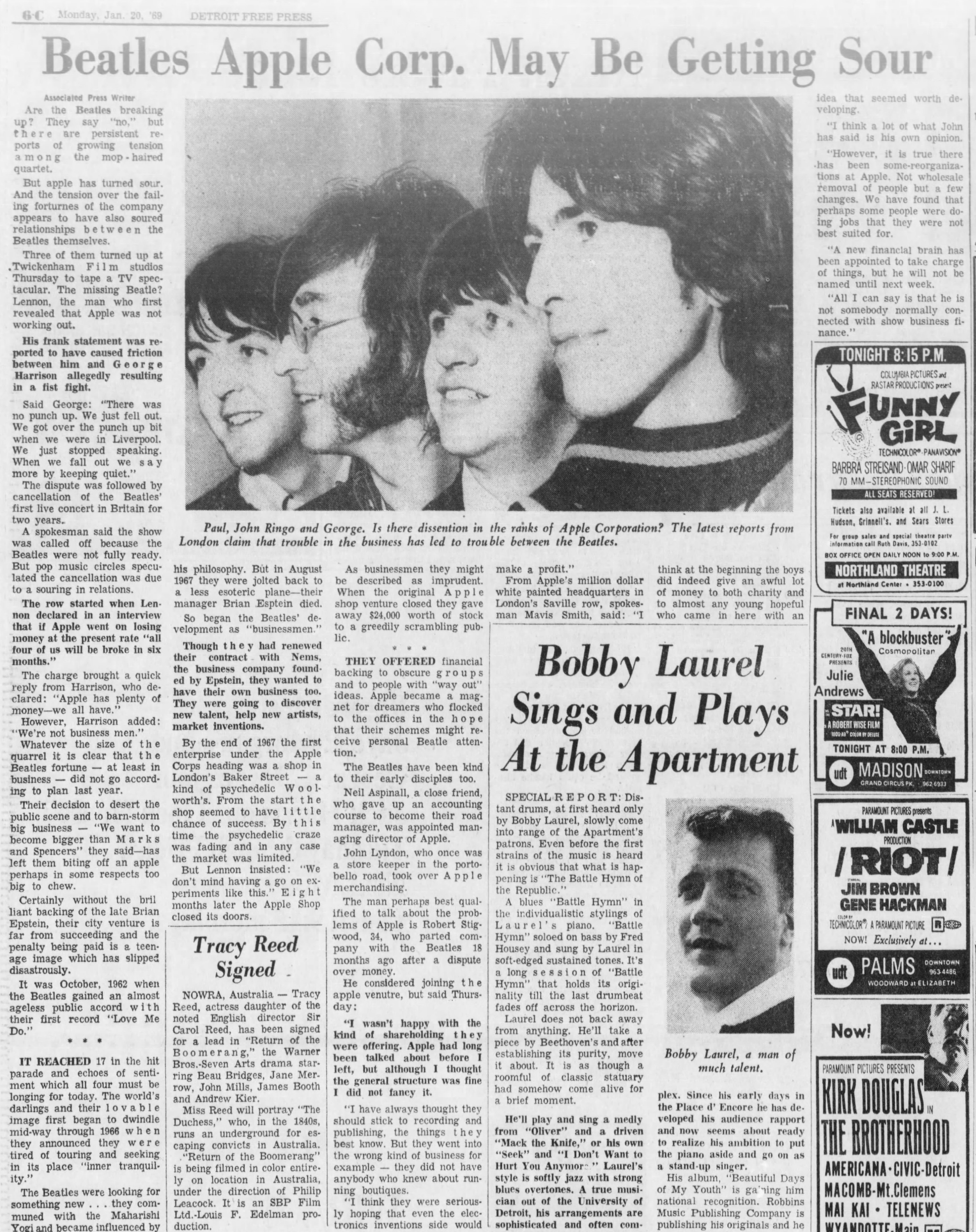
It wasn’t just that George left the Beatles. Word was out that that things got violent.

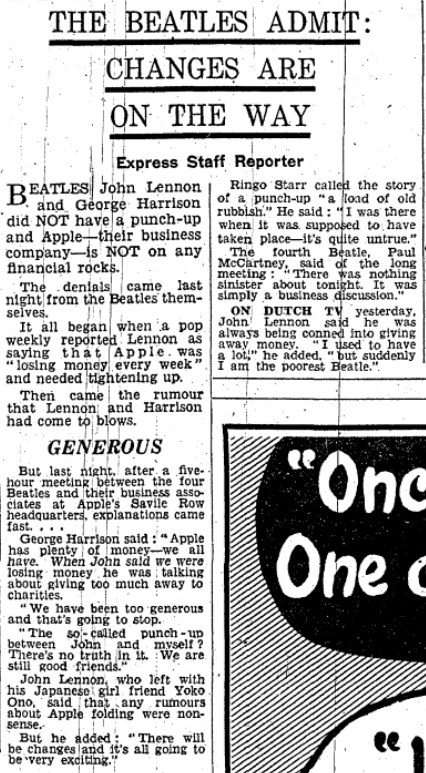
From the Daily Express, January 16, 1969:

Beatles John Lennon and George Harrison did NOT have a punch-up and Apple — their business company — is NOT on any financial rocks.

The denials came last night from the Beatles themselves.

It all began when a pop weekly reported Lennon as saying that Apple was “losing money every week” and needed tightening up.

Then came the rumour that Lennon and Harrison came to blows.

But last night, after a five-hour meeting between the four Beatles and their business associates at Apple’s Savile Row headquarters, explanations came fast.

“The so-called punch-up between John and myself? There’s no truth in it. We are still good friends.”

Ringo Starr called the story of a punch-up “a load of old rubbish.” He said: “I was there when it was supposed to have taken place — it’s quite untrue.”

A few days later, on January 21, Ringo told BBC’s David Wigg that “there’s that famous old saying, you’ll always hurt the one you love,” when he was asked if the group was still close. But he spoke without any specifics regarding George’s departure, just generic reconciliatory language.

“[W]e all love each other and we all know that,” Ringo said. “But we still sort of hurt each other, occasionally. You know… where we just misunderstand each other and we go off, and it builds up to something bigger than it ever was. Then we have to come down to it and get it over with, you know. Sort it out. And so we’re still really very close people.”

One of the Beatles’ official mouthpieces, the Beatles Book Monthly fan club magazine predictably poured cold water on the idea of a physical altercation in its March 1969 issue. In his diary feature, Mal Evans went as far to write there wasn’t any argument at all when George “stalked” out.

Matching the account on the tapes, Mal said George simply came over during lunch to “quietly” say he was going home. “There WASN’T a fight, physical or verbal,” Mal wrote. “There WEREN’T any tempers or shouting. I just couldn’t believe it when I saw the press afterwards.”

George Harrison maintained in subsequent interviews that no punches were thrown. But another George had another memory.

“They actually came to blows,” George Martin told Phillip Norman in his 2008 biography John Lennon: The Life. “You’d think it would have been with Paul, but it was John. It was all hushed up afterwards.”

Here’s where the retelling of the day’s events descends more deeply into farce.

According to a separate account from EMI engineer Dave Harries, a frazzled Martin only arrived at Twickenham that day as Harrison departed from the studio.

As related in Ken Womack’s Martin biography Sound Pictures:

I remember that George Martin had just backed across the car park in his Triumph Herald and knocked a dent in the door of George Harrison’s Mercedes and he didn’t have time to tell him he’d dented his car before George walked out in a huff and drove off.

Just hours after engaging in passionate car talk, this wasn’t George’s finest hour.

While George Martin was around to some arguable degree that morning (and at the sessions overall), there was no doubt fellow producer Glyn Johns was there on January 10. He was an active participant on the day’s tapes.

Johns, too, wrote of his recollections of that day in his 2014 autobiography Sound Man:

I have a very clear memory of sitting outside in the bleak surroundings of the soundstage at Twickenham on that cold gray afternoon with Denis [O’Dell], the line producer for the film, both of us praying that the elation of being employed for a project with the most successful artist in the world was not about to come to a grinding halt after two days.

It is not my place to discuss any detail of what happened, but it is common knowledge that George left the band and was persuaded to return a couple of days later.

While an implication is there, Glyn wouldn’t spill the beans. Although in Graeme Thompson’s 2015 George Harrison biography Behind the Locked Door, Glyn conceded there may not be too many beans to spill:

When it became apparent that there was going to be a bit of an argument those of us who weren’t in the band left the room. It was clear that it would be intrusive for us to remain. So what actually was said and and what went on I don’t know, but I do know that George left the band that day. The whole thing was very uncomfortable, and it was very embarrassing for me and others who were not in the band to be close by while this was going on — to have to watch this begin and be there in the immediate aftermath. It was very unpleasant and I felt really awkward.

The Beatles pre-enact their January 10, 1969, fistfight more than five months before it probably didn’t happen. (From the Mad Day Out photo session in 1968).

More than 50 years after the fact, what we know with absolute certainty is that George Harrison quit the Beatles the afternoon of January 10, 1969. Everything else — most prominently whether there was a physical altercation — is ultimately speculative.

It’s not just what happened that’s in question, but the why. We’ll never unearth that last straw, the specific reason George quit when and how he ultimately did on January 10. There’s just too much open to interpretation, and as long as the tapes of the day are considered complete, there is simply no smoking gun, no spark that broke George. The conversation with Dick James, the rehearsals of “Get Back” and “Two of Us” — these moments lacked an obvious trigger beyond what were usual pockets of growing frustration.

It’s worth mentioning the other three Beatles openly discussed their feelings and opinions in the wake of George’s departure on the Nagra tapes, directly addressing his growing sense of frustration as a junior member of the group. They were aware of this, and their conclusions were consistent with much of what is discussed below.  I’ll examine those specific conversations, which also touch on off-site meetings, however, in future posts when we reach those days on the blog’s timeline.

Still, by rewinding many of the same sources we examined above in this post to construct what happened, we can put together a loose reasoning as to why George left the Beatles. Notably absent from each of these recollections is the one mentioned specifically in the original flurry of news reports — George’s fury with John over the latter’s comments about Apple’s difficult financial situation. George and John even had light-hearted discussions about business earlier in the day. It seems clear the Apple finances excuse for George’s departure was a leap of faith by the media. Musical and personal differences were responsible.

Back to Mal’s Diary in the March ’69 Beatles Book Monthly:

Singing and playing together would always be fine with [George] and the last thing he was suggesting was any break-up of the Beatles. So that day, January 10, George didn’t want to stay at Twickenham rehearsing for a show he couldn’t believe in.

And what — or who — could make George an such an unbeliever? In published interviews over the subsequent decades, George was at least consistent on why he left: His famed filmed argument with Paul (“I’ll play, you know, whatever you want me to play“) gave him a moment of clarity.

From George’s 1980 memoir I Me Mine:

I remember Paul and I were trying to have an argument and the crew carried on filming and recording us. Anyway, after one of those first mornings I couldn’t stand it. I decided this is it! — it’s not fun any more — it’s very unhappy being in this band — it’s a lot of crap — thank you I’m leaving.

His Anthology interviews, conducted in the early 1990s and first broadcast in 1995, yielded similar memories:

They were filming us having a row. It never came to blows, but I thought, “What’s the point of this? I’m quite capable of being relatively happy on my own and I’m not able to be happy in this situation. I’m getting out of here.’

Everybody had gone through that. Ringo had left at one point. I knew John wanted out. It was a very, very difficult, stressful time, and being filmed having a row as well was terrible. I got up and I thought, ‘I’m not doing this anymore. I’m out of here.’

Paul wanted nobody playing on his songs until he decided how it should go. For me it was like: ‘What am I doing here? This is painful!”

In other words, George’s recollections were colored by the Let It Be movie. He’s just like the rest of us!

George elevated the “I’ll play” argument in a way that other recent encounters, which were also filmed but not included in the final release, did not.

“I’ll play, you know, whatever you want me to play. Or I won’t play at all, if you don’t want me to play. Whatever it is that will please you, I’ll do it.”

Even Paul had the self-awareness to admit his role in George’s departure, saying in the Anthology book with a hilarious parenthetical: “These things had been going down in Let It Be. George leaving because he felt he was being told what to do (I think that’s why he left).”

Ringo was more certain of the reason, going way back. He corroborated George’s accounts in 1971, telling Melody Maker:

George had to leave because he thought Paul was dominating him. [H]e was, because Michael Lindsay-Hogg liked Paul I would think more than the rest of us.

Indeed, George called for a divorce one day after the “I’ll play” argument, but a move to actually leave was delayed. This, as George continued to match Paul in productivity (or come close) during the sessions, certainly lapping a creatively spent John. But it was George’s own songs that were afterthoughts and that treatment deeply affected him.

Paul, though, was not the lone accused party.

Yoko Ono has unjustifiably been blamed for a lot of terrible things over the last half-century. Among the dramatis personae of the Get Back sessions, she was largely out of the spotlight to this point on the tapes, often speaking for John but not fighting for overall attention, certainly not as the group actually made music. And, perhaps by the filmmaker’s design, Yoko was usually off-mic. But since the White Album sessions, she was a disruptive figure to the other three Beatles. While Paul earned his share of the blame, Yoko drove George out of Twickenham, too.

“[S]uperimposed on top of that was Yoko, and there were negative vibes at that time,” George later said in interviews for Anthology. “John and Yoko were out on a limb. I don’t think he wanted much to be hanging out with us, and I think Yoko was pushing him out of the band, inasmuch as she didn’t want him hanging out with us.”

The accusation of bad vibes wasn’t something John quickly forgot. From his famously raw Lennon Remembers interview for Rolling Stone, conducted in December 1970:

George, shit, insulted her right to her face in the Apple office at the beginning, just being ‘straight-forward,’ you know that game of ‘I’m going to be up front,’ because this is what we’ve heard and Dylan and a few people said she’d got a lousy name in New York, and you give off bad vibes. That’s what George said to her! And we both sat through it. I didn’t hit him, I don’t know why.

(Emphasis added.)

George had a stubborn memory, too, to the point of remembering things that didn’t quite happen. From a 1977 interview in Crawdaddy:

There’s a scene [in Let It Be] where Paul and I are having an argument, and we’re trying to cover it up. Then the next scene I’m not there and Yoko’s just screaming, doing her screeching number. Well, that’s where I’d left.

A few years later in I Me Mine, George references “the time in the film where John and Yoko were freaking out screaming.”

There’s only one problem with George’s accounts: There is no scene in Let It Be where Yoko is performing and “freaking out screaming.” She’s hardly in the movie at all, really. But the event in question — Yoko sitting in with the other three Beatles and “doing her screeching number” is an event that did happen.  The original, longer rough cut of the Let It Be film did feature Yoko jamming with the other Beatles, per Peter Jackson, and it appeared in the unreleased pre-Anthology documentary “The Long and Winding Road” (which George was not only aware of, but shared a copy with Eric Idle with as source material for The Rutles).

Playful punch-up: John and George at Savile Row after discussing — and denying — any fight between the two. Footage from Peter Jackson’s Get Back.

To the surprise of absolutely nobody who has closely followed the group’s history, the combination of the four Beatles, their associates and the passage of a half century makes for a most compelling but absolutely terrible narrator. Barring the emergence of additional footage or audio, we’ll never know the trigger for George’s departure.  Maybe Yoko did do something specific to put him over the edge (the digestive biscuit episode allegedly happened later, so that wouldn’t be it). Or it could have been something John said — or didn’t say, leaving his opinions to Yoko. Maybe the “I’ll play, you know, whatever you want me to play” argument between George and Paul really did change everything.

Or maybe John had it all figured out for an interview he gave for Earth News in 1976 — a quote later used to great effect in Anthology:

[L]ike people do when they’re together, they start picking on each other. It was like, ‘It’s because of youyou got the tambourine wrong — that my whole life is a misery. It became petty, but the manifestations were on each other because we were the only ones we had.

George’s domestic situation at this precise moment is essential to the story yet is generally ignored. For the duration of the Twickenham sessions, he was estranged from his wife, Pattie, and involved with 20-year-old Charlotte Martin — Eric Clapton’s ex-girlfriend — who was living at Kinfauns with him for the duration of their brief affair.

After George left the Beatles on January 10, 1969, he drove back to his Esher home, ended the affair and began his reconciliation with Pattie. Oddly, those decisions didn’t reach the threshold of snacking with the Voormanns’ to make his diary. It wasn’t a choice of the Beatles or Pattie, but like John suggested, perhaps George’s musical issues were amplified by his marital issues.

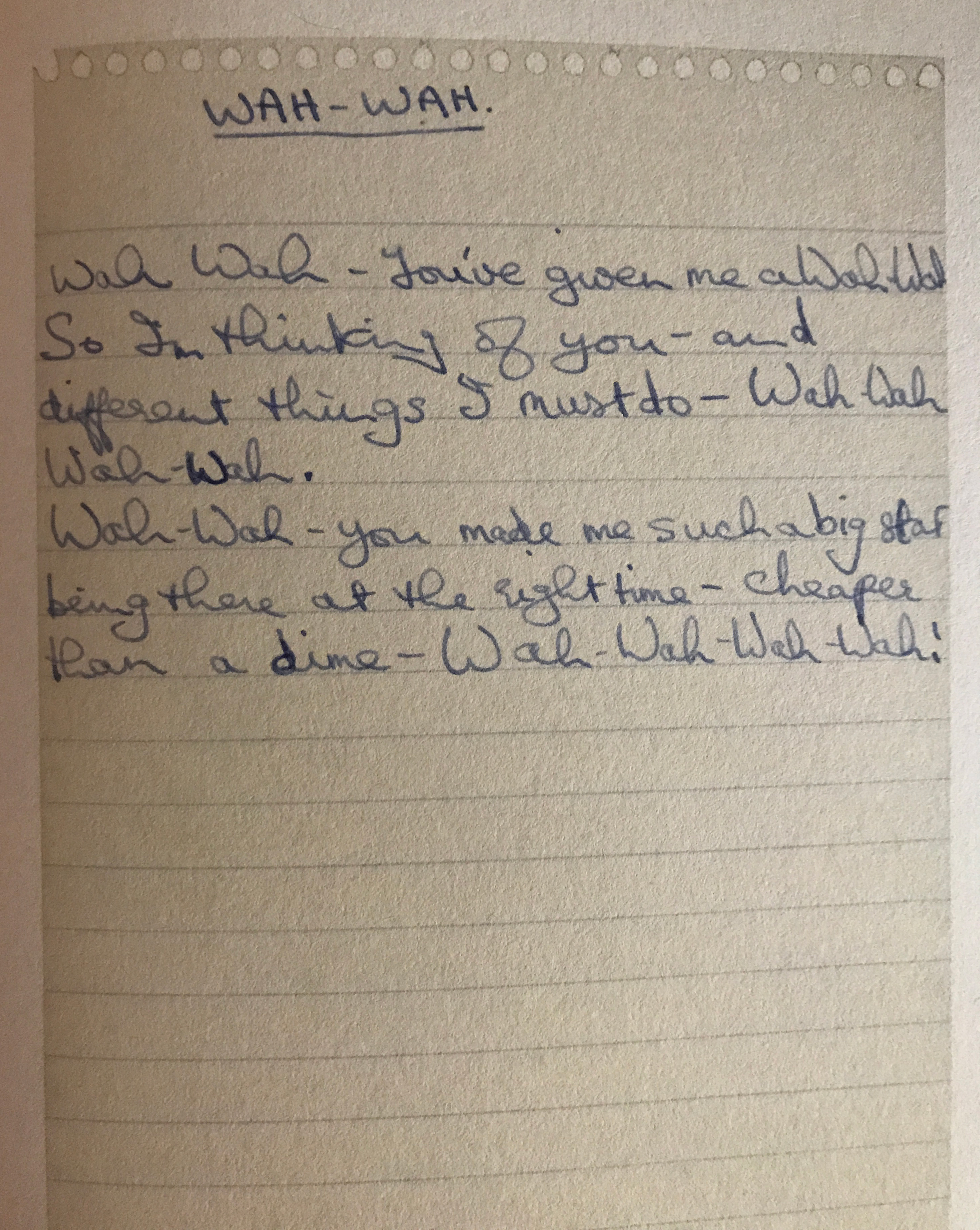
George wasn’t working for the Beatles anymore that afternoon, but he remained on the clock. In his first act as a temporarily liberated solo artist, George played, you know, whatever he wanted to play, and he wrote “Wah-Wah,” which later appeared on the All Things Must Pass LP and was the opener of his first solo performance, at The Concert For Bangladesh. George couldn’t have found  a more symbolic beginning to his stage debut as a solo headliner, opening with a song born from his first independent moment.

“‘Wah-Wah’ was a ‘headache’ as well as a footpedal,” George later wrote in I Me Mine.

George’s hand-written lyrics to “Wah-Wah.” (Published in I Me Mine)

“It had given me a wah-wah, like I had such a headache with that whole argument,” George told Crawdaddy in 1977.

“It was such a headache.”

Professional clashes with Paul, personnel issues with Yoko (and John), personal crises with Charlotte and Pattie — these were all reasons George left the Beatles. If Paul wasn’t so pushy, maybe it would have made dealing with Yoko and the problems at home easier. If Yoko wasn’t so ubiquitous and John withdrawn, maybe George could work more easily with Paul with one less work distraction. If George’s marriage was fine, maybe he could have slogged through the work day, more easily accepted his continued junior role and at least had an opportunity to unwind and unload in a relaxed home.

But each of those factors played off the other. He’s just like the rest of us.

38 Comments

Filed under Day by day

Jan. 10: Only the Northern Songs, Pt. 1

In 1999, George Harrison called “Only a Northern Song” — recorded during the Sgt. Pepper sessions in early 1967 but not released until January 13, 1969, on the Yellow Submarine soundtrack LP — a “piss-take” against his former song publisher, whom he characterized as a con man and thief.

From an interview with Billboard, 30 years after the song’s release:

It was at the point that I realized Dick James had conned me out of the copyrights for my own songs by offering to become my publisher. As an 18- or 19-year-old kid, I thought, ‘Great, somebody’s gonna publish my songs!’ But he never said, ‘And incidentally, when you sign this document here, you’re assigning me the ownership of the songs [Harrison had written as a Beatle],’ which is what it is. It was just a blatant theft. By the time I realized what had happened, when they were going public and making all this money out of this catalog, I wrote ‘Only A Northern Song’ as what we call a ‘piss-take,’ just to have a joke about it.

“Only a Northern Song” has absolutely nothing to do with the Get Back sessions, but the timing of its release does. Just 72 hours before the Yellow Submarine soundtrack LP hit stores, the Beatles convened at Twickenham for a truly climacteric day — not just in these sessions but in the group’s history.

Ringo, Paul (representing Gryffindor) and Dick James discuss the Northern Songs catalog on January 10, 1969.

Three hours (on the Nagra tapes) before George Harrison quit the Beatles on January 10, 1969, the target of his lyrical furor — Dick James — was one of the very first voices heard on the day’s recordings. Starting in 1963, Dick James Music administered Northern Songs, earning the publishing company a fortune and the band’s songwriters a disproportionately scant share of those riches. George’s share was but a fraction of what Paul McCartney and John Lennon managed to earn. Dick sold his majority share of Northern Songs out from under the songwriters about two months after the conclusion of the Get Back sessions, but that’s another story altogether.

Dick James was already on the tip of the Beatles’ tongues during the sessions in the previous days — Paul’s tongue, really, when he joked the publisher would “have the children” if the Beatles would “have a divorce” and break up. And perhaps anticipating the January 10th appearance, John name-checked Dick in the improvised “Shakin’ in the Sixties” just the day before.

But if there was any significant ire toward Dick, from George or mostly anyone else on the day of his visit, it didn’t materialize in the audio, which revealed a lengthy, seemingly cordial encounter (John said some things counter to this, but more on that next post).

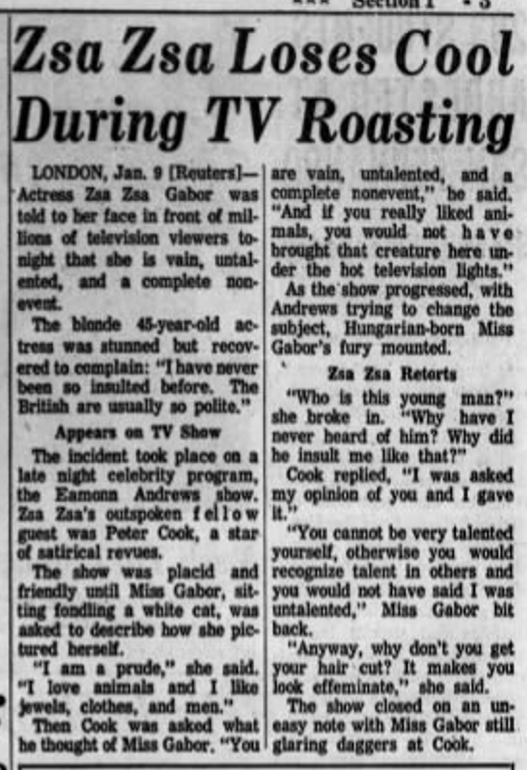
Like so many mornings at Twickenham, the previous night’s must-see TV was the first big subject up for discussion, with Paul, Dick, Ringo Starr, engineer/producer Glyn Johns and director Michael Lindsay-Hogg retelling an astounding confrontation between Peter Cook and Zsa Zsa Gabor in which the comedian referred to the actress as “vain, untalented and a complete non-event.” (John and George hadn’t arrived yet).

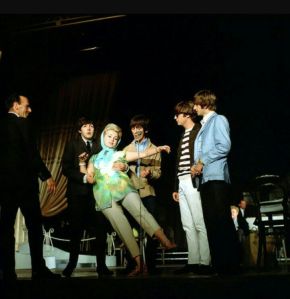
An event: The Beatles with Zsa Zsa Gabor, at rehearsals for the Night of 1,000 Stars in 1964.

Paul did his best/worst Zsa Zsa impression for her reply: “I zink you are the rudest man you’ve ever seen.”

This exchange on Eamonn Andrews’ show was literally international news — here’s a syndicated story by Reuters that appeared in that morning’s Chicago Tribune — but of course all news is local when it comes to the Beatles, who seemed to have crossed paths with everyone and everything.

“She’s very honest,” Paul said of Zsa Zsa. “Quite entertaining. One thing I don’t like her for is — she was with her daughter. Her daughter was always around EMI when we were making our last album. We saw Zsa Zsa with her daughter there … and she makes a sort of ass out of her daughter. She’s so honest, she’s a bit too honest. She sort of said, ‘Don’t wear that sweater, darling, it makes you look fat.’”

(Roger McGuinn of the Byrds later claimed that he introduced George to Ravi Shankar’s music at an “LSD party” at Zsa Zsa’s Los Angeles mansion, which the Beatles rented during their 1965 tour. This proves again, there are no Beatles footnotes, only incredible parenthetical, contextual anecdotes worthy of stories themselves.)

The conversation soon shifted to more proximate family matters, when Dick asked Paul if his father and brother, Mike, received his telegram on the birth of Mike’s daughter, Benna, a few weeks earlier — “More gear to the McGear.”

“Mike had become a Benna-ficiary,” Paul replied with what clearly was already a well-worn joke.

Not much later Dick likewise discussed family with Ringo, almost like he was an elder of the clan himself, needling the drummer about more having more kids.

Dick: How’s Maureen? You haven’t even told me.
Ringo: She’s wonderful. She’ll be here later.
Dick: Zak?
Ringo: He’s wonderful, too, thank you.
Dick: No brother or sister on the way?
Ringo: Not yet.

Dick forgot 16-month-old Jason, but Ringo didn’t seem to mind.

A great deal of the conversation between Dick, Ringo, Paul, Glyn and Michael revolved around the extensive Lawrence Wright Music catalog, which was purchased by Northern Songs a few weeks earlier in late December 1968, but clearly the extent of the collection wasn’t known to the band until this morning.

“Mind boggles with a catalog like this,” Dick said at one point. “’Cause as fast as you remember some, you forget the other titles.”

The massive song inventory was very much in the wheelhouse of Paul and Ringo, who each would occasionally interject a superlative or sing along a line from various titles.

“That’s the greatest one you’ve got,” Ringo said of “Stardust,” which he’d record that November, with Paul arranging.

As Dick aptly noted, “there are some golden oldies in there that are ridiculous.”

Ridiculously classic? Absolutely. Like the aforementioned “Stardust,” the songs included “Home on the Range,” “It Don’t Mean a Thing if it Ain’t Got That Swing,” “Stormy Weather” and “Just a Gigolo.”

And it’s quite ridiculous that the Beatles held an actual financial stake in World War I propaganda songs and other novelties like “Eat Less Bread,” “He’s in the Infirmary Now,” “Don’t Go Down in the Mine, Dad,” “My Yiddishe Momme” and “Nobody Loves a Fairy When She’s 40.

A song like “Carolina Moon” stood out to Paul — “My Uncle Ron’s favorite. Sings at all the parties.” And while George presumably came to “Hard Hearted Hannah” via another source, the Tin Pan Alley-era Northern Song was a jump-off point for the late-1970s Harrisong “Soft-Hearted Hana.”

Of course the most important inventory in the Northern Songs catalog would always be the ones with the “Lennon/McCartney” credit, and those assets were discussed, too.

“They’ll release ‘Ob-la-di, Ob-la-da’ by us on the continent,” Paul said. “Hopefully with ‘While My Guitar Gently Weeps’ on the b-side” (and it was a few weeks later).

“How about the ‘Ob-la-di, Ob-la-da’ covers and things? All right?” Dick asked.

“Yes, doing well,” Paul answered, without mentioning Marmalade’s version had just finished a run at the top of the charts.

“I brought some records over to the flat, just in case you’d like to hear it,” Dick told Paul. “Vera Lynn’s ‘Goodnight’ as a waltz. Stephen [James, Dick’s son] produced it. Done as a 3/4. Sounds beautiful.”

The Beatles had spent the previous six days writing and rehearsing the newest batch of Northern Songs, and nearly 40 minutes into the day’s tapes, the publisher was treated to a sneak peak of five songs. It’s a curious set, featuring Paul solo at the piano, and one that should have been among the clear highlights of every session bootleg. Except, very frustratingly, for much of the half hour he was merely background music.

The Long and Winding Road” and “Let It Be” had become morning standards, so Paul’s performance for Dick wasn’t extraordinary. And to hear Paul tickle the ivories on “Maxwell’s Silver Hammer” was likewise unremarkable. But to hear a piano-based “Don’t Let Me Down” — with Paul alone on vocals with an obvious mastery of and affection for the material — and “I’ve Got a Feeling” are true oddities.

Around the same time Paul headed over to the piano, George arrived at Twickenham for the final time.

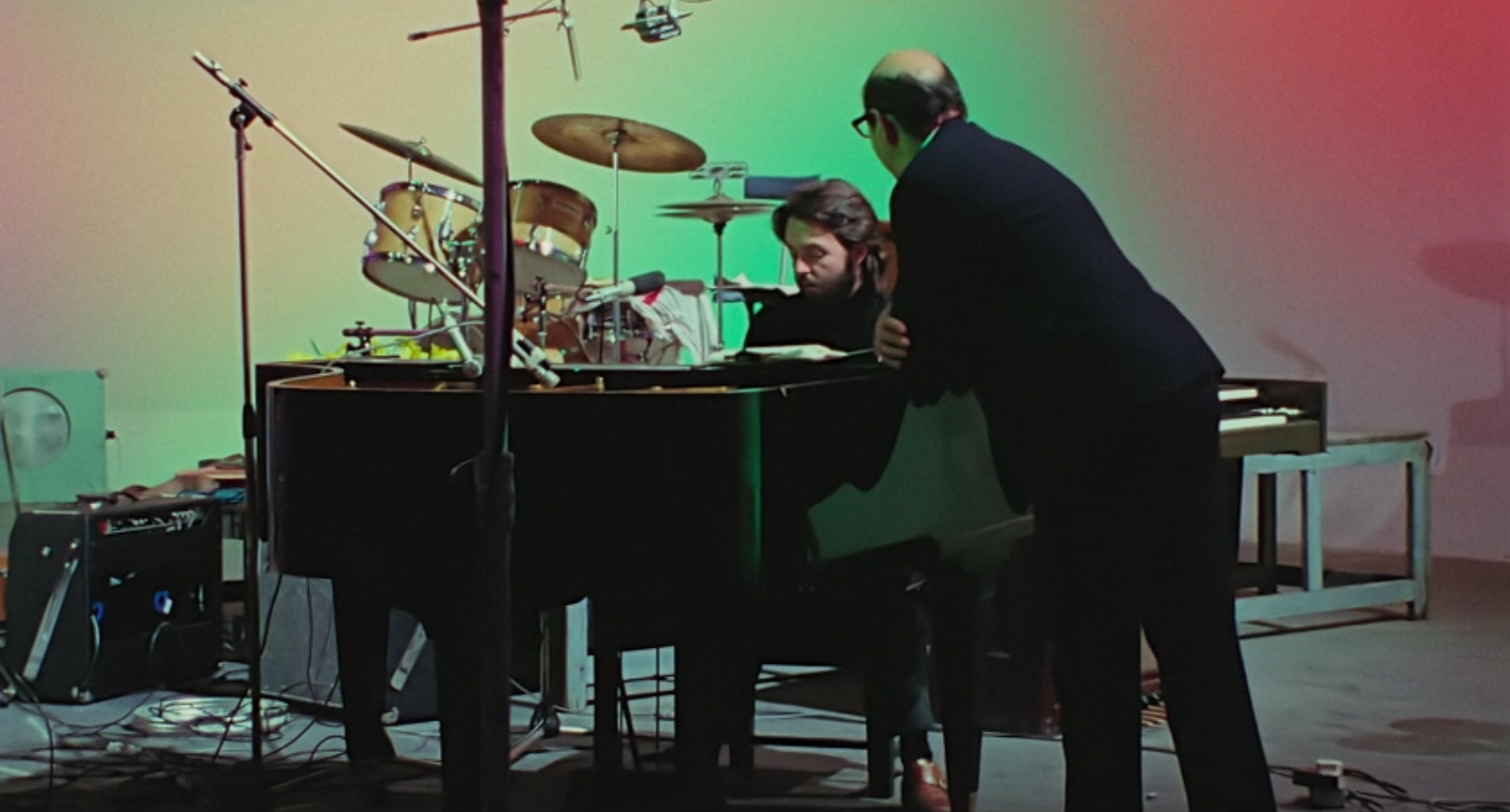
Paul and Dick at the piano, January 10, 1969.

The greeting between George and Dick was warm, with the George offering thanks for a Christmas gift — a set of drinking glasses.

Dick, who most assuredly had no idea George’s wife had walked out on him days earlier, could be excused for his response to the guitarist.

“Useful. Something to drink out of. Or the wife can throw.”

More on Dick James’ visit to Twickenham in the moments before George Harrison left the band coming in the next post, coming soon!

4 Comments

Filed under Day by day