Tag Archives: Let It Be movie

TMBP Extra: Oh what joy

With birthday posts previously produced for Paul McCartney, John Lennon and George Harrison, it’s about time we righted a wrong, and completed the set with the man born as Richard Starkey. Like the others and in the spirit of this blog, here’s a look at Ringo Starr’s life as it straddled the big days circled on the calendar in 1968 and 1969.
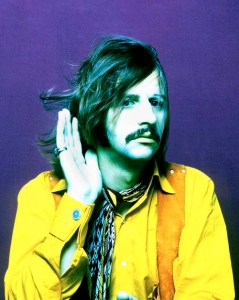
Ringo Starr, 1969

How did you spend your 29th birthday? Ringo Starr, the eldest Beatle, spent July 7, 1969, at EMI Studios on Abbey Road — like he spent so many of days in his 20s — laying down the drum track for “Here Comes The Sun.” We’ve all been stuck working on our birthdays, but this doesn’t sound like a bad gig, if you can get it.

Yet, 11 months earlier, Ringo gave up that gig, walking out on the Beatles during the White Album sessions.

From the Anthology book:

I left because I felt two things: I felt I wasn’t playing great, and I also felt that the other three were really happy and I was an outsider. I went to see John … I said, ‘I’m leaving the group because I”m not playing well and I feel unloved and out of it, and you three are really close.’ And John said, ‘I thought it was you three!’

So I went over to Paul’s and knocked on the door. I said the same thing: ‘I’m leaving the band. I feel you three guys are really close and I’m out of it.’ And Paul said, ‘I thought it was you three!’

I didn’t even bother going to George then. I said, ‘I’m going on holiday.’ I took the kids and we went to Sardinia.

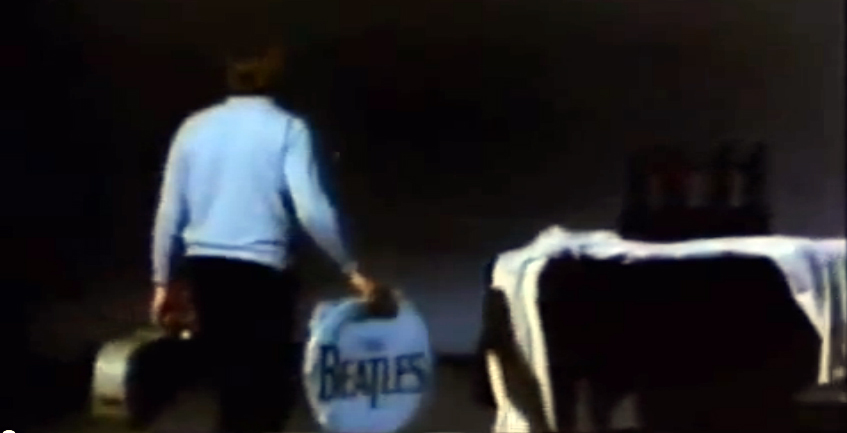
He famously returned two weeks later after to a flower-covered drum kit as the sessions continued (they never stopped recording, with Paul filling in on drums for a few songs).

Still, Ringo’s time away was fruitful, spent on Peter Sellers’ yacht, where the captain told him stories about octopuses on the seabed.

A couple of tokes later with the guitar — and we had ‘Octopus’s Garden’!

Ringo’s relationship with Sellers — a member of The Goon Show, beloved by the teenage future Beatles, and whose novelty records had been produced by George Martin — dated back a few years and would benefit the drummer in several ways in the decade’s final years. In November 1968, Ringo took advantage of a Sellers’ market, moving into the actor’s former Brookfield House estate in Elstead, Surrey. Just a couple months later, the two would co-star in a movie. But first, Ringo had another movie to film with the Beatles.

Ringo’s resistance to go abroad during the Get Back sessions — he was most insistent of any of the Beatles — led to the beauty of the rooftop performance. This blog’s entire purpose is to tell that story.

Musically, Ringo did Ringo things in the January 1969 sessions, and as a songwriter, he continued work on “Octopus’s Garden” (as seen in the Let It Be film) and also brought a few unfinished songs to the table, too.

But the sessions were just a warm-up for what came next at Twickenham Studios, where Ringo — teamed up with Sellers — filmed The Magic Christian, his first true starring role (Ringo had a small part playing a Mexican gardener in Candy, which was released in this period, too). This took time, with filming running from February into May. The film would be released in December 1969.

Let It Be — the film and the record — wouldn’t see a release until 1970, a few months before Ringo turned 30. But the Beatles weren’t finished yet in the wake of those sessions. “Octopus’s Garden” would be formally recorded in April 1969, although recording for Abbey Road, to this point sporadic, wouldn’t get into full swing until July.

In December 1969, Ringo said in an interview with the BBC that “I want to be a film actor. I don’t want to be like Cary Grant or one of them who, like, really do the same performance in everything, and the story is the only thing that changes.”
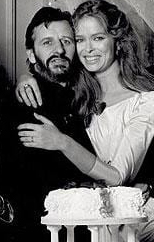
Ringo & Barbara at their wedding

That may be the biggest takeaway in the career of Ringo Starr between July 7, 1968 and 1969 — because he did look at life beyond, or at least in addition to, the Beatles and rock and roll. Without the songwriting gifts of John, Paul and George, Ringo applied his natural charm to film, and was finally able to step fully out into the spotlight and marquee, without other Beatles to his side, or front. And while he was successful in the early 1970s with his solo career, he remained active on the screen, too, even if it wasn’t to that same critical or commercial success.

If you judge success by the bigger things in life, however, Ringo’s foray into film couldn’t have been any more fruitful. A few months before his 40th birthday, in 1980, Ringo filmed Caveman, starring alongside model Barbara Bach. After meeting on the set, they would wed a year later, and have been together ever since.
2 Comments

Filed under Extra

Jan. 8: Rocky and the Rubbers

Our world lost — and the stars and heavens regained — David Bowie last week. I didn’t feel much like blogging about the Beatles for a little bit, even though this post had already been mostly written. But as the man once sang, time is waiting in the wings, and we should be on by now. So please enjoy the continuation of the Beatles’ Nagra tapes timeline, picking up with the morning of January 8, 1969, as David Bowie was celebrating his 22nd birthday across town and working on writing Space Oddity.

It’s tough to say “this is when they got serious” when there were laughs and smiles throughout, but after more than a half hour on the January 8, 1969, Nagra reels, the Beatles at least found a bit of motivation and a short-term goal to complete, getting serious in deed if not demeanor. With a concert to be staged, John, Paul, George and Ringo gathered their focus for a chirpy, energetic run-through of four songs deemed early contenders for a live show.

Paul led the proceedings, tabbing his original duet as the opener: “Johnny, ‘On Our Way Back Home.’”

If you’ve seen Let It Be — and I really hope you have and will one day again on some sort of modern entertainment replay device – you’ve been struck by how loose John and Paul are, hamming it up as they sing into the same microphone.

Two of Us

Paul, who Ringo in an interview the previous year referred to as“Elvis” in reference to his performance of “Lady Madonna,” was closer to the toxically impaired King, comically slurring and sneering throughout a take that both he and John sang without benefit of a lyric sheet. That’s how we end up with John, laughingly repeating his mistake “two of us wearing postcards” once the take was complete. They laughed the as they sang it during the take, too.

While Paul and John can’t often get through more than a few words without butchering a lyric, there was no turning back once they started, with this a sincere attempt at a run-through.

The sequence appears slightly edited in the film, cutting the performance in half from its actual three minutes to a minute-and-a-half. Had the group secretly abandoned the film and this leaked, conventional wisdom would have been that the group had a blast at Twickenham. Maybe they were just hamming it up for the cameras — or John was, at least — but it’s hard to deny a somewhat different spirit in the room with a watch and listen. When things were languid at Twickenham, it was painfully clear.

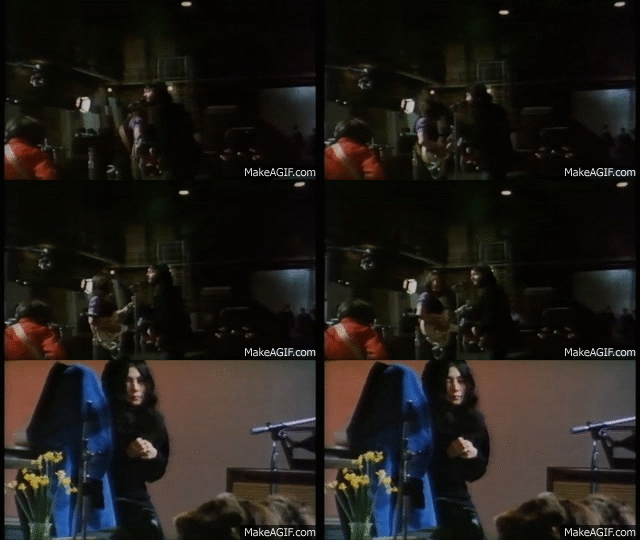
A visually telling edit by movie director Michael Lindsay-Hogg comes around 30 seconds into the clip, as we catch John glancing over at Yoko, who blankly stares back, as he stands oh, so close to Paul, showing some of the genuine affection that they certainly used to have and somewhere deep in there still did.

Yoko and Us

Two of us, and also Yoko

If you can use the word “tragedy” when referring to the fact a song was omitted from a compilation –- you shouldn’t, but I will, deplorably -– it’s a tragedy this take didn’t make it onto Anthology 3. It’s in the film, thus is a recognizable, published “official” release, so despite the issues with the lyrics, it’s “out there.” Consumers would have understood having an(other) imperfect take on the compilation, if not welcomed it.

In the film, the song comes out of the “shocktric shocks” sequence from a few days earlier, and then dumps into “I’ve Got a Feeling,” but in reality the group – after the improvised “You Got Me Going” and a few unserious seconds of “Twist and Shout” – delivers “Don’t Let Me Down.” Note the time between the end of “Two of Us” and “Don’t Let Me Down” is less than a minute. Dallying was at a minimum. While “Don’t Let Me Down” appears several times in Let It Be, this version is not in the film.

George didn’t quite nail the introduction, but again there was no concern when the lyrics were muffed. John simply shouted “Snotgobbler!” and moves on. That’s rock and roll. So was the pre-primal scream from John as the song began.  So were the lyrics “nobody ever rubbed me like she do me,” which John subs in at one point. The band played on, and musically it was relatively tight, really an achievement at this point in the song’s lifespan.

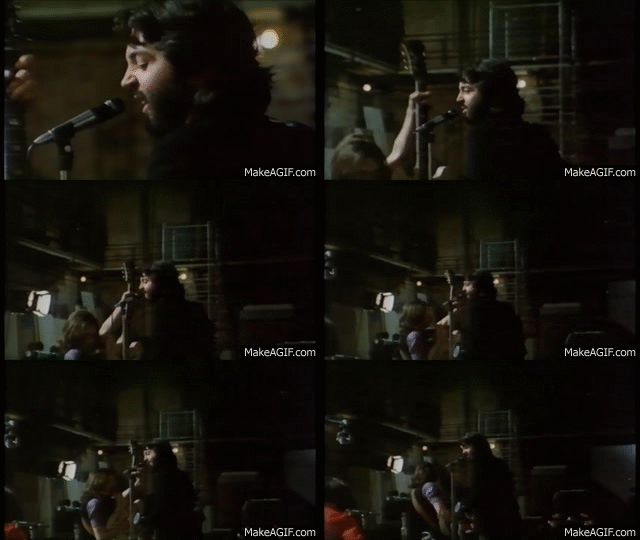
beardclose up

Paul beard porn from the January 8 sessions, as seen in Let it Be. Thank me later.

John came out of the high-energy take with thanks from the “band.” “God bless you, ladies and gentlemen, I’d just like to say a sincere farewell from Rocky and the Rubbers, this is Dirty Mac himself saying …”

Paul cut in, all business: “I’ve Got a Feeling.”

goodmorning

“Good morning!”

The performance was a tick slower at the outset, and with continued lyrical miscues (especially Paul and John mismatching “oh no” and “oh yeah” early on), but it retained the same vigor as the two previous songs. Paul shouts a celebratory “good morning!” after wailing “somebody who looks like you!” as George hits the middle-eight guitar part.

This sequence made the film, notably appended to a particularly torturous rehearsal from a day later.

Three songs into the run-through, John revealed some fatigue, perhaps reflecting the weight of the previous week more than the prior 10 minutes: “Only another two days to go, then we’ll have another two off.” But Paul then offers a pick-me-up, suggesting, “Do ‘One After 909’.” So they did.

This number marked the one point in the four-song run-through the group stopped after they started, rebooting the take after George’s solo. Once again, there’s a disconnect with the film. Based on clothes alone, this performance of “One After 909” is featured visually early in the movie — after Paul’s discussion of the song with Lindsay-Hogg from a couple days earlier (as seen in the film) — but paired with the audio of a take from January 9.

The movie and even a moment of the Let It Be LP was further fleshed out with a bit of memorable dialogue coming out of “One After 909.” You’ll hear it on the Let It Be LP prior to “For You Blue,” George’s eventual lone contribution to album that was just days old, as John reads from the newspaper.

Queen says no to pot-smoking FBI members.

What, you thought she’d be OK with it?

Again, we have a disconnect between the movie and the tapes, as the film moves to a previous day’s take of “Oh! Darling” while in real time, the band had completed their first commitment to a run-through for a show yet to materialize. It was rough, but it was spirited, and if anything, the set must have given them the idea there would be a light at the end of the tunnel if they chose to shine it. With at least four fully formed songs, they were on their way, and the apparent positivity could easily be read to bode good fortune ahead.

Probably inspired by “One After 909,” they continued a quick dip into their back catalog.

10 Comments

Filed under Day by day

Jan. 7: Bangers and mashups

OK, stick with me here.

Nearly 46 years ago, somewhere between lunch and the resumption of the day’s writing session-cum-rehearsals for “Maxwell’s Silver Hammer,” it sure sounds like Paul McCartney may just have invented the mashup, or at least a rough approximation.

Really!

This is not a medley, sampling, sound collage or musique concrete a la “Revolution No. 9” and others before it. This is turn-of-the-21st century-style mashup: Think The Grey Album, Girl Talk or the Beatles’ own Love with elements of two or more songs layered on top of each other.  The kind of stuff Paul got roped into a few years back before an audience, he and George performed live to tape decades earlier in a little bit of completely obscure history.

That would be 1967’s “When I’m 64” (written a decade earlier as one of Paul’s first songs and described here by Paul as the “beautiful geriatric Beatles song”) sung atop “Speak to Me,” which would ultimately lead off Jackie Lomax’s debut album, as produced by George and released two months later.  We already heard George briefly play a more proper version of “Speak to Me” to John a few days earlier.

As Paul’s “When I’m 64” vocals eventually drop out – and his mouth clicks chime in – we go from a forgotten moment of debatable history to one that would have a lasting impact on wax: the debut of Maxwell’s actual Silver Hammer, the anvil, as ordered before lunch.

The band comfortably eases out of “Speak to Me” with a fun and increasingly polished run through of “Oh! Darling” – polished for this point in the sessions, for sure –  the second time they played the song in a few hours, and with John having rejoined the group back on guitar. The song is essentially complete and by all accounts should have been by now part of the core considered for the live show at this early stage. It doesn’t get any further attention this afternoon as Paul immediately returns to “Maxwell’s” for the better part of another hour. This initial launch into the song is captured in the Let it Be film, spliced in from the point where Mal strikes the anvil.  It’s a truncated slice of the song, and in the film we end up getting thrust into the Shoctric Shocks incident, which actually occurred four days earlier.

Paul doesn’t introduce any new wrinkles yet in this first go-round after lunch. He’s pleased, though. “It’s catchy enough, then,” he says after the first full take. He soon boasts of the dramatis personæ and vibe of the song, “It’s so cartoon … such caricatures.”

Paul remains a delightful caricature of himself, remaining fixated on the whistles that color the song throughout. “We want a mic for John and George on this ’cause the whistle on this,” is Paul’s first and primary direction to the crew. George’s initial concern in the early going of the post-lunch session is getting the song’s timing and cues down, especially for the sake of Mal, who wielded the hammer. Not that George didn’t try to give his drummer an additional bit of work.

“I’m sorry, George, the hammer’s too heavy for me,” Ringo says to laughter.  As it turned out, Ringo would end up carrying that weight after all, striking the anvil in July, when the group properly recorded “Maxwell’s” for Abbey Road.

By Paul’s thinking, the roadie was the man for the job.

Mal’s more like Maxwell, anyway. … He should be very scholarly. Very straight, in a striped tie and a blazer, sort of. Big chrome hammer. That’s how I see him anyway. [He’s] Maxwell Edison, majoring in medicine, in fact.

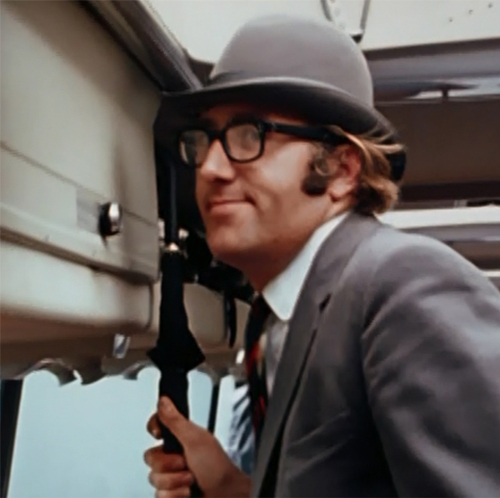
Resplendent in a smart gray blazer and striped tie, Mal Evans is already dressed for the role of Maxwell Edison as he rides the Magical Mystery Tour bus.

Resplendent in a smart gray blazer and striped tie, Mal Evans is already dressed for the role of Maxwell Edison, medical student, as he rides the Magical Mystery Tour bus.

Sparked by a question from George about the repeated of “bang, bang” in the chorus, Paul runs through the song structure again with the usual caveat: “I haven’t written the last bit.”

That’s fine with George, who thinks he knows how the song goes. “I just know it in my head, rather than the words, because the words are not in the right order anyway.”

Loose as he can be, Paul repeats the song structure: “It’s like two verses (scatting and singing) Bang, bang. … Clang, clang. … Whistle. … That’s nice fellas.”

As work continues, George shows a bit of concern with his own instrumentation.

George: To the man that’s producing me, whenever I play bass, because I don’t know anything about it, I don’t know what the sound is. I just plug it in and play it. So if somebody knows how to get the sound or record it. I mean Glyn’ll have to do that if he’s around. So you can mention that to him.

That’s some pretty self-deprecating talk from George, but he really has few bass credits under his belt to this point.

Straight out of the Small Faces’ playbook, John ad libs a narrative introduction to the song, laying out Maxwell Edison’s origin story, with Paul picking up in the middle.

John: Let me tell you the story about Maxwell’s Silver Hammer. He got it from F.D. Cohen, the pawnbroker from Bayswater.

Paul: Maxwell was a young boy just like any other boy, and he might’ve lived a life like any other young boy’s life had it not been for some certain unforeseen circumstances.

And … whistle!

Given that the band spent more than an hour on the song of about five hours of recorded tapes this day, it’s no surprise it was a very early contender for the live act. So much so, George began offering up suggestions on how to stage it, beyond costuming for the band and Mal. There’s a practical side to his suggestions, too.

George: I think we can do it with lots of people singing the chorus, ‘Bang, bang, Maxwell’s Silver Hammer,’ but it’s very difficult for me to whistle and sing and keep in sync. … It should be like the end of [Hey] Jude.

John:  ‘You all know it, join in, gang, because we don’t know it.’

George: We could just project it up, have the chorus projected up there.

We’re not sure what Paul thinks of that idea, since there’s whistling to be done, and no joke whistling, please.  “Really, do it like it’s straight,” he says, telling George how the notes of the chorus solo goes. That’s a whistle solo, not a guitar solo, mind you.  Paul does work on improving the song, spending a few minutes crafting a harmony based on a short, partial climb up a scale “with jumps on the hammer,” in his words. It’s pretty and adds to the carnival-like atmosphere the song has to this point.

For the final takes of the day of the song, the rest of the group still doesn’t have the song’s structure completely down, and Paul resorts to vocal cues to alert when the whistling solos come. John asks Paul to shout out “blow it, boys” at the appropriate time. Paul can’t help but repeat his helpful reminder: “It should be very straight, the whistling.”  He really does keep saying this, to a near obsessive state, and at no point is he kidding about it.

The “Maxwell’s” rehearsals for the day end with a final, full run through. The song’s basic elements are there: new harmonies, whistle solos, the anvil and a full strong structure. What it lacks is a complete set of lyrics, but Paul isn’t sweating it, concluding with a simple, “OK, that’s Maxwell’s.”

While the song did progress with the work on Jan. 7, there was a noticeable missed opportunity shortly after lunch as a lead-in to the mashup sequence. For a few brief moments as the group warms up, a sloppy yet sincere take of “Maxwell’s” features Ringo on vocals, and it sounded like the perfect fit. Paul’s song eventually drove the other three Beatles to fury; giving Ringo an extended vocal role could have changed a little corner of Beatles history.

As the sessions continue, John takes the reins for the next song, one that not only has its lyrics set, but the instrumentation as well.

“Should we do ‘Across the Universe?’ We almost know that, don’t we?”

9 Comments

Filed under Day by day

TMBP Extra: All that lies ahead

As I write this, it’s Friday, Jan. 31. About three-and-a-half weeks ago was Jan. 7. Check your own personal calendars, news headlines and the like. It’s not that long ago. That matters to me, and this blog, because this is where the Beatles come in.

Flip (or click) back several calendar pages – 45 in fact – and we’re at January 1969, dominated by the Get Back sessions. Jan. 31 marked its final day, a short day dedicated to nailing for film and for tape usable takes of Paul’s non-rooftop-suitable “Two of Us,” “Let It Be” and “The Long and Winding Road.” (The clips appeared in the movie prior to the rooftop show, but were in fact filmed the next day).

What of Jan. 7? That’s where we left off last in the session timeline, at a genuine pivot point.  George suggested the group “have a divorce,” Paul said he’d thought about that, too. The Doldrums. It hung over the band.

So what happened between Jan. 7 and Jan. 31, 1969, to recast the sessions? Well, I’m not going to give it all away at once. What else would I blog about, the recording of Sentimental Journey? (That actually seems like an interesting, star-studded, intercontinental story, but I digress.) Three and a half weeks is such a short period of time, in relative terms, and we know that the group was on the brink Jan. 7. By Jan. 31 so much memorable musical output was in the bank and in the works. Factor in that there’s 10 ½ days without George after his walkout and more than a week without any rehearsals at all, and I’m left grasping at superlatives.

To wit: From Jan. 7-13 and Jan. 21-31, 1969 (18 days, and that includes weekends not spent in the studio):

  • Paul wrote the majority of “The Long and Winding Road,” “Let It Be” and “Get Back” and debuted future solo tracks “Another Day,” “Teddy Boy” and “Back Seat of My Car”
  • George wrote: “I Me Mine,” “Old Brown Shoe” and “Something,” as well as “Wah-Wah” at home during his break from the band.
  • Everything you hear on “Let It Be,” plus “Don’t Let Me Down” was recorded.
  • We saw the birth – and if not the birth, than at least the studio debut – of Abbey Road’s “I Want You,”  “Oh! Darling” and “Octopus’s Garden.”
  • We have the rooftop show, too.
  • The Beatles even found time to meet with Allen Klein for the first time.

And I feel like I’m understating what happened.

So, there’s just a little bit of food for thought before I return to the timeline (soon!). Context is everything, and with January here and now gone, it provided the perfect chance to put into focus how much these guys got done throughout the madness they, for the most part, created themselves.

5 Comments

Filed under Extra

TMBP Extra: Everybody had (another) good year — 2nd Blogoversary

opening

Work begins anew for the Beatles. From the opening scene in Let It Be.

John Lennon, Paul McCartney, George Harrison and Ringo Starr were working stiffs like the rest of us* 45 years ago today, when those four, joined by a film crew, headed back to work after New Year’s.

The hours they put in over the subsequent month has stood the test of time, as documented on the Let It Be album and film, and with the results of their labor also eventually surfacing on Abbey Road and various solo albums.

But you all knew this.

I did too before I started this blog, two years ago today. But I just didn’t know how deep the story ran and how much more there was to these sessions. Especially with so much of our knowledge of this era couched in the record’s tumultuous production and release a year later and the breakup that preceded it.

A few days ago, I rewatched the Let It Be film (I’ve been watching it every few weeks in spurts as I write, but this was purely for “leisure,” having a few beers with my wife, who wanted to see it again). Knowing what I know now, both in my own immersion in the tapes and researching what is available about the sessions (far less than you think), I’m struck by what really got me interested in the tapes in the first place: You see all of the results, but absolutely none of the motivation.

Why did they move from Twickenham to Apple all of the sudden? Who’s this guy showing up to play keyboards? Why are there so many covers, and so many songs we’d see later on Abbey Road? What’s the deal with playing on the roof? Was that the first choice for the concert they allude to really late?

The movie creates more questions than it answers. And of course, that’s a part of what makes listening to the tapes so captivating.

Finding answers is also what makes for some really deep blog posts. In 2013, I wrote 13 posts on the timeline (of 19 total posts last year) covering a little less than 3 1/2 hours on the tapes.

Wait, what?

Yes, a mere 3 1/2 hours of conversations and rehearsals were able to form the basis of 13 posts — and more than 17,000 words therein. But talk about memorable moments in just those 200-plus minutes:

It makes you wonder what kind of film Michael Lindsay-Hogg could have made if he had his way. This drama is writing itself. And with a great soundtrack!

Cheers to you all!

Cheers to you all!

And to think, we’re only at the middle of Jan. 7.  There’s a heck of a way to go, and I can’t wait to dig in.

I can’t say enough for the support I’ve gotten from readers, be it in comments, over Twitter, Facebook and from other blogs. It’s been amazing to share this experience — and communicate with — Beatles fans as passionate and curious as I am. I want to especially thank and point back to Hey Dullblog, Kenwood, A Mythical Monkey, Ultimate Classic Rock  and the York Beatles Appreciation Society for linking to me over these years. It really makes this all the more fun to know people are reading and enjoying it.

And the most special thanks to my wife, Dianne, for being my editor and putting up with my “child-like wonder” at Paul’s playing the songs he introduced Jan. 7, 1969, live daily in 2013.

Here’s a recap of the first few days:

What’s next? More of the same in 2014. Happy New Year!

*- Full disclosure: While I may be a working stiff, I actually have the day off. But back to work Saturday!

2 Comments

Filed under Extra, General, Recap